Support Irish Radio History Archiving

Irish Pirate Radio Recordings

Showing posts with label BBC. Show all posts

Friday, 9 August 2024

The Centenary of 2BE, Belfast


In 2023 Ireland began a decade of centenaries in Irish radio history. After the 1923 launch of Ireland’s first yet short lived licensed radio station, 2BP, in September 1924 the first permanent radio station of the island of Ireland opened. This is that story…..

2BE, the Launch of Belfast Radio in 1924

“that it will not now be necessary for broadcasting station to arranged in the Free State. There will one in Belfast from which the programmes can heard free any charge. Let us hope the station in question will broadcast some really educational programmes”[1]

These words were the thoughts of a radio listener-in from Belfast in 1924. After the openings of stations on the British mainland, in 1924 it was Belfast’s turn to join the growing list of stations under the control of the British Broadcasting Company[2]. In March 1924, the BBC announced that station call sign 2BE broadcasting on 435m medium wave would take to the airwaves later that year. The BBC were already available in London (2LO), Birmingham (5IT), Bournemouth (5BM), Cardiff (5WA), Manchester (5ZY), Newcastle (5NO), Glasgow (5SC) and Aberdeen (2BD).

The opening of either new regional stations or relay stations for the BBC slowed as the company struggled to find new and clear frequencies. On March 7TH 1924 it was announced by the British Broadcasting Company as it was still known as that the Belfast station had been given ‘official sanction’ and that the wavelength for listeners in Ulster was 435m medium wave. The Belfast Telegraph reported,

‘The power the station will kilowatts and a wave-length metre of 435 will be used. The call sign will be 2BE. A site has yet been found for the station, but the company hopes that it will be opened from two to three months’ time.’

By the end of March, Harold Bishop[3] the assistant chief engineer arrived in Belfast to lay the groundwork for the new station.


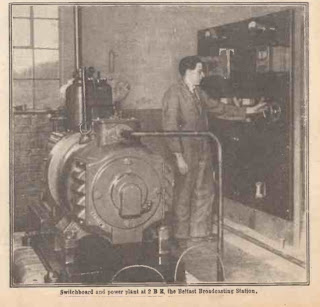
The studios and offices of 2BE, were to be located at 31 Linenhall Street, a central position in the city, while the aerial and transmitting plant to be erected at the Corporation Electricity Station at the East Bridge Street. The aerial was of the" sausage " type, and the ends were supported by the two tall smoke-stacks of the generating station, the halyards already being in position.


In 1919, 31 Linenhall Street was sold by Linen company of Daniel Currell and Sons. 


It was purchased by British Thomson Houston Limited a manufacturer of wireless valves. The company also had offices as Suffolk Street in Dublin. It would be their upper floors that would be used as the studios and offices for 2BE.


According to T.P. Allen in Popular Wireless Weekly

“The space now occupied by the offices and studio was originally one large flat, and this had to be divided off into the various rooms necessary for the staff. The studio itself is approached through a winding corridor, which divides the various offices, all of which are situated on the second floor and above the B.T.H. Company's Belfast premises. The corridors are liberally placarded with requests for silence, and a waiting -room is provided for artistes; those wishing to listen -in while waiting their turn may do so. The studio is treated in the same way as those " across the Channel," and is draped and carpeted, and has a canopy of light fabric, all with the idea of reducing echo. As a matter of fact, the draping was not finished when the station commenced its present experimental transmissions.”


In advance of the station opening Walter Montagu Douglas Scott was appointed as the Station Director. He was the cousin the Duke of Buccleuch, educated at Eton University, and described as widely travelled as both a traveller and a diplomat. An accomplished linguist, he was also keenly interested in musical and dramatic art and declared upon his appointment that he hoped to make making the Belfast station one of the most successful in the BBC system. Scottish born Edmund Thompson was appointed as his assistant. He had been educated at Edinburgh University. A Territorial officer, at the age of 21 was promoted to Major, He was in charge of a siege battery in France during the First World War and was awarded the Military Cross in 1919. Local man Godfrey Brown was appointed the musical director with his assistant named as Thomas Corrin.

After a week of nightly tests for one hour, on Monday September 15th, 2BE went on the air. The first voice to be heard on the airwaves was that of twenty four year old William Tyrone Guthrie. Guthrie was born in 1900 at Tunbridge Wells, Kent in England. He had just joined the BBC and his later career would be producing plays for radio and as a theatrical director. His second cousin was the Hollywood actor Tyrone Power.


The introduction of ‘Hello Hello this is 2BE, the Belfast station of the British Broadcasting Company’ got programming under way at seven o’clock. The Orchestra then played the National Anthem but shortly after the airwaves fell silent as a technical hitch put 2BE off the air for thirty minutes. The reaction to the first night was mixed. Former Director General of the BBC Tony Hall recounted on the nineth anniversary of the opening of 2BE that one writer to the newspaper in Belfast said that,

“I see from the papers that there is a large increase in the sales of radio sets. After last night’s programme I am selling my set too.”

The station’s director Douglas Scott spoke to his audience just before the close down,

“Belfast calling. Thanks to the efficiency and energy of our engineering staff, the Belfast Broadcasting station is established and should have commenced working at 7 this evening but owing to a technical fault we were delayed until 7.30. The official opening of this station by his Grace the Governor of Northern Ireland will take place in October upon a date which will be published later.

Our future endeavours will be to offer all our listeners an attractive programme. In all the British broadcasting stations there is a common keenness to offer the best. The wavelength to this station has been fixed in conjunction with the Northern Government authorities, also having regard to the wave-lengths of our existing stations. We trust that everybody will be satisfied and that this opportunity to claim indulgence for any sins of omission or commission and we also wish to express our hope that those listening at Bellevue this evening will have enjoyed the programme’.

This is the Radio Times listing of the first week of 2BE.


The BBC’s assistant controller for Scotland Millar Craig and the BBC’s chief Engineer Peter Eckersley were both in studio for the first night’s broadcast. The Freeman’s Journal reported listening-in to the first night’s broadcast but started their article with less enthusiasm than listeners north of the border.

“The first words spoken from the new broadcasting station in Belfast last night reached Dublin in a very English accent. It was the precise, careful modulation of Southern standard English, made familiar to listeners in this country by the official announcers from the English stations. I had just been listening through Glasgow to the sturdy accent of the Clyde and had expected from Belfast the accent of the Lagan, which, despite all our differences would have been more welcome than the intonation of the foreigner.

But just at present Belfast is more English, than the English themselves, and perhaps the choice of an announcer was motived by that consideration. Another straw showing the present direction of the Belfast wind was the fact that while the British, stations are content to finish their programmes with God Save the King, Belfast began its first programme with what most of its inhabitant’s regard as that good party tune.”

Not everything went smoothly in that first week, the Irish Sunday Independent on Sunday 21st reported, Edward Dillon wrote,

“I tuned in the other night to the transmission from the newly completed Belfast station. Sure enough, shortly after seven 2BE came through with almost startling clearness and called, though with a very English accent, "Hello, everybody Belfast calling! This is the Belfast station of the British Broadcasting Company”, who are opening one station a month and then " Silence . . . And more silence. Had the station been blown up? Had the chief engineer started to discuss the Boundary Question with the Director of Programmes, with unhappy results to the microphone? Anyway, tune as we might not a sound from 2BE could we pick up after.”
After a month on the air, the station was officially launched on Friday October 24th at a major event and outside broadcast from the Ulster Hall. Hundreds gathered in the hall, while thousands listened across Ulster and many more turned in as the opening was simultaneously broadcast across the BBC network. 


The band of the Seaforth Highlanders provided the music including the playing of the national anthem that announced the arrival of the Governor of Northern Ireland, The Duke of Abercorn[4]. Apart from the Duke’s speech, there were also speeches delivered by Lord Gainford, chairman of the BBC, Sir James Craig, the Northern Ireland Prime Minister, Sir William Turner, the Belfast Lord Mayor who acted as MC for the event and Dr. Livingstone, Vice Chancellor of Queens University. Also in attendance was John Reith the chairman of the British Broadcasting Company. 

Each of the speeches were received with sustained applause but the biggest cheer and roar was reserved for the end of the night when the news bulletin was relayed from London stating that the then self-styled President of the Irish Republic and commander of the losing side in the Irish Civil War, Eamon DeValera, had been arrested in Newry.

At the end of the gala evening it was Antrim born Archibald McKinstry, a director at the British Broadcasting Company through his role at Metropolitan Vickers, that motioned a vote of thanks to the Governor and his wife Lady Abercorn.

In his speech Craig humorously intimated that the reason that the station was known as 2BE was that the station was in the Second city of the British Empire. This was a titled often spoken of as Dublin prior to the War of Independence.

In March 1935 the station was renamed as the Northern Ireland Regional Service. After the Second World War it was renamed the Northern Ireland Home Service and today 2BE is known as BBC Radio Ulster.


[1] Radio Notes Belfast Newsletter July 1st 1924

[2] It did not become the British Broadcasting Corporation until 1927

[3] 1900 – 1983, Bishop was awarded a CBE for his services to broadcasting

[4] James Albert Edward Hamilton, 3rd Duke of Abercorn (30th November 1869 – 12th September 1953

Sources
World Radio History
Irish Newspaper Archives
British Newspaper Archives
BBC Archives
BBC NI
RTE
National Archives UK
Wireless World


Friday, 11 June 2021

A Salute to the Men who Put 2RN (& BBC TV) on the air in 1926 (Part 2) William Beatty

In part two of our salute to the men who brought 2RN to the airwaves in January 1926, we look at the engineers who bought the Marconi transmitter in the UK, had it shipped to Ireland, renovated the wooden hut in the grounds of McKee Barracks and installed the framework for broadcasting at new studios on Little Denmark Street. These men were integral to the early success of radio in Ireland and their key roles have almost vanished from history...until today.


William Arnold Beatty was born in Cork to parents from Bangor County Down. As soon as the young Beatty could access a place in the School of Wireless Telegraphy on the Mardyke in the city centre, he enrolled. Once qualified in the new profession as a Wireless Operator of Marconi equipment he found himself travelling the high seas of the world in ships wireless rooms despatching morse messages for his employer Gugielmo Marconi.


He was on board merchant ships crossing the Atlantic as the First World War raged and shipping encountered a new deadly threat, being torpedoed by German submarines. In 1917, off the coast of Tory Island, his vessel was torpedoed and sunk. He was saved by being prepared and engaging with all the safety measures at the time. A year later he watched from the deck of the SS Highland Pride as a British cruiser was sunk as it protected a convoy of ships crossing the Atlantic from South America.


In 1922, as the new Irish Free State Government took control of the affairs of a devastated and war torn country, Beatty returned to land and joined the new National Army of the Free State. With his skills he was immediately attached to the Signal Corps. Many of his colleagues in the Signals Corps were fellow former Marine wireless operators who were renowned as being face with the Morse codes key. He was in charge in the Wireless Room at Portobello Barracks on August 22nd 1922 when the first news of the assassination of Michael Collins at Beal na Blath reached the capital.


In 1924 Beatty left the Army and in October the following year he was hired as the Assistant Engineer for 2RN with an annual salary of three hundred pounds per annum but interestingly with no pension. He worked under TJ Monaghan, who had been seconded from the Department of Posts and Telegraphs to overseas the opening of the Free State’s first radio station. He was at the heart of the McKee barracks hut transmitter location and the nearby aerial array. The transmitter was a 1.5kw Marconi transmitter and his engineering knowledge, training and expertise was invaluable in getting the signal on the air.

           SEE WILLIAM BEATTY & THE 2RN TRANSMITTER HUT IN BRITISH PATHE NEWS


He was in charge of many of the first outside broadcasts carried out by the station. This included its very first when 2RN was still in the test transmission phase in December 1925 before the official launch on January 1st 1926. The first outside broadcast came from the La Scala Theatre on Princess Street, beside the GPO on O’Connell Street. In March 1926, he operated outside broadcasts from various locations around Dublin but with limited equipment, it meant that Beatty would have to load and unload the equipment from taxis as he moved from location to location. In May 1926, the first OB from Cork took place and Beatty was on hand to ensure the broadcast went smoothly. The variety show took place in the Cork Municipal School of Music located on Union Quay. He would make several trips to Cork through the following year as the second Irish station 6CK was readied to open from the old Women’s Gaol overlooking the Southern city. A similar broadcast came from the Town Hall in Sligo on June 15th 1926 with Beatty once again in charge of the OB. The system operated meant that the microphone Beatty transported west was attached to the telephone line in the Mayor’s office which in turn was linked to the telephone exchange in the GPO and then by telephone line to the studios in Little Denmark Street and according to newspaper reports it worked perfectly. [1]


It was Beatty who set up the heavy cumbersome microphone on the side-line at Croke Park for 2RN to become the first station in Europe to broadcast a live commentary of a field sport. So primitive was the ‘Press’ facilities at Croke Park at the time, a 2RN employee had to spend the entire game standing with an umbrella over the microphone to protect the expensive equipment. On another occasion when covering a rugby game at Lansdowne Road, the ball hit and damaged the microphone, the game being held up until temporary repairs were made and the link to the city centre studios restored. In November 1927[2], Beatty was in charge of the technical infrastructure for an OB from the Empire Theatre, Galway. Not only did Beatty set up the broadcast equipment but he acted as the announcer from Galway on the night linking to Dublin.

In September 1928, the Irish Independent reported that,

‘Major Bell, lessee of the Capitol Theatre in his review of the position of the cinema trade before a party of Pressmen on Thursday, mentioned that the Capitol was installing such a system and mentioned the fact that useful ideas on the subject had been put forward by Mr. W. Beatty, engineer, Dublin Broadcasting Station.

Yesterday and Irish Independent representative saw Mr. Beatty and got from him some views on the subject. Mr Beatty is at present seeking protection for an invention of his dealing with the phono-film.’   


Beatty left the station in 1930 and moved to the United Kingdom where he initially took up a role with the International Maritime Radio Corporation who were installing powerful equipment on ocean going liners including those of Cunard and White Star. His fascination with sound and the moving picture led him to Alexander Palace outside London and working with someone who is considered by many as the Father of Television, John Logie Baird. He was one of the main engineers on Baird’s mechanical system of television broadcasts who was competing with EMI/Marconi’s electrical system, which ultimately won the battle to be the main system used by the BBC. In 1936 he was the Production Manager at Baird. [3]


After losing to EMI/Marconi, the Baird company went into a slump and eventually receivers were called in. Beatty moved on to HMV overseeing the production of new wireless receiving sets and later to Philco. With each company he worked for including the International Standard Electric Company and the Anglo- American company Kolster-Brandes Limited, he was refining equipment being used in both transmitting and receiving radio and television signals. He applied for and was granted numerous patents[4] for these improvements.


 William Beatty passed in Sussex away on January 26th 1949[5] leaving behind a wife, Barbara.


Part of William Beatty’s engineering team at 2RN were Andrew Kettle. Kettle would later work for the ESB and serve as the Honorary Secretary of Bohemian Football club and represented the north Dublin club on the FAI Council.  James Nolan from Walsh Island Offaly, involved in attacks by the IRA on Black and Tans including ambush at Mount Lucas near Edenderry in February 1921. Joined the national army and was attached to the signal corps where he discovered that he was a competent wireless engineer and finally Michael Nugent. Without the hard work, ingenuity, professionalism and dedication of these men, 2RN would not have joined the world’s cavalcade of radio stations on January 1st 1926 and Radio Eireann would not have been so quickly embraced by the Irish listening public. Thanks lads.


[1] The Sligo Independent June 19th 1926

[2] The Connaught Sentinel November 22nd 1927

[3] The Sunday Independent 31st May 1936

[4] The US & UK Patents Office

[5] Northern Whig Newspaper


Thursday, 10 June 2021

A Salute to the Men who put 2RN on the Air, (Part One) The Irish Eckersley, TJ Monaghan


Peter Eckersley was a famous name associated with the early days of radio in the United Kingdom. A sometimes eccentric extrovert, he was initially involved with the first broadcasting station, 2MT, before moving onto 2LO and then the amalgamation of radio stations that became the BBC. He was a controversial character but there is little doubt that without him the success of the BBC would have been stalled. In Ireland we had an engineer who was described as the ‘Irish Eckersley’[1]. He was a powerful Civil Servant who held sway over his domain unchallenged for over a quarter of a century, he controlled all engineering decisions over radio broadcasting, telephone and aeronautical communications. Yet very little is known or remembered of Thomas Joseph Monaghan, ‘The Irish Eckersley’.


T.J. Monaghan, as he was known, was born on April 21st 1887 near Accrington, Lancashire, England. His parents were Galway born doctor Thomas Monaghan and Josephine Maguire. He was educated at Xaverian College boarding school at Mayfield, Sussex. In 1902 he began attending South-western Polytechnic. Founded in 1895, one of the principal aims of the South-Western Polytechnic Institute was the provision of education for the poorer inhabitants of London. An emphasis was placed on instruction in handicraft, trade and business, together with access to recreational facilities, sought to improve the career prospects and their physical, social and moral conditions. This initiative initially took the form of day and evening classes for men and women over fifteen years of age, with the Institute offering well-equipped laboratories for the study of subjects such as mechanical and electrical engineering, mathematics, physics, chemistry and metallurgy, in the hope of attracting male students keen to learn a trade and enter industry. Practical training was additionally available in carpentry, brickwork and advanced cookery; whilst classes in economics and commerce offered training in shorthand and typewriting for lady secretaries together with examinations for appointments in the civil service and the post office. Students were also afforded the opportunity to attend lectures in literary arts and to receive instruction in languages. He left the College with a Batchelor of Science degree in Engineering, passing with first class honours.


Following his graduation, he received practical training variously at the Royal Small Arms factory at Enfield, Yarrow & Co. at Poplar, and Simpson-Worthington at Newark until 1909. In 1910, Monaghan then joined the General Post Office (GPO) as an assistant engineer at their H.Q. in London. The General Post Office in St. Martin's Le Grand, later known as GPO East, was the main post office for London between 1829 and 1910, and during that period was the headquarters of the General Post Office of the United Kingdom of Great Britain and Ireland, and was England's first purpose-built post office. It was demolished in 1912. It was the UK's second purpose-built post office after Dublin's GPO, which was completed in 1818 to a design by Francis Johnston, and still in use.


He was transferred to Belfast in 1910, spending two years there, then moving to Dublin and then to Cork in 1919, during which time he was in charge of works and maintenance of telegraphs, telephones, and wireless. In August 1913 he married Winifred Hackett in County Offaly.  At the beginning of the War of Independence in 1919, he was transferred back to the London HQ of the GPO on special wireless work and in 1921 he was appointed as officer-in-charge of the Leafield Wireless Station in Oxfordshire responsible for plant erection and the running of what was then one of the principal wireless stations in the world. Leafield was a powerful wireless station with a 250 KW arc transmitter that was to be part of an Imperial Wireless Chain that would connect the empire. Officially opened by the then British Postmaster General E G Kellaway, it initially connected with a similar station at Abu Zabal in Egypt.


 Following the end of the War of Independence and the creation of the Irish Free State he returned to Ireland in 1923 and became a staff engineer at Department of Posts & Telegraphs in Dublin responsible under the engineer-in-chief for a variety of aspects of the work of the department, including the initiation of the Irish broadcasting service. His first big project was all the technical aspects of the arrival of radio in Ireland and the launch of 2RN. He was seconded from the Department to 2RN and in tandem with the building of the transmitting apparatus was on the committee that appointed key personnel including the station director. That was the inspired appointment of Seamus Clandillon but Monaghan had his input on all aspects of the arrival of State sponsored radio in Ireland.


He was the man charged with putting 2RN on the air along with fellow radio engineer William Beatty. They purchased a 1.5kilowatt Marconi transmitter and installed it in a wooden hut on the grounds of McKee Barracks near the Phoenix Park. Aerials were erected and by mid November 1925, the first test transmissions from the station began. The station officially went on the air at 7.45pm on January 1st 1926. A year later he was involved with installing the transmitter for the second Irish station 6CK in Cork. 6CK was based in the former Women’s Gaol in the city.

In November 1928 he replaced L.J. Kettle as the Chairman of the Trinity College Physical Laboratory. In lecture when he assumed the position, titled ‘Efficient Communications’ he said,

'It would take 100 years of constant human speech to generate enough energy to boil water for a single cup of tea.’


Monaghan travelled to the various wavelength conferences that saw the wavelengths of both 2RN and 6CK change regularly. The range of the two stations was limited and the Government decided that a more powerful transmitter would be purchased and installed somewhere in the centre of the country. Monaghan and his team of engineers, including John Lyons, undertook painstaking research testing various locations including Tullamore and Portlaoise before settling on Moydrum outside Athlone.

With the intended launch originally scheduled for 1933, one of the biggest events to be staged in the new Irish Free State was the 1932 Eucharistic Congress of the Catholic Church. Monaghan was put in charge of ‘broadcasting’ the entire event. Installation at Moydrum was sped up and the new transmitter was operating in time for the first blessing in June 1932 and the signal strength meant that all the island was able to tune in. Not only was Monaghan in charge of the radio broadcasting end of the event, but he also increased the capacity of the telephone system and he provided facilities for the overseas Press attending the event to keep in touch with news desks around the world.


Another success for Monaghan was the installation of over three hundred loudspeakers wired throughout the city to relay the ecumenical events from the Pro Cathedral, O’Connell Bridge where an altar had been erected and from the Phoenix Park where Mass was celebrated.


By the late 1930’s as war loomed, the Irish Government under Fianna Fail and Eamon DeValera wanted to be able to speak to the Irish diaspora abroad. Up to that point they relied on special broadcasts surrounding St Patrick's Day but a new Short Wave service would assist in the dispersing the Irish Governments neutral stance when war did break out. The short wave service achieved limited success and was eventually discontinued. When transmissions were heard abroad and listeners wrote with reception reports, it was Monaghan who would reply with QSL and conformation letters.


During World War Two or the Emergency as it was known in Ireland, Monaghan joined the Irish Army and the Signal Corps. He helped set up an emergency broadcasting station in Eamon de Valera’s house should the main studios or aerials be bombed and put out of action. He also, with the help of the BBC, synchronised the frequencies of the Irish stations at Cork, Dublin and Athlone in order to prevent enemy pilots identifying their location from radio broadcasts.


But not only was Monaghan looking after radio from his offices in Leitrim House in the offices of Dublin Castle, he was controlling the progress of telephone services in Ireland including the arrival of the automatic telephone exchanges. His remit also had him looking after aeronautical communications and as the result of Ireland’s position at the edge of Europe, closest to continental America’s, aircraft communications was a vital area especially post World War Two.


Monaghan represented Ireland at numerous conferences across Europe and the United States. These conferences allocated frequencies for his radio station, now known as Radio Eireann, discussed modernizing Telephone systems and formatting safe flying for the expanding aviation industry.


He became engineer-in-chief in 1930 and moved the family to 15 Clarinda Park North, Dun Laoghaire. Monaghan was elected MICEI in December 1929, served on council, was a vice president and served as honorary secretary, becoming president in 1942. He was also a member of the IEE and served as chairman of its Irish branch.


During the war he joined the Irish army signal corps and was promoted to the rank of Colonel. In 1951, he was instrumental in forming the Signals Club made up of ex members of the Signal Corps. Monaghan married Winifred in 1909, a daughter Judith was born in .. Judith met her future husband Gatt Westerhout at the radio conference in Dublin in 1955. They married a year later and her Dutch born husband carved out an extraordinary career in astronomy. They couple had 5 children two sons, Gart and Julian Westerhout; two daughters, Magda Westerhout Mobley and Brigit Molony, with her partner of 56 years passing away in 2012.

TJ Monaghan retired in April 1952. In 1958 he was appointed as Chairman of the Institute for Industrial Research and Standards and in May 1958 he joined the board of the National Board and Paper Mills, the Mills located in Granard, Co. Longford. Also appointed to that board at the time was the former Minister for Industry and Commerce, Daniel Morrissey.

T.J. Monaghan died at his home at 18 Summerhill Road, Dun Laoghaire on 10 July 1971.  


[1] Described by Seamus Hughes, station announcer in the Irish Independent December 16th 1925, two weeks before the official launch of 2RN on January 1st 1926.


Friday, 26 February 2021

Harold Forster, The Art of Advertising 1920's Radio. The Marconi Hero


Today the real success of an advertising campaign can be reflected in how memorable their campaign was. Coca – Cola’s musical ads, ‘I’d like to Teach the World’, their reappropriation of Santa Claus from his original green out fit to the Coke colours of red and white are instantly identifiable, ‘For Mash get Smash’ or ‘It’s Martini’ are still fondly remembered. In the 1920’s the print media was the main weapon of the advertisers to reach the public but in the early part of the roaring Twenties, a new pretender to the advertising crown was making it way to market, radio.


The Marconi company led the way with innovation in both transmitting and receiving, producing the most popular ‘listening-in’ devices for the wireless. To deliver their message, the Marconi Company used the newspapers and trade publications. In order that their products stood out from the crowd, in 1923 they commissioned a series of drawings used in newspaper ads encouraging purchases of their radios sets. They showed how valuable they were to enrich the lives of those who invested in the new medium.


They contracted an illustrator and artist to capture the ‘joy’ of radio listening and his work created a sensation in the newspapers and for their readers. Radio became a must have. The graphic illustrations, portrayed in an art deco style were stylish, appealed to the emotions and illustrated how radio could make like better. Advertisers were selling a dream; the world of radio was elegant no matter where you were or what you did. Many of the Marconi portrayals were of upper class people in decorative, modernist settings, creating a utopia often far from the lives of working class post war Britons. The purchase of a radio set was far beyond the financial reach of many of those who were still recovering from the First World War. Homemade crystal sets were extremely popular with working class listeners. Marconi’s advertisements exuded luxury and created a theme that the new medium of radio would offer everything including music, weather forecasting and information talks.


You can support our work with the price of a cup of coffee at KO-FI. Every little helps with research site payments and books purchased for future great radio history memories. Use the link button at the top of the blog. 

The illustrations displayed a modern affluent Britain. The surroundings are plush set in drawing rooms, with quality furniture and fittings. The men are smartly dressed, with nearly all of them smoking a pipe or a cigar. The women are drawn in elegant dresses and crafted hairstyles. The ballroom scenes exude affluence and a rich lifestyle and spell the end of the live music era replaced by music through the wireless. Radio is a unifier of the family unit as the drawings feature parents and their children, even the children enjoying the radio broadcasts with their grandparents. One depicts what appears to be a teacher and her children outdoors being educated by the radio broadcasts. In one scene a couple have gone to the country to have a picnic in their automobile listening to the radio while the enjoyed their moment yet if you look closely, they are not alone as another man watches on from the tree line. The radio set is shown as the perfect accompaniment indoors or outdoors.  The reality however for many living in the UK in the early twenties, all of this high-brow living was aspirational.


By 1923, the British Broadcasting Company had just been formed and had taken over the running of the various stations around Britain operated by wireless set manufacturers. On 18 October 1922 the British Broadcasting Company Ltd was incorporated with a share capital of £60,006, with cumulative ordinary shares valued at £1 each and six major shareholders,

The shares were equally held by six companies:

·        Marconi's Wireless Telegraph Company

·        Metropolitan Vickers Electrical Company

·        Radio Communication Company

·        The British Thomson-Houston Company

·        The General Electric Company

·        Western Electric Company

Marconi was at the heart of transmitting and manufacturers radio sets. They wanted to cement their position at the forefront of radio, in a crowded field of manufacturers. Harold Forster was employed to produce a set of illustrations that would be used in the newspaper campaign for their premier product ‘The Two Value Marconiphone’. The campaign, which was broadcast at a national and local level, helped the Marconi Company maintain its lead as the main seller of ‘listening-in’ sets in the UK. The illustrations used in the advertisements had two different styles often used deliberately in the publication they were placed in to appeal to various classes. The more elaborate drawings appeared in national newspapers and trade publications, and often as half page advertisements while the darker, less crowded portraits appeared in regional newspapers.


Forster, in his late twenties in 1923, would have an illustrious career as an illustrator and an artist. He did not confine himself to the Marconi work, illustrating many products and brands. He was responsible for pre-war Black Magic chocolate illustrations. He produced a number of the famous World War Two posters commissioned by the British Government including the ‘Keep Mum, She’s Not So Dumb’ and ‘Forward to Victory’ posters. He would also produce iconic movie posters including for the Jack Hawkins action film, ‘Angels One Five’.