Support Irish Radio History Archiving

Irish Pirate Radio Recordings

Showing posts with label Belfast Radio. Show all posts

Thursday, 16 April 2026

My Journey Researching Sectraian Pirate Radio in Belfast with Insults for Free


In 2018, I began researching a book on sectarian pirate radio in Belfast and I had an article appear in a number of newspapers asking for anyone with information and providing a contact email address. On August 18th, 2019, I received an email from an account titled ‘the beer society’ but signed c/o Michael Steven. I responded and there was a back and forth with emails and eventually I agreed to travel to Belfast and said I would met up perhaps in a hotel in the centre of the city.


On August 20th I received an email asking to meet with Stephen Caves at his home which I was informed was off Tennant Street which is off the Shankill Road near the Spectrum Community Centre. I told Michael to tell Stephen that I would visit Belfast and on 27th August I travelled north from Dublin, staying at the Maldron Hotel located to the rear of the famous heritage pub The Crown Liquor Saloon.


On the morning of the meeting, while I perhaps should have been nervous or apprehensive, I was in fact excited and looking forward to the meeting and gaining a valuable insight into pirate radio in Belfast. For someone born in the early 60s, I was aware of all the events that made up the Troubles propelling it to front page news around the world, but being from the South, I had little understanding of what it was like living in that maelstrom of sectarian violence and paramilitary activity. There was no sense that I perhaps was entering ‘enemy territory’.


I stepped out onto the street and jumped into the back of a taxi at the rank. I told the driver ‘Coniston Close, off Tennant Street, please’. There was a moment of silence, and the driver turned to me in the back seat and calmly enquired

‘With that accent?’

This was a reference to my obvious southern, Dublin accent and here was I asking this driver to take me into what would be seen as the heart of unionist/loyalist life in Belfast. I said yes and he moved off. After two sets of red traffic lights, we reached a third and eventually the driver asked the obvious question ‘why?’ I dd not want to go into too much detail so I said that visiting a radio engineer as a radio historian. We drove up the Shankill Road, the rows of union jack bunting, union jacks on every lamppost and the infamous UVF, UDA and British military murals decorating several gable walls.


I arrived at the house and the driver, I think out of concern, asked me if I wanted him to wait, I said no as I did not know how long our conversation would last for but in fairness gave me a card with a taxi number on it. I knocked on the door after asking a couple of neighbours exactly where Stephen Caves flat was, each one looking me up and down suspiciously. I eventually entered a flat designated for Stephen who was wheelchair bound, missing part of a leg from the knee down.


He introduced himself as did I likewise and explained my research into the thorny subject of (a) Illegal broadcasting and (b) the sectarian use of those broadcasts. Stephen’s friend and what appeared to be a carer, Michael arrived dressed in a grey suit and obviously had a hearing issue as he had aids in both ears and an unusual way of speaking that took me a few minutes to get a hold of to understand.


Stephen Thompson Caves was born in November 1951 in Belfast. He was just 18 years old when the Troubles began in August 1969. The Troubles would continue until 1998 when a peace agreement known as The Good Friday Agreement eased tensions, saw paramilitaries disarm and installed democracy at Stormont. In January 1971 Stephen, described as 19 and unemployed of Tate Street, was charged with riotous assembly with 22 others at Urney Street on January 24th. The following month was sentenced to six months in prison for both the original offence and failing to turn up in accordance with bail conditions.


Stephen told me that he was a loyalist and was involved in Radio Shankill in the early years of the Troubles. But once he imparted that part of the story to me what followed was quite remarkable as his involvement in pirate radio continued.


He told me he ran numerous pirate radio stations usually broadcasting on 101mhz FM. One of the longest running stations was Speak Your Peace. He described the station as a community instruction station, grassroots radio giving voice to his community. When I asked him was any of the stations ever raided by the RUC (now the PSNI), he told me once. I asked if it was for illegal broadcasting or interference to legal broadcasters he said no,

‘They knocked on the door one Friday evening, cause we, I had a friend who knew how to identify and dismantle a pipe bomb that may have been placed under your car. And the coppers believed that if this person knew how to dismantle one, he knew how to build it. But they were in hard luck as we only used a tape to play the information, he wasn’t there in person on that occasion’.

He went onto also tell me that they would broadcast a comparison style show, not for petrol, insurance or foods but where to find, how much to pay and what was the best drugs to buy in Belfast on any given weekend. I was shocked but he reassured me that the show that followed that was a ‘gardening show’, which he explained was someone telling listeners how to grow their own drugs like marijuana.


Speak Your Peace first went on the air Sunday 2nd October 1994 from 9am to 8pm. The transmitter would be fired up every Sunday for as they said, ‘up to Christmas to give a voice to the oppressed and depressed’. However, the station was raided on Monday December 12th 1994.


Over two hours, I asked questions and I listened to him telling me tales of the various stations he ran interspersed with questions about how safe I felt visiting ‘enemy territory’ just off the Shankill Road. I was in no doubt from what was said, names discussion and at times what was not being said that Stephen had loyalist paramilitary links.


As the conversation continued, he told me that one of the stations he was involved with was known as ‘Out 101’ in 1995 which was on the air supporting LGBT rights in Belfast. This seemed such a dichotomy, on one hand the Christian conservative ‘anti-homosexual’ Loyalist and Orange Order and the other a man who was definitely Protestant and loyalist in leanings but was a supporter of something so opposite to what I had been led to believe was hard to take in.


Other stations in the 101-fold were ‘BARC, the Belfast Autonomous Radio Collective’ and one of the first uses of the transmitter in 1986, Radio Free Ulster, described as broadcasting.

 ‘With an undiluted programme of loyalist music and songs.’

That station operated during a loyalist workers strike in March of that year.


Towards the end of April 1994, the station was opened identifying itself as May Day 101 in the run up to May Day. The city was still in the grip of sectarian violence and one presenter stated that in the three days since the station came on the air, nine people had been murdered in the city. He added,

‘As we listen to the soundtrack of Belfast (the sound of Army helicopters flying overhead outside the window of the secret studio) we’ve got the RUC, the British Army, the UDA, the UVF the IRA and the INLA claiming to be our protectors, but we are hostages. MAY DAY 101 is a boil on the bum of broadcasting, the acne of the airwaves.’


In advance of my contact with Stephen, with the help of a friend I interviewed to another gentleman in the Spectrum centre, known as ‘Graham’. He too was involved in pirate radio in the early 1970s in Belfast and had a fascinating story to tell but it was the after that visit that I was to relate here. My colleague asked me if I wanted him to call me a taxi or would I like to walk down the Shankill Road towards the city centre. To me I felt it was a chance I would never get again, so along with a friend of his, we began to walk down the Shankill Road, I was taking in every shop window, every business, every SUV with well-built men with loyalist tattooed arms intimidatingly leaning out the open windows. Halfway down the road, they asked if I wanted to have a beer, and I felt this was a now or never moment. We went into the pub, unions jacks hanging from the ceiling, pictures of the then Queen Elizabeth II on the walls. We sat at a round barrel in the middle of the floor, and they ordered a pint of Tennent’s for me. We chatted quietly, encouraged to keep my southern accent on the down low.


Fifteen minutes in and just about to leave, an older customers, late fifties or early sixties stood beside me and uttered,

‘it must be terrible being a Southern Catholic’

I wanted the ground to open up and swallow me, my embarrassment for the two lads was churning. They reassured him that I was with them and that I was OK!

 He continued,

‘What a southern catholic Fenian doing in a decent pub like mine?’ even though he was just a customer and not an owner or management.

Another few comments and I reached the end of the tether.

‘How do you know I’m a southern catholic, I could be Protestant, atheist, or even a Jehovah’s Witness?

‘I know by the look of you you’re catholic.’

‘OK you’re right, I am a southern Catholic from Dublin, but I know what I am. I’m like a box of corn flakes, you know what you are getting, you are the multipack of cereals, Presbyterian, Anglican, Methodist, Free Presbyterian, Church of Ireland, Church of England or but I know one thing for sure, you’re the box no one likes.’

There was an uneasy silence, I was either going to be flattened or run like a hare being chased by a greyhound out the door. It seemed like ages before he said anything.

‘Hi, fair play to you kid’ and with that he tapped my back and actually sat down and joined us while we quickly finished what was left in or pints. I eventually arrived at the end of the Shankill, said my goodbyes and thank you and returned to the Maldron to muse over what had happened and begin to transcribe the notes I had made.


Soon after as I continued my research on the opposite side of the divide, including a very informative and generous visit to Radio Failte's headquarters,  I stopped into a pub near the Falls Road, the nationalist side. I ordered a pint and off handedly remarked to the bartender that his pint was 10p dearer than a similar pint on the Shankill Road. He paused, had a good look at me, leaned down slightly and queitly said,

'Once you finish that one it's time to head off pal.'

 My Dublin accent accounted for nothing here.

Then on February 9th I received this message from Michael.

Dear Eddie,

Stephen Caves died on 2nd February 2020 from terminal cancer. We both knew he did not have long to live when we met you. 


Stephen wanted his pirate radio show recordings to be sent to you on audio cassette. I have also noted that he has some pirate radio advertising leaflets that he wanted to send to you as well.


I am currently putting Stephen’s cassette tapes into a pile for illegal transmissions and another for legal transmissions.


I hope through sending you these recordings, a wide range of people will not only be able to hear Stephen’s pirate radio recordings but remember Stephen as well.

Thanks from Michael Steven


Stephen’s passing was announced to the Belfast community,


‘It is with deep sadness that we announce the death of Stephen Caves, Director of Trans Pride NI, who passed away this morning. A long-term activist, human, disability and environmental rights campaigner, he will be sorely missed.’

Michael wrote in tribute,

It was lovely to see my old comrade resting in peace yesterday. He was wearing the grey waistcoat that I gave him, when he was an amazing groomsman at my wedding in 2014. I was also pleased to see that he was wearing the purple Society for the Preservation of Beers from the Wood tie, a Society that he was a member of right up until his death. Stephen took great pleasure in handing out leaflets from this Society and many other human rights, disability and environmental groups he was involved with. In his later years, he even instructed his dog walkers to collect money they found on the street to Hearing Dogs for the Deaf! His kindness and caring nature will be greatly missed.


I was devastated and saddened. Michael had offered to post the cassettes to me but when in subsequent emails told me there were over forty tapes, I suggested that I would travel once again to Belfast to collect the donation to the Irish Pirate Radio Archive.

I arranged to meet Michael in the MAC in the Cathedral Quarter. He asked if his partner could join us for lunch while we completed the handover, I said no problem and as a gesture I would pay for lunch. Adrianne joined us and I honestly became confused, to the point when as I drove back to Dublin later that day, I had to stop at a services station just to put everything into context.

The life in Belfast that I had been brought up to seemingly know and understand was a different and more diverse city that I ever could have imagined. Michael Steven, Stephen’s friend, had been born female and known as Lindsay while his married partner Adrianne Elson, they were married in 2014, was born a man named Adrian. In 2022, it was revealed in the newspapers that the couple had given birth to beautiful twins named Mavis and Christin.

Friday, 9 August 2024

The Centenary of 2BE, Belfast


In 2023 Ireland began a decade of centenaries in Irish radio history. After the 1923 launch of Ireland’s first yet short lived licensed radio station, 2BP, in September 1924 the first permanent radio station of the island of Ireland opened. This is that story…..

2BE, the Launch of Belfast Radio in 1924

“that it will not now be necessary for broadcasting station to arranged in the Free State. There will one in Belfast from which the programmes can heard free any charge. Let us hope the station in question will broadcast some really educational programmes”[1]

These words were the thoughts of a radio listener-in from Belfast in 1924. After the openings of stations on the British mainland, in 1924 it was Belfast’s turn to join the growing list of stations under the control of the British Broadcasting Company[2]. In March 1924, the BBC announced that station call sign 2BE broadcasting on 435m medium wave would take to the airwaves later that year. The BBC were already available in London (2LO), Birmingham (5IT), Bournemouth (5BM), Cardiff (5WA), Manchester (5ZY), Newcastle (5NO), Glasgow (5SC) and Aberdeen (2BD).

The opening of either new regional stations or relay stations for the BBC slowed as the company struggled to find new and clear frequencies. On March 7TH 1924 it was announced by the British Broadcasting Company as it was still known as that the Belfast station had been given ‘official sanction’ and that the wavelength for listeners in Ulster was 435m medium wave. The Belfast Telegraph reported,

‘The power the station will kilowatts and a wave-length metre of 435 will be used. The call sign will be 2BE. A site has yet been found for the station, but the company hopes that it will be opened from two to three months’ time.’

By the end of March, Harold Bishop[3] the assistant chief engineer arrived in Belfast to lay the groundwork for the new station.


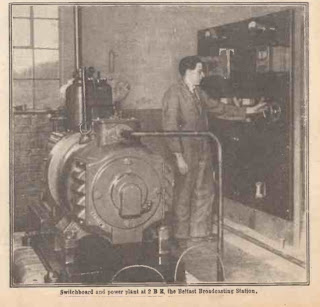
The studios and offices of 2BE, were to be located at 31 Linenhall Street, a central position in the city, while the aerial and transmitting plant to be erected at the Corporation Electricity Station at the East Bridge Street. The aerial was of the" sausage " type, and the ends were supported by the two tall smoke-stacks of the generating station, the halyards already being in position.


In 1919, 31 Linenhall Street was sold by Linen company of Daniel Currell and Sons. 


It was purchased by British Thomson Houston Limited a manufacturer of wireless valves. The company also had offices as Suffolk Street in Dublin. It would be their upper floors that would be used as the studios and offices for 2BE.


According to T.P. Allen in Popular Wireless Weekly

“The space now occupied by the offices and studio was originally one large flat, and this had to be divided off into the various rooms necessary for the staff. The studio itself is approached through a winding corridor, which divides the various offices, all of which are situated on the second floor and above the B.T.H. Company's Belfast premises. The corridors are liberally placarded with requests for silence, and a waiting -room is provided for artistes; those wishing to listen -in while waiting their turn may do so. The studio is treated in the same way as those " across the Channel," and is draped and carpeted, and has a canopy of light fabric, all with the idea of reducing echo. As a matter of fact, the draping was not finished when the station commenced its present experimental transmissions.”


In advance of the station opening Walter Montagu Douglas Scott was appointed as the Station Director. He was the cousin the Duke of Buccleuch, educated at Eton University, and described as widely travelled as both a traveller and a diplomat. An accomplished linguist, he was also keenly interested in musical and dramatic art and declared upon his appointment that he hoped to make making the Belfast station one of the most successful in the BBC system. Scottish born Edmund Thompson was appointed as his assistant. He had been educated at Edinburgh University. A Territorial officer, at the age of 21 was promoted to Major, He was in charge of a siege battery in France during the First World War and was awarded the Military Cross in 1919. Local man Godfrey Brown was appointed the musical director with his assistant named as Thomas Corrin.

After a week of nightly tests for one hour, on Monday September 15th, 2BE went on the air. The first voice to be heard on the airwaves was that of twenty four year old William Tyrone Guthrie. Guthrie was born in 1900 at Tunbridge Wells, Kent in England. He had just joined the BBC and his later career would be producing plays for radio and as a theatrical director. His second cousin was the Hollywood actor Tyrone Power.


The introduction of ‘Hello Hello this is 2BE, the Belfast station of the British Broadcasting Company’ got programming under way at seven o’clock. The Orchestra then played the National Anthem but shortly after the airwaves fell silent as a technical hitch put 2BE off the air for thirty minutes. The reaction to the first night was mixed. Former Director General of the BBC Tony Hall recounted on the nineth anniversary of the opening of 2BE that one writer to the newspaper in Belfast said that,

“I see from the papers that there is a large increase in the sales of radio sets. After last night’s programme I am selling my set too.”

The station’s director Douglas Scott spoke to his audience just before the close down,

“Belfast calling. Thanks to the efficiency and energy of our engineering staff, the Belfast Broadcasting station is established and should have commenced working at 7 this evening but owing to a technical fault we were delayed until 7.30. The official opening of this station by his Grace the Governor of Northern Ireland will take place in October upon a date which will be published later.

Our future endeavours will be to offer all our listeners an attractive programme. In all the British broadcasting stations there is a common keenness to offer the best. The wavelength to this station has been fixed in conjunction with the Northern Government authorities, also having regard to the wave-lengths of our existing stations. We trust that everybody will be satisfied and that this opportunity to claim indulgence for any sins of omission or commission and we also wish to express our hope that those listening at Bellevue this evening will have enjoyed the programme’.

This is the Radio Times listing of the first week of 2BE.


The BBC’s assistant controller for Scotland Millar Craig and the BBC’s chief Engineer Peter Eckersley were both in studio for the first night’s broadcast. The Freeman’s Journal reported listening-in to the first night’s broadcast but started their article with less enthusiasm than listeners north of the border.

“The first words spoken from the new broadcasting station in Belfast last night reached Dublin in a very English accent. It was the precise, careful modulation of Southern standard English, made familiar to listeners in this country by the official announcers from the English stations. I had just been listening through Glasgow to the sturdy accent of the Clyde and had expected from Belfast the accent of the Lagan, which, despite all our differences would have been more welcome than the intonation of the foreigner.

But just at present Belfast is more English, than the English themselves, and perhaps the choice of an announcer was motived by that consideration. Another straw showing the present direction of the Belfast wind was the fact that while the British, stations are content to finish their programmes with God Save the King, Belfast began its first programme with what most of its inhabitant’s regard as that good party tune.”

Not everything went smoothly in that first week, the Irish Sunday Independent on Sunday 21st reported, Edward Dillon wrote,

“I tuned in the other night to the transmission from the newly completed Belfast station. Sure enough, shortly after seven 2BE came through with almost startling clearness and called, though with a very English accent, "Hello, everybody Belfast calling! This is the Belfast station of the British Broadcasting Company”, who are opening one station a month and then " Silence . . . And more silence. Had the station been blown up? Had the chief engineer started to discuss the Boundary Question with the Director of Programmes, with unhappy results to the microphone? Anyway, tune as we might not a sound from 2BE could we pick up after.”

After a month on the air, the station was officially launched on Friday October 24th at a major event and outside broadcast from the Ulster Hall. Hundreds gathered in the hall, while thousands listened across Ulster and many more turned in as the opening was simultaneously broadcast across the BBC network. 


The band of the Seaforth Highlanders provided the music including the playing of the national anthem that announced the arrival of the Governor of Northern Ireland, The Duke of Abercorn[4]. Apart from the Duke’s speech, there were also speeches delivered by Lord Gainford, chairman of the BBC, Sir James Craig, the Northern Ireland Prime Minister, Sir William Turner, the Belfast Lord Mayor who acted as MC for the event and Dr. Livingstone, Vice Chancellor of Queens University. Also in attendance was John Reith the chairman of the British Broadcasting Company. 

Each of the speeches were received with sustained applause but the biggest cheer and roar was reserved for the end of the night when the news bulletin was relayed from London stating that the then self-styled President of the Irish Republic and commander of the losing side in the Irish Civil War, Eamon DeValera, had been arrested in Newry.

At the end of the gala evening it was Antrim born Archibald McKinstry, a director at the British Broadcasting Company through his role at Metropolitan Vickers, that motioned a vote of thanks to the Governor and his wife Lady Abercorn.

In his speech Craig humorously intimated that the reason that the station was known as 2BE was that the station was in the Second city of the British Empire. This was a titled often spoken of as Dublin prior to the War of Independence.

In March 1935 the station was renamed as the Northern Ireland Regional Service. After the Second World War it was renamed the Northern Ireland Home Service and today 2BE is known as BBC Radio Ulster.


[1] Radio Notes Belfast Newsletter July 1st 1924

[2] It did not become the British Broadcasting Corporation until 1927

[3] 1900 – 1983, Bishop was awarded a CBE for his services to broadcasting

[4] James Albert Edward Hamilton, 3rd Duke of Abercorn (30th November 1869 – 12th September 1953

Sources
World Radio History
Irish Newspaper Archives
British Newspaper Archives
BBC Archives
BBC NI
RTE
National Archives UK
Wireless World


Friday, 10 September 2021

2BE Commercial Sabotage by 2RN


When 2RN took to the airwaves on January 1st 1926, two stations now operated on the island with 2BE broadcasting from Belfast. As soon as 2BE took to the airwaves in September 1924, the listening public south of the border demanded a domestic service from the Irish Free State government. They listeners demanded something different from apparently British and Unionist slanted output from the Belfast station. There was a sense of nationalistic pride in the opening of 2RN and while initially signal power would not see them as competitors to each other, their competition did however play out on the pages of the most read newspapers north and south of the border.


An unusual night of programming took place on both 2BE[1] and 2RN[2] on Friday February 19th, just weeks after the launch of 2RN. When 2RN began broadcasting in January transmission times were just two hours, 8pm until 10pm. By the beginning of February one hour had been added, 2RN now broadcasting from 7.30pm until 10.30pm. Programming from the Dublin station consisted mainly of instrumental and operatic music which led to complaints appearing in newspapers and trade magazines and comparisons being made with 2BE and British mainland stations.


On that Friday night, 2RN began with a tuning note at 7.30 allowing listeners both to tune in and identify the station. Two fifteen minutes talks were then broadcasts, the first one on Egypt, the second on savings certificates. From 8pm for the following 90 minutes 2RN relayed 2LO from London. Dublin listeners were treated to the Hungarian String Quartet, Vivienne Chatterton, Soprano who performed a number of Hungarian folk songs and readings by Dorothy Warren.

From BBC Genome

Meanwhile at exactly the same time on 2BE in Belfast from 8pm and heavily advertised in both the Northern Ireland newspapers and the Radio Times, a ‘Concert by the Dublin Artists’. The Belfast station was clearly audible in Dublin with a stronger transmitter than 2RN’s at McKee Barracks. The 2BE show consisted of performances by Gerard Crofts, Baritone, Jean Nolan, Mezzo Soprano and already a seasoned radio performer on 2RN, Arthur Darley[3], Violinist and the stage comedian and humourist Jimmy O’Dea[4].  The 2BE proved extremely popular with listeners, with Dublin listeners complaining about both the content of the relay from London and the quality of the rebroadcast. The Belfast Newsletter reported,

‘A troupe of instrumentalists give a concert this afternoon at the 2BE studios when many popular musical numbers will be included. A select quartette of Dublin artists (two vocalists, a violinist and an entertainer) are visitors at the station this evening, when an astonishingly comprehensive programme of Irish folk and other music will be broadcast between 8 O’Clock and 9.30.’


It was important for the new medium of broadcasting that listeners could read the schedules in the daily newspapers. There was an antipathy towards the Unionist leaning Belfast station from Dublin newspapers. This manifested itself when the two broadcasters clashed for listeners on that Friday. The Evening Herald published its ‘Broadcasting’ schedule but to divert attention from the obvious attraction of ‘Dublin Artists’ for Dublin listeners, they purposely inserted the 2RN schedule into the middle of the 2BE programme. It was an attempt to draw readers and possible listeners to the 2RN broadcasts rather than Belfast, it was commercial sabotage.

The Evening Herald February 19th 1926


[1] 440m Medium Wave

[2] 390m Medium Wave

[3] Played on 2RN’s opening night broadcast on January 1st 1926 and died December 1929

[4] Identified in the papers as James O’Dea