Support Irish Radio History Archiving

Irish Pirate Radio Recordings

Showing posts with label RTE Archives. Show all posts

Friday, 14 November 2025

100 Years Ago, 2RN broadcast its first test transmission.


At 6.45pm on this day 100 years ago, Saturday November 14th the first test transmissions begin

‘Hallo hallo hallo, aye aye aye, hallo hallo hallo’ were the first words spoken by Seamus O’hAodha (Seamus Hughes). This was followed by,

‘Se seo staisiun 2RN Baile Atha Cliath ag triail’ (This is 2RN Dublin Testing)

By 7.45pm, according to an article on the front page of the Sunday Independent, a large crowd had gathered at Hogan’s wireless shop on Henry Street to hear the first transmissions.


Thursday, 19 December 2024

The 50th Anniversary of RTE's Radio Liberties

2025 will mark the fiftieth anniversary of one of Ireland's unique radio experiments. This is the story of RTE's Radio Liberties 


Almost fifty years ago RTE launched a new experiment in local radio broadcasting that while it brought local communities their own pop up radio station, unwittingly RTE created a monster as these local communities saw the benefit of having their own radio station and soon after the RTE’s mobile van departed, in that town, village or community, a pirate station opened to replace it. By the mid-eighties while RTE were still travelling the highways and byways of Ireland with their small radio station, a pirate radio boom swept the country with as many as one hundred and fifty illegal stations on air each weekend across the nation. In 1975 the Dublin inner city locality of The Liberties was the location of the first in this unique decade long experiment from the national broadcaster. For the duration of the local arts festival, RTE would bring their new mobile radio van which not only contained a studio but also a small low powered transmitter. While the technical elements would be overseen by RTE, all the programming from research to production and presentation would be conducted by a committee of locals. The on-air presenters too would be local voices often inexperienced but many were caught by the radio bug. The concept was originally credited to the then Director General of RTE George Waters. For many years the man tasked with being the go between with RTE and the committee was Paddy O’Neill. Paddy was born near Skibbereen in County Cork and after a brief career as a national schoolteacher he became involved in the Abbey theatre from where in 1951 he joined Radio Eireann. At the station he became a producer, one of his most influential roles as producer was for the popular Din Joe’s ‘Take the Floor’.

Paddy was also a greyhound enthusiastic both racing them and being involved in the organising of races. Under the alias ‘Paddy O’Brien’ he became Radio Eireann’s greyhound racing commentator later taking up the role of Chairman of Bord na gCon in 1983.


At 10am on Friday May 9th 1975, Radio Liberties came on the air on 96.6mhz FM (or still described in 1975 as VHF) and would stay on for the next ten days. The transmitter had a two mile radius. They would broadcast twice a day, in the morning from 10am – 12.30pm and in the afternoon from 3pm – 5pm. The RTE van was based across the road from the church on the High Street and two of the main presenters were Harry McGurk and Eileen Reid, a well-known Showband singer. Interviews with locals were conducted by legal secretary Maura Ryan and house painter Tony Clabby. The station was a tremendous local success. While initially the van carried only a FM transmitter by 1977 they had also added a medium wave transmitter on 202metres.


The RTE van with BBC logo being used for Radio Rhonda


The RTE van would visit one hundred and forty venues staying for between three days and one week until their final outing in October 1987 when the RTE Community radio station visited Dun Laoghaire as Radio Phobail Dun Laoghaire.


According to the Nenagh Guardian,

‘Radio Liberties opened at 10 a.m. last Friday morning. It came on the air from nothing more sophisticated than a white caravan, parked on a street corner between decaying buildings and obstructive blocks of flats, with a slight Liffey aroma in the background. It was a complete definition of the word Local’.


The then recently appointed new RTE Director General Oliver Maloney invited members of the national press to Montrose for a free lunch and they were then bussed into High Street to see the mobile station in action. Apart from the national newspaper reports, other media coverage came from another Dublin media broadcasting experiment when a crew from Ballyfermot Community Television arrived in the Liberties to conduct interviews with those who were on the air in the mobile van on the High Street.


The following year RTE were back in the Liberties. RTE Community Radio Liberties went on air on Saturday May 15th and would continue until May 23rd. This year the broadcasting hours were 3pm – 5pm and 7pm to 10.30pm. What was unusual about this visit was that on the day of their first broadcast and despite being technically operated by RTE, Radio Liberties was the only legal station on the air in Dublin. A strike by thirty carpenters who worked for the State broadcaster meant that the rest of the stations staff refused to pass the pickets and RTE was closed. As the strike continued to black out RTE Radio and Television, Radio Liberties was gaining a wider audience as their low powered FM transmissions were being relayed on the main Dublin medium wave frequency. The strike would last thirteen days before a settlement was reached.


This would not be the last time RTE’s Community Radio service would visit the Liberties as their final visit was in April 1981 but they would travel across Ireland to towns and villages and city suburbs to provide the impetus for local community radio and unwittingly creating that golden era of pirate radio in the 1980’s. The Liberties would have their own pirate radio station in the late eighties Liberties Local Community Radio (LLCR).

Friday, 13 December 2024

Ten Irish Radio Facts You May Not Know


Ireland has had a long, colourful and unique place in broadcasting history and as we enter a decade of radio centenaries, we look back at some of the facts that you may not be aware of that brings Ireland’s broadcasting history to the fore.

1.     The first public demonstration in Ireland of the new medium of Wireless Telegraphy took place on March 8th 1898. In front of an invited audience at the theatre of the Royal Dublin Society (RDS), a lecture was delivered by Monsignor Gerald Molloy titled ‘The Principles of Electric Signalling without Wires’. Also on stage with the cleric was the man who was at the forefront of Wireless Telegraphy development, Guglielmo Marconi. Marconi who proudly celebrated his Irish heritage through his mother Annie Jameson, a member of the whiskey distilling family.  A demonstration took place with a transmitter placed on the stage under the control of Monsignor Molloy and Marconi’s assistant William Lynd. In the gallery was Marconi with the receiving set and morse messages were sent through the ether in the theatre. That theatre today is the main chamber of the Irish parliament, Dail Eireann where the now Minister for Communications delivers his speeches.


2.     “One of the first places taken possession of by the insurgents was the Wireless School over Reis’ shop at the corner of Abbey Street and here during the night the wireless apparatus was re-erected complete with aerials”.

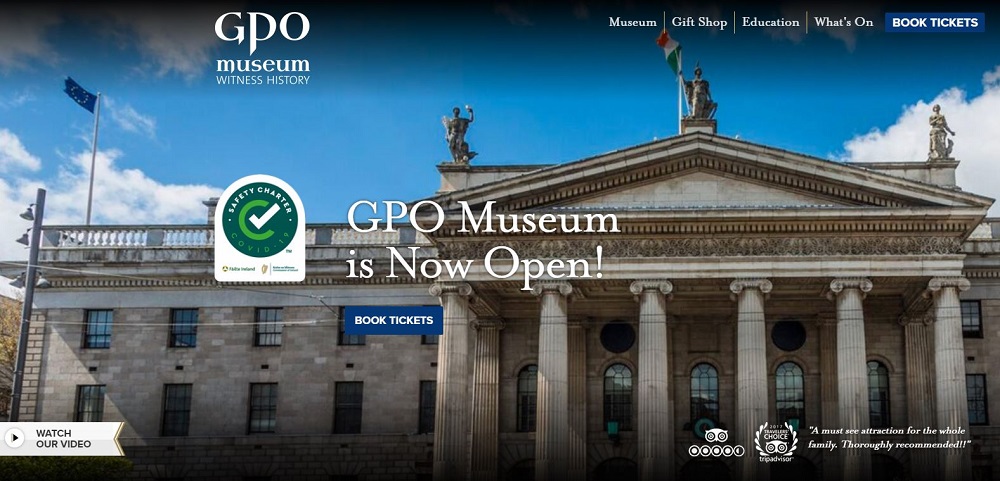
Thus, the Freeman’s Journal reported on events in O’Connell Street, April 1916. Rebel Radio ‘broke down the walls of silence built by the enemy’. The rebels’ launch of their very own radio station in April 1916 was a real and tangible success during the Easter Rising. This group of innovators broke new ground barely a decade after the invention of radio. Their actions, often under intense fire from their enemy, beat the odds and the British censorship blanket in Ireland. The radio station, located opposite the rebel headquarters in the GPO, was expertly planned and executed and it became a world’s first as the Irish Republic became the first State to be declared globally by radio. It was the first instance of battlefield propaganda being broadcast to the general listener. As the first Director of Irish Broadcasting the proclamation signatory (and later executed leader) Joseph Plunkett led a group of extraordinarily brave rebels. His charges included Fergus O’Kelly, John ‘Blimey’ O’Connor, Liam Daly and the Hollywood star Arthur Shield’s.

“To Officer in Charge Reis's and D.B.C. The main purpose of your post is to protect our wireless station. Its secondary purpose is to observe Lower Abbey Street and Lower O'Connell Street. Signed. James Connolly, Commandant General”.

3.     For many when 2RN, the forerunner of RTE Radio took to the airwaves on January 1st 1926, it was the first but before 2RN and even Belfast’s 2BE, Irelands first licensed radio station 2BP took to the airwaves for three days August 14th -16th 1923. It would be the first time that listeners in Dublin could hear Irish voices singing and playing Irish traditional airs.


4.     Much has been written and it is still fondly remembered that Tolka Row, first broadcast on RTE in January 1964, was the stations first foray into producing a soap opera but in fact it was the BBC who stole the march on the Irish broadcasters by first broadcasting Tolka Row on radio in October 1957 and on BBC TV in March 1959. RTE would eventually broadcast the Dublin based soap for five series.


5.     The two Irish language broadcasters TG4 & Raidio na Gaeltachta both had pirate incarnations before becoming legal entities. Radio Saor Connemara was a forerunner of the Irish language service on radio while Telifis na Gaeltacht in Rosmuc in 1987 promoted our native language on TV, before the arrival of TG4.


6.     First commercial use of radio was by the Goodbody family in Clara, County Offaly. The family and fellow businessmen were early investors in the Marconi wireless invention. The wireless system in the town connected wirelessly their flour manufacturing plant with their sack producing building.

7.     First use of radio for sports journalism in the world was by Marconi at the 1898 Dun Laoghaire regatta. Marconi transmitted radio signals from the tug The Flying Huntress in the bay giving details of the progress of the yacht races in the Kingstown Regatta to his assistant who manned the receiving equipment in what is now Moan Park House, Dun Laoghaire. The information was then telephoned to The Dublin Express newspaper who published results of the races shortly after they ended. This event represented the very first use of radio in journalism and sports broadcasting.


8.     In 1964, the famous pirate ship Radio Caroline was fitted out as a radio station in the County Louth harbour of Greenore by Dublin born Ronan O’Rahilly, whose family owned the port. The station, now with an Ofcom licence still broadcasts from the Ross Revenge ship off the Essex coast.


9.     Radio 2000 who lost out on the national franchise applied for one of the two Dublin licences, which he duly won along with Capital Radio. The franchises for Dublins independent local radio stations were awarded Radio 2000 and Capital Radio on March 2nd. At 8am on July 20th Capital Radio went on the air broadcasting from the St. Stephens Green Centre on 104mhzFM becoming the first of the new licensed radio stations. Radio 2000's station 98FM was launched from the former home of the pirate station Q102 in Mount Street broadcasting on 98mhzFM. Both stations had stolen the march on the nationally licensed Century Radio this despite Century's protests that the success of the national station depended on Century being on the air before the local stations. Capital Radio was launched at the Berkley Court Hotel with the first voice heard on the station being that of Scott Williams. Dublin's Lord Mayor Sean Haughey officially declared the station open before handing over to the studios and Colm Hayes who played the station's first record, Phil Lynott's 'Old Town'.


10.  The Hurdy Gurdy Museum in the Martello Tower in Howth has one of the largest collections of antiques radios and equipment from Irish radio history. The brainchild of the late Pat Herbert, the museum according to its website derives its name as ‘a homage to a remark made by Taoiseach Seán Lemass, who asked an RTÉ radio controller in the 1950s "How's the hurdy gurdy?". 


Wednesday, 1 November 2023

The Time For A Dedicated Independent Irish Radio Archive is NOW


We have harvested wood and bogs to heat and cook, we’ve tamed rivers to provide electricity and now we have harnessed the wind, the oceans, and the sun to create renewable energy but the ether has been a natural resource that we’ve utilized successfully, using it to communicate and entertain ourselves for over a century. The radio waves that help us land planes on the Aran Islands and listen to the Cranberries have also been harnessed. According to the most recent JNLR ratings 80.2% of the adult Irish population listen to Irish radio every day. It is our heritage.


Our love affair with radio has propelled Irish radio history onto a global stage. From Marconi’s Irish mother encouraging her son to experiment, to the rebels of 1916 ensuring that Ireland became the first nation in the world to be declared by radio to Clondalkin born Ronan O’Rahilly helping to revolutionise radio with his Radio Caroline, we have a rich tapestry in radio and it continues to evolve from analogue to digital to online.


 We are now entering a celebration of Irish radio milestones. 1923 and Ireland’s first licensed radio station 2BP takes to the airwaves, 2BE is launched by the BBC in Belfast in 1924, the new Free State inaugurates 2RN in 1926, while Cork sees the arrival of 6CK in 1927 and 1932 sees radio take the Eucharistic Congress to a global audience.


Are we remiss in not exhibiting our immense radio history? How will scholars of the future discover how and why in this modern age of social media that analogue radio listenership is still over eighty percent? Unlike many nations of a comparable size, Ireland does not have a centralised radio archive or museum both open to both donations and research. Our disregard of our broadcasting heritage is shameful. The memories of those in front and behind the microphone seems lost in the mists of time.


The largest radio and audio archive is RTE’s. While not complete, the only recorded snippet of the opening nights broadcast comes courtesy of the BBC who rebroadcast part of the opening night to the UK, it is an invaluable resource but spending cuts within the broadcaster has seen its staffing levels and importance reduced. An independently funded body should be put in charge of maintaining, updating and making available all radio archives, including RTE, commercial, local and community radio.


We have the archives; it is scattered to the four corners of the island. We have a unique collection of invaluable Irish radio artifacts gathering dust on shelves in the Cork City Gaol Museum, a passion of the late Paddy Clarke, degrading as I write this impassioned plea. Without County Louth born Fr. Nicholas Callan and his work on the induction coil in the mid-19th century, Marconi may not have ended up leaving Italy, his archives are in Maynooth University. Without the work of the Irish Radio Transmitters Society to save the work of Colonel Meade Dennis, the world’s first radio ham, another remarkable story would be lost. His equipment was donated to the Computer and Communications Museum at NUIG. The RTE scripts of the past are located at UCD. The Hurdy Gurdy Museum in Howth, a personal achievement of the late Pat Herbert is a treasure trove of Irish radio history. The Irish Pirate Radio Archive is located at Dublin City University. There is the RTE archive, totally under resourced and haemorrhaging staff, a massive an invaluable archive unfortunately for scholars hidden behind a pay wall. There are the archives of the independent sector for which limited Sound and Vision grant money is available. The archives of at first the IRTC, then the BCI, later BAI and now Coimisiún na Meán are a vital thread to understanding and studying Irish radio history. This scattered approach is diffused and disorganised and without a centralised online guide. Our radio archives physical and audio should be housed in a dedicated sound and audio archive like the Centre National de L’Audiovisuel in Luxembourg or the German Broadcasting Archive.


Whether its Clifden in 1907, O’Connell Street in 1916, 2BP’s broadcasts in 1923. 2RN in 1926, Radio Caroline in 1964, Radio Nova in 1981, Atlantic 252 in 1989 or Christmas FM in 2008, the physical and audio archives should be centralised so that those who have kept safe their treasures over the decades have somewhere to donate their collections. There should be strategic policy developed for Irish radio archiving and history protection.


With the GPO relocating its offices from O’Connell Street to The Point, perhaps the GPO could be used to house a unique collection of radio memorabilia, artefacts, archives, and audio. We need action now as each and every day new material is created, new memories are made and yet voices are lost.


Monday, 2 January 2023

The Original 2RN in 1924

The history books tell us that the forerunner of RTE Radio One, 2RN began broadcasting on January 1st 1926. The callsign 2RN had been assigned to the new Irish broadcasting station by the British post office but 2RN was not the first applied for callsign and the Little Denmark Street based station was not the first application of the 2RN callsign.


In 1924[1] when negotiations were taking place as to whether a new Irish Free State radio station should be a commercial enterprise or a state run monopoly, a Dail wireless committee heard that a group of five companies led by Andrew Belton’s Industrial Developments Limited had coalesced into the Irish Broadcasting Company. The IBC was to apply for the licence as a commercial station but a political scandal involving Belton and a committee member Darrell Figgis led to the decision to be taken that the Irish station would be state run. In anticipation of obtaining a licence, Belton applied to the British Post Office for the callsign 4RN[2] as in ‘For Erin’ but at the time there was no callsigns with the number 4 designation. Instead, the British Post Office allocated the callsign 2RN as in ‘come back TO Erin’ instead.


The issue initially was that there was already a wireless operator with the callsign 2RN. It had been assigned to David Daniel Richards, a resident at ‘Mametz House,’ 36 Bontnewydd Terrace in Trelewis, Glamorgan, Wales. Richards was a demobbed British soldier after the First World War who had acquired wireless operator knowledge at the front. To allow for the Irish station to use his callsign, in 1924 his callsign slightly changed to 2 ARN.


[1] Maurice Gorham’s ’40 Years of Irish Radio’.

[2] The 4RN callsign would later be used by a Queensland radio station.


Friday, 11 June 2021

A Salute to the Men who Put 2RN (& BBC TV) on the air in 1926 (Part 2) William Beatty

In part two of our salute to the men who brought 2RN to the airwaves in January 1926, we look at the engineers who bought the Marconi transmitter in the UK, had it shipped to Ireland, renovated the wooden hut in the grounds of McKee Barracks and installed the framework for broadcasting at new studios on Little Denmark Street. These men were integral to the early success of radio in Ireland and their key roles have almost vanished from history...until today.


William Arnold Beatty was born in Cork to parents from Bangor County Down. As soon as the young Beatty could access a place in the School of Wireless Telegraphy on the Mardyke in the city centre, he enrolled. Once qualified in the new profession as a Wireless Operator of Marconi equipment he found himself travelling the high seas of the world in ships wireless rooms despatching morse messages for his employer Gugielmo Marconi.


He was on board merchant ships crossing the Atlantic as the First World War raged and shipping encountered a new deadly threat, being torpedoed by German submarines. In 1917, off the coast of Tory Island, his vessel was torpedoed and sunk. He was saved by being prepared and engaging with all the safety measures at the time. A year later he watched from the deck of the SS Highland Pride as a British cruiser was sunk as it protected a convoy of ships crossing the Atlantic from South America.


In 1922, as the new Irish Free State Government took control of the affairs of a devastated and war torn country, Beatty returned to land and joined the new National Army of the Free State. With his skills he was immediately attached to the Signal Corps. Many of his colleagues in the Signals Corps were fellow former Marine wireless operators who were renowned as being face with the Morse codes key. He was in charge in the Wireless Room at Portobello Barracks on August 22nd 1922 when the first news of the assassination of Michael Collins at Beal na Blath reached the capital.


In 1924 Beatty left the Army and in October the following year he was hired as the Assistant Engineer for 2RN with an annual salary of three hundred pounds per annum but interestingly with no pension. He worked under TJ Monaghan, who had been seconded from the Department of Posts and Telegraphs to overseas the opening of the Free State’s first radio station. He was at the heart of the McKee barracks hut transmitter location and the nearby aerial array. The transmitter was a 1.5kw Marconi transmitter and his engineering knowledge, training and expertise was invaluable in getting the signal on the air.

           SEE WILLIAM BEATTY & THE 2RN TRANSMITTER HUT IN BRITISH PATHE NEWS


He was in charge of many of the first outside broadcasts carried out by the station. This included its very first when 2RN was still in the test transmission phase in December 1925 before the official launch on January 1st 1926. The first outside broadcast came from the La Scala Theatre on Princess Street, beside the GPO on O’Connell Street. In March 1926, he operated outside broadcasts from various locations around Dublin but with limited equipment, it meant that Beatty would have to load and unload the equipment from taxis as he moved from location to location. In May 1926, the first OB from Cork took place and Beatty was on hand to ensure the broadcast went smoothly. The variety show took place in the Cork Municipal School of Music located on Union Quay. He would make several trips to Cork through the following year as the second Irish station 6CK was readied to open from the old Women’s Gaol overlooking the Southern city. A similar broadcast came from the Town Hall in Sligo on June 15th 1926 with Beatty once again in charge of the OB. The system operated meant that the microphone Beatty transported west was attached to the telephone line in the Mayor’s office which in turn was linked to the telephone exchange in the GPO and then by telephone line to the studios in Little Denmark Street and according to newspaper reports it worked perfectly. [1]


It was Beatty who set up the heavy cumbersome microphone on the side-line at Croke Park for 2RN to become the first station in Europe to broadcast a live commentary of a field sport. So primitive was the ‘Press’ facilities at Croke Park at the time, a 2RN employee had to spend the entire game standing with an umbrella over the microphone to protect the expensive equipment. On another occasion when covering a rugby game at Lansdowne Road, the ball hit and damaged the microphone, the game being held up until temporary repairs were made and the link to the city centre studios restored. In November 1927[2], Beatty was in charge of the technical infrastructure for an OB from the Empire Theatre, Galway. Not only did Beatty set up the broadcast equipment but he acted as the announcer from Galway on the night linking to Dublin.

In September 1928, the Irish Independent reported that,

‘Major Bell, lessee of the Capitol Theatre in his review of the position of the cinema trade before a party of Pressmen on Thursday, mentioned that the Capitol was installing such a system and mentioned the fact that useful ideas on the subject had been put forward by Mr. W. Beatty, engineer, Dublin Broadcasting Station.

Yesterday and Irish Independent representative saw Mr. Beatty and got from him some views on the subject. Mr Beatty is at present seeking protection for an invention of his dealing with the phono-film.’   


Beatty left the station in 1930 and moved to the United Kingdom where he initially took up a role with the International Maritime Radio Corporation who were installing powerful equipment on ocean going liners including those of Cunard and White Star. His fascination with sound and the moving picture led him to Alexander Palace outside London and working with someone who is considered by many as the Father of Television, John Logie Baird. He was one of the main engineers on Baird’s mechanical system of television broadcasts who was competing with EMI/Marconi’s electrical system, which ultimately won the battle to be the main system used by the BBC. In 1936 he was the Production Manager at Baird. [3]


After losing to EMI/Marconi, the Baird company went into a slump and eventually receivers were called in. Beatty moved on to HMV overseeing the production of new wireless receiving sets and later to Philco. With each company he worked for including the International Standard Electric Company and the Anglo- American company Kolster-Brandes Limited, he was refining equipment being used in both transmitting and receiving radio and television signals. He applied for and was granted numerous patents[4] for these improvements.


 William Beatty passed in Sussex away on January 26th 1949[5] leaving behind a wife, Barbara.


Part of William Beatty’s engineering team at 2RN were Andrew Kettle. Kettle would later work for the ESB and serve as the Honorary Secretary of Bohemian Football club and represented the north Dublin club on the FAI Council.  James Nolan from Walsh Island Offaly, involved in attacks by the IRA on Black and Tans including ambush at Mount Lucas near Edenderry in February 1921. Joined the national army and was attached to the signal corps where he discovered that he was a competent wireless engineer and finally Michael Nugent. Without the hard work, ingenuity, professionalism and dedication of these men, 2RN would not have joined the world’s cavalcade of radio stations on January 1st 1926 and Radio Eireann would not have been so quickly embraced by the Irish listening public. Thanks lads.


[1] The Sligo Independent June 19th 1926

[2] The Connaught Sentinel November 22nd 1927

[3] The Sunday Independent 31st May 1936

[4] The US & UK Patents Office

[5] Northern Whig Newspaper


Thursday, 10 June 2021

A Salute to the Men who put 2RN on the Air, (Part One) The Irish Eckersley, TJ Monaghan


Peter Eckersley was a famous name associated with the early days of radio in the United Kingdom. A sometimes eccentric extrovert, he was initially involved with the first broadcasting station, 2MT, before moving onto 2LO and then the amalgamation of radio stations that became the BBC. He was a controversial character but there is little doubt that without him the success of the BBC would have been stalled. In Ireland we had an engineer who was described as the ‘Irish Eckersley’[1]. He was a powerful Civil Servant who held sway over his domain unchallenged for over a quarter of a century, he controlled all engineering decisions over radio broadcasting, telephone and aeronautical communications. Yet very little is known or remembered of Thomas Joseph Monaghan, ‘The Irish Eckersley’.


T.J. Monaghan, as he was known, was born on April 21st 1887 near Accrington, Lancashire, England. His parents were Galway born doctor Thomas Monaghan and Josephine Maguire. He was educated at Xaverian College boarding school at Mayfield, Sussex. In 1902 he began attending South-western Polytechnic. Founded in 1895, one of the principal aims of the South-Western Polytechnic Institute was the provision of education for the poorer inhabitants of London. An emphasis was placed on instruction in handicraft, trade and business, together with access to recreational facilities, sought to improve the career prospects and their physical, social and moral conditions. This initiative initially took the form of day and evening classes for men and women over fifteen years of age, with the Institute offering well-equipped laboratories for the study of subjects such as mechanical and electrical engineering, mathematics, physics, chemistry and metallurgy, in the hope of attracting male students keen to learn a trade and enter industry. Practical training was additionally available in carpentry, brickwork and advanced cookery; whilst classes in economics and commerce offered training in shorthand and typewriting for lady secretaries together with examinations for appointments in the civil service and the post office. Students were also afforded the opportunity to attend lectures in literary arts and to receive instruction in languages. He left the College with a Batchelor of Science degree in Engineering, passing with first class honours.


Following his graduation, he received practical training variously at the Royal Small Arms factory at Enfield, Yarrow & Co. at Poplar, and Simpson-Worthington at Newark until 1909. In 1910, Monaghan then joined the General Post Office (GPO) as an assistant engineer at their H.Q. in London. The General Post Office in St. Martin's Le Grand, later known as GPO East, was the main post office for London between 1829 and 1910, and during that period was the headquarters of the General Post Office of the United Kingdom of Great Britain and Ireland, and was England's first purpose-built post office. It was demolished in 1912. It was the UK's second purpose-built post office after Dublin's GPO, which was completed in 1818 to a design by Francis Johnston, and still in use.


He was transferred to Belfast in 1910, spending two years there, then moving to Dublin and then to Cork in 1919, during which time he was in charge of works and maintenance of telegraphs, telephones, and wireless. In August 1913 he married Winifred Hackett in County Offaly.  At the beginning of the War of Independence in 1919, he was transferred back to the London HQ of the GPO on special wireless work and in 1921 he was appointed as officer-in-charge of the Leafield Wireless Station in Oxfordshire responsible for plant erection and the running of what was then one of the principal wireless stations in the world. Leafield was a powerful wireless station with a 250 KW arc transmitter that was to be part of an Imperial Wireless Chain that would connect the empire. Officially opened by the then British Postmaster General E G Kellaway, it initially connected with a similar station at Abu Zabal in Egypt.


 Following the end of the War of Independence and the creation of the Irish Free State he returned to Ireland in 1923 and became a staff engineer at Department of Posts & Telegraphs in Dublin responsible under the engineer-in-chief for a variety of aspects of the work of the department, including the initiation of the Irish broadcasting service. His first big project was all the technical aspects of the arrival of radio in Ireland and the launch of 2RN. He was seconded from the Department to 2RN and in tandem with the building of the transmitting apparatus was on the committee that appointed key personnel including the station director. That was the inspired appointment of Seamus Clandillon but Monaghan had his input on all aspects of the arrival of State sponsored radio in Ireland.


He was the man charged with putting 2RN on the air along with fellow radio engineer William Beatty. They purchased a 1.5kilowatt Marconi transmitter and installed it in a wooden hut on the grounds of McKee Barracks near the Phoenix Park. Aerials were erected and by mid November 1925, the first test transmissions from the station began. The station officially went on the air at 7.45pm on January 1st 1926. A year later he was involved with installing the transmitter for the second Irish station 6CK in Cork. 6CK was based in the former Women’s Gaol in the city.

In November 1928 he replaced L.J. Kettle as the Chairman of the Trinity College Physical Laboratory. In lecture when he assumed the position, titled ‘Efficient Communications’ he said,

'It would take 100 years of constant human speech to generate enough energy to boil water for a single cup of tea.’


Monaghan travelled to the various wavelength conferences that saw the wavelengths of both 2RN and 6CK change regularly. The range of the two stations was limited and the Government decided that a more powerful transmitter would be purchased and installed somewhere in the centre of the country. Monaghan and his team of engineers, including John Lyons, undertook painstaking research testing various locations including Tullamore and Portlaoise before settling on Moydrum outside Athlone.

With the intended launch originally scheduled for 1933, one of the biggest events to be staged in the new Irish Free State was the 1932 Eucharistic Congress of the Catholic Church. Monaghan was put in charge of ‘broadcasting’ the entire event. Installation at Moydrum was sped up and the new transmitter was operating in time for the first blessing in June 1932 and the signal strength meant that all the island was able to tune in. Not only was Monaghan in charge of the radio broadcasting end of the event, but he also increased the capacity of the telephone system and he provided facilities for the overseas Press attending the event to keep in touch with news desks around the world.


Another success for Monaghan was the installation of over three hundred loudspeakers wired throughout the city to relay the ecumenical events from the Pro Cathedral, O’Connell Bridge where an altar had been erected and from the Phoenix Park where Mass was celebrated.


By the late 1930’s as war loomed, the Irish Government under Fianna Fail and Eamon DeValera wanted to be able to speak to the Irish diaspora abroad. Up to that point they relied on special broadcasts surrounding St Patrick's Day but a new Short Wave service would assist in the dispersing the Irish Governments neutral stance when war did break out. The short wave service achieved limited success and was eventually discontinued. When transmissions were heard abroad and listeners wrote with reception reports, it was Monaghan who would reply with QSL and conformation letters.


During World War Two or the Emergency as it was known in Ireland, Monaghan joined the Irish Army and the Signal Corps. He helped set up an emergency broadcasting station in Eamon de Valera’s house should the main studios or aerials be bombed and put out of action. He also, with the help of the BBC, synchronised the frequencies of the Irish stations at Cork, Dublin and Athlone in order to prevent enemy pilots identifying their location from radio broadcasts.


But not only was Monaghan looking after radio from his offices in Leitrim House in the offices of Dublin Castle, he was controlling the progress of telephone services in Ireland including the arrival of the automatic telephone exchanges. His remit also had him looking after aeronautical communications and as the result of Ireland’s position at the edge of Europe, closest to continental America’s, aircraft communications was a vital area especially post World War Two.


Monaghan represented Ireland at numerous conferences across Europe and the United States. These conferences allocated frequencies for his radio station, now known as Radio Eireann, discussed modernizing Telephone systems and formatting safe flying for the expanding aviation industry.


He became engineer-in-chief in 1930 and moved the family to 15 Clarinda Park North, Dun Laoghaire. Monaghan was elected MICEI in December 1929, served on council, was a vice president and served as honorary secretary, becoming president in 1942. He was also a member of the IEE and served as chairman of its Irish branch.


During the war he joined the Irish army signal corps and was promoted to the rank of Colonel. In 1951, he was instrumental in forming the Signals Club made up of ex members of the Signal Corps. Monaghan married Winifred in 1909, a daughter Judith was born in .. Judith met her future husband Gatt Westerhout at the radio conference in Dublin in 1955. They married a year later and her Dutch born husband carved out an extraordinary career in astronomy. They couple had 5 children two sons, Gart and Julian Westerhout; two daughters, Magda Westerhout Mobley and Brigit Molony, with her partner of 56 years passing away in 2012.

TJ Monaghan retired in April 1952. In 1958 he was appointed as Chairman of the Institute for Industrial Research and Standards and in May 1958 he joined the board of the National Board and Paper Mills, the Mills located in Granard, Co. Longford. Also appointed to that board at the time was the former Minister for Industry and Commerce, Daniel Morrissey.

T.J. Monaghan died at his home at 18 Summerhill Road, Dun Laoghaire on 10 July 1971.  


[1] Described by Seamus Hughes, station announcer in the Irish Independent December 16th 1925, two weeks before the official launch of 2RN on January 1st 1926.