

Across Europe and further afield the arrival of radio
created a new sense of national identity and nations displayed their national
pride by building ornate architecturally stunning broadcasting houses but not
in Ireland. At a Transnational Radio Seminar in Luxembourg in 2018 organised by Andreas Fickers and Richard Legay, one of the speakers at the event was Maryam El Moumni of the Brandeburg University of Technology spoke of the Archaeology of Radio and I pondered what the Irish experience of this was.
Radio arrived in Ireland north of the border in
Northern Ireland with the opening of 2BE in Belfast. The station which first
went on air on October 24th 1924 was originally located in a converted
warehouse in cramped rooms. Following a decade of violent turmoil, a new Irish
Free State turned its attention to broadcasting. Two years after the Belfast
launch, a new Dublin station 2RN went on air. The studios were located in a
terrace of houses on Little Denmark Street in the heart of the city centre with
the studios linked to the makeshift transmitter site at the nearby McKee Army
barracks. The Dublin station was followed by 6CK in Cork City.
The success of radio stations across Europe was
continuing upwards and nations felt a sense of pride in beaming their
transmissions not just to a national audience but transnationally across
borders. It was often a sense of national pride which after the postage stamp
demonstrated to the world that a nation was truly independent. Elaborate,
ornate and architecturally wonderful buildings were being created across Europe
from England to Germany.


Nauen Germany
1920 BBC HQ
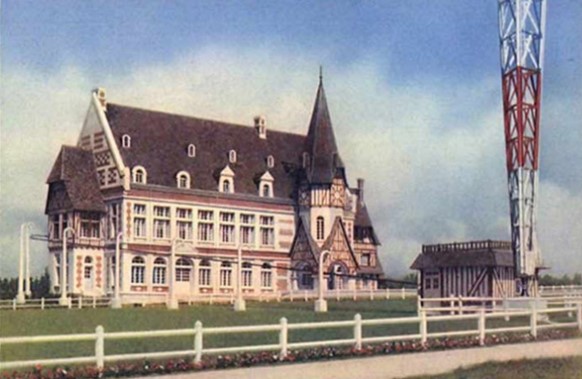
Radio Normandie in France in the 1930s
When the decision was taken that a Irish Free State radio
station would be state controlled rather than a commercial entity, a location
was needed for the studios and transmitter. The overriding issue for the
fledgling state broadcaster was the lack of finance and this would dictate what
could be afforded for the launch. There would be no spectacular ‘broadcasting
house’ built instead when the station was launched on January 1st 1926 the
stations studios were located in the inner city of Dublin on a narrow market
street on Little Denmark Street. Number 36 was a four storey over basement
building constructed of concrete and steel with a red brick finish and slated
roof[1]. There was single
studio and one actor who appeared in numerous early radio plays Harry Brogan
remembered that they used their coats hanging on the studio windows to keep the
noise of shouts from the street traders out.
The locating of the transmitter in a wooden hut in the
grounds of McKee Barracks was for two reasons expediency and security. McKee
Barracks named after Richard McKee who was a key IRA operative for Michael Collins
during the War of Independence with Britain. He had been captured in November
1920 and after being tortured he was supposedly shot dead as he tried to escape
from his captives in Dublin Castle, the then British Government in Ireland
headquarters. Originally called Marlborough Barracks it was built by the
British Army in 1888. When Ireland became the Irish Free State in 1922, the
British gave the barracks to the Irish forces and named after McKee 2] .

The McKee Barracks Hut (c) British Pathe News
By 1928 the small and cramped Dublin studios had become unfit for
purpose and the station and its personnel were moved to the first floor of the iconic GPO (General Post Office opened in 1818) on O’Connell
Street with one former presenter describing the corridors décor as reminding
him of a public house gentleman’s urinal.
JJ Walsh the Minister for Posts and Telegraphs
announced in the Dail,
‘The station is in the
McKee Barracks, and the broadcasting headquarters, or studio, as it is usually
termed, is in Great Denmark Street. The items set out here include furniture
and equipment for both places. Under the heading relating to miscellaneous
expenses, which amount to £850, we have such items as postage, stationery, and
copyright royalties. Copyright royalties in broadcasting are not only difficult
of arrangement, but are also expensive. We have also under this particular
heading provision for weather reports and news services, and also such items as
we may from time to time be called upon to provide in the way of extra musical
equipment, gramophone records, and matters of that kind.’
Now, it is intended that this sum of £14,385 shall cover the period up to the end of the financial year. Thereafter the broadcasting estimates will take their place in the annual estimates and be discussed as separate items. It is not intended that these estimates should be included within the sphere of the Post Office proper.’[3]
Following the destruction of the GPO during the 1916
Easter Rising, it’s rebuilding was not completed until 1928 and when it was reopened the fourth
floor was taken over by 2RN, later to be renamed as Radio Eireann, who now had three
studios instead of the one at Little Denmark Street. In the 1950’s two more
studios were built and in 1956 six more studios including a continuity suite
were added on the third floor. But the GPO was never designed as a broadcast
centre and the station suffered from the lack of sound proofing.[4]
When it came to put a second station on the air,
Ireland’s second city Cork was to the location for 6CK. Once again the station
was to be located in a second hand building, the former Women’s Gaol in the
city. Today the Irish Radio Museum is located in the building where 6CK was broadcast
from. Work on the Goal commenced in 1816 and the building of the prison proper
started in 1818, The building having been designed by William Robertson. It
opened to prisoners on 1824 and became a women’s only prison in 1878. The Goal
closed as a prison in 1923 after the events of both the War of Independence and
the Civil War. In 1927, the upper floors of the Governors House became the home
of 6CK.

(c) Radiomuseum.org
The major expansion for
Radio Eireann was the installation of a new high powered transmitter in the
midlands near Athlone. The decision was taken at Cabinet level
in November 1931 to build a high-powered transmitter in Athlone. Since the
inception 2RN wanted to be heard nationwide and the Government desired that
Irish broadcasts and programmes should be heard further afield, to be on at
least a par with some of the European stations that were now quite popular
in Ireland. They wanted to counteract the broadcasts of 2BE and the BBC
networks although the BBC had been quite helpful directly to the staff and
management of 2RN. This included the relaying of certain broadcasts including
St. Patrick’s Day broadcasts and sporting events including the motor racing from
the Phoenix Park. A large powerful transmitter would be
geographically located in the centre of Ireland. Engineers identified both
Athlone, County Westmeath and Birr County Offaly as possible
locations. In 1931 a site was purchased at Moydrum Castle on the
outskirts of Athlone for the transmitter. The Department of Finance set aside
resources for the building of the infrastructure and the purchase of a 100
kilowatt transmitter from the Marconi Company in England. A four hundred and
twenty-five aerial was erected and when DeValera came to power in February 1932
a new impetus was injected to have the station operational in time for the
Eucharistic Congress being held in June 1932.
The first Eucharistic
Congress was held in 1881 under Pope Leo XIII. The congresses were organised by
a Papal Committee for Eucharistic Congresses to increase devotion to the
Eucharist as a part of the practice of faith, and as a public witness of faith
to Catholic population at large. The 31st International Eucharistic Congress was
held in Dublin, 21-26 June 1932. It was the premier international Catholic
event. The 1932 Congress provided the platform for the Irish Free State
Government of DeValera to assert their position as a leading Catholic nation.
It would be the largest public gathering in twentieth-century Ireland until the
1979 visit of Pope John Paul II. There was even an act passed by the Government
specifically for the event titled the Eucharistic Congress (Miscellaneous
Provisions) Act, 1932.
Congresses were often linked
with anniversaries or other events special to Christians and in particular to
Catholics of the country in which they took place. The 30th Congress which took
place in Carthage, Tunis, commemorated the death of St.
Augustine. The Dublin congress commemorated the death of St.
Patrick, Ireland’s patron saint.
The new Irish State
mobilized its meager resources in order to meet the challenge posed by this
show case event. The arrival of the special Papal Legate, Cardinal Lorenzo Lauri
at Dún Laoghaire Harbour at the beginning of Congress Week was
greeted by thousands along the harbour piers and the Papal Mass in
the Phoenix Park six days later was attended by over 1,000,000
of the faithful. The event was considered to be an outstanding success. The Irish State had
successfully entertained literally thousands of churchmen and laity who came
to Dublin from every corner of the globe to pray.
The Congress was a
logistical nightmare for the under resourced radio station. The station carried
out a number of major outside broadcasts from across Dublin for the event.
These programmes were relayed by landline to Athlone whose transmitter was
operating at sixty kilowatts allowing coverage over much of Europe and more
importantly the powerful transmitter allowed for coverage across Ireland. For
those with radio sets it was a massive improvement in quality but the
broadcasts were relayed on receivers in churches and halls across the country
allowing everyone access for the first time to listen to 2RN. The Congress
marked the first time that the overwhelmingly Catholic population heard the
voice of the Pope relayed over the Athlone transmitter on the final day of the
Congress. Reaction to the broadcasts in the print media was positive and
commended the station on their achievements.
The Athlone transmitter was officially opened by Eamon DeValera on
February 6th 1933 but some complaints remained that the station was too Dublin
orientated as the studios and all of the programmes produced came from the GPO
Studios in the capital. In January 1937 the Athlone transmitter power was
increased to the full 100 kilowatts. Radio Athlone began life on 413m but the
Lucerne Conference altered that to 513m medium wave. With the opening of
Athlone, the Dublin transmitter was closed down and the station
became known as Radio Athlone rather than 2RN.

The Athlone transmitter building (c) Joe Guilfoyle

Although no longer in use, the building houses the oldest working 1930's Marconi transmitter

On December 31st 1961 a new
television channel began and Radio Eireann became Radio Telifis Eireann. The
television studios were located at Montrose in Donnybrook. The site at Montrose
was originally bought by University College Dublin in June 1949 as a University
Campus but in a swap UCD moved across the road to Belfield and the State took
over the Montrose site. On the land was a house once lived in by Guglielmo
Marconi, the father of radio whose mother Annie Jameson owned Montrose House.
Jameson was related to the famous distilling family before she married
Marconi’s father.
In June 1960 Michael Scott of Scott, Tallon and Walker
architects was appointed architect to design the new RTE television centre at
Montrose. Scott had won acclaim as the architect of the Dublin central bus
station Busaras. The contract to built the television studios was signed on
October 3rd 1960 with the Government, RTE and Michael Scott with the builders E
Stone of Thorncastle Street. The company had previously built the new stand at
Lansdowne Road. The studios were the first building in Ireland to use pre-cast
concrete and flat slab structure.[5]
A 380 ft a self supporting lattice steel tower in the
grounds connected with transmitter site at Kippure in the Dublin Mountains.
Following a tender process the contract to build the tower was awarded to
Anderson & Martin Capital Equipment in association with Huso Verft and Mek
of Tronsberg Norway with an estimated cost of £20,000. Working on behalf of
Radio Eireann was Chief Engineer J. J. O’Keefe, A. G. Tobin head of transmitters
which were built by Pye Limited.
By the end of the decade the GPO was now unfit for
purpose as a broadcasting centre and a new purposely built radio centre was to
be built at Montrose after almost a half century of radio broadcasting radio in
Ireland was to get its first dedicated radio studios.
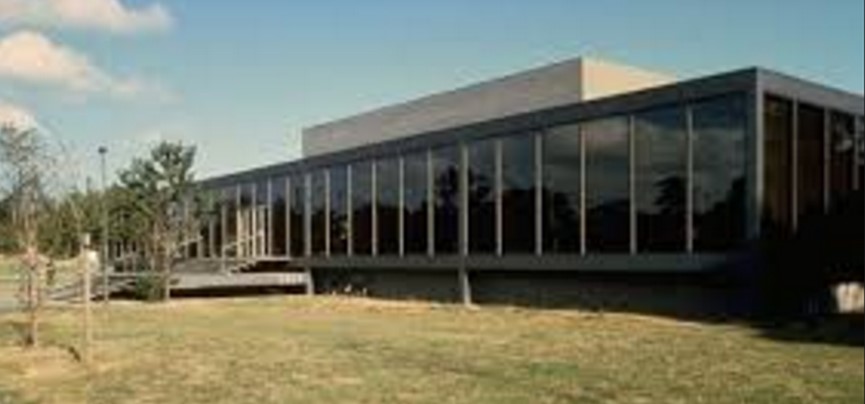
 RTE
on top, Illinois Institute of Technology on the bottom,
RTE
on top, Illinois Institute of Technology on the bottom,
it's hard to tell the difference
Ronnie Tallon (1927 – 2014) of Scott, Tallon and
Walker was appointed to design the RTE Radio Building.[6]
Tallon was an admirer of Mies Van Der Rohe (b.1886 Germany d. 1969 US Citizen)
who designed unornamented steel and lass skyscrapers.[7]
The architects had previously worked on the building of the Illinois Institute
of Technology and there is no escaping the similarity.
Work on the Radio centre commenced June 9th 1969 on 8
acres formerly used as the sports ground of nearby St. Andrews College. The
original budget was £650,000 but eventually cost was over one million pounds.
The final broadcast came from Henry Street on November 8th 1976.

When new legislation in 1988 created an independent
commercial radio sector for the first time a national licence was granted to
Century Radio but like the early days of Radio Eireann, they were located on
the floor of an office block across the street from the iconic and historic
Christ Church Cathedral. Located at One Christchurch Square, High Street, the
station went on air on September 4th 1989 but due to financial troubles was
gone within two years. To get on air the station’s owners had purchased the
pirate radio transmitters and site of Sunshine Radio on the Northside of the
city.


The Transmitter building at Clarketown, Co Meath
When the joint venture of RTL (Radio Luxembourg) and
RTE on longwave 252m, Atlantic 252 was launched and located in County Meath. The stations studios were located in a three-storey period building known as
Mornington House on Summerhill Road in the town of Trim. According to the
auctioneers[8] the building
consisted of
Accommodation: ground
floor, entrance hall with ornate stairs to first floor, production room (sub
divided into smaller offices), boardroom, kitchen with filled floor and wall
presses. ladies & gents toilets. First floor, four offices, reception,
three studios. Second floor, two offices, landing office, library and links
room.
This was not a purposely built radio station but an
adapted studio facility. The stations powerful transmitter and aerial system at
nearby Clarkestown were the subject of a number of High Court appeals by local
residents and an active campaign to prevent its installation and operation.
After the demise of Atlantic 252 Mornington House was bought by Meath County
Council for their own uses in 2002 for € 750,000
Pirate radio had a long and colourful past and some
locations for the stations have included Georgian Houses in the Dublin City
Centre, garden sheds, attics and caravans. While no pirate radio station built
a purpose built studio and broadcasting facility some stations purchased
portacabins to broadcast from as they were easy to locate and to soundproof.
Perhaps the largest and most successful pirate radio station was Radio Nova
(1980 – 1986) who were initially located in a Georgian building on Herbert
Street on the south side of Dublin city near the Grand Canal.

There transmitter
site was located at a nightclub complex in the foothills of the Dublin
Mountains near Rathfarnham known as Green Acres. Following a number of raids on
the station and the jamming of their microwave link from Herbert Street to
their main transmitter, the station moved to Rathfarnham where the nightclub
was renamed Nova Park. Q 102 also broadcast from the basement of a Georgian
House on Upper Mount Street until the closure of the majority of pirate radio
stations in December 1988 when new tougher legislation was enacted and a new
Independent sector was created. Other stations because of their illegal nature
found themselves located in Caravans, farm sheds and garages.

When the independent franchises were awarded the
national franchise was awarded to Century Radio, who located their headquarters
in an office block in the shadows of Christchurch Cathedral on High Street.
Their transmitter network was leased from RTE which two medium transmitters and
their sites were bought from former pirate stations Sunshine Radio in Dublin
and ERI in Cork. Century was a short lived station, closed to due crippling
financial losses but the two successful Dublin candidates 98FM and Capital
Radio were launched in 1989. Initially 98FM were located in Studios in a shopping
centre on St. Stephen Green, while Capital Radio was located in the former Q 102
headquarters in a Georgian house on Upper Mount Street. 98FM would later move to a former granary silo
building on the banks of the Grand Canal while FM 104 as Capital Radio was re-branded and moved to the upper floors of an office block in the docklands. The
floors would be shared by FM 104 and a legal Q 102 who were both owned by the
same parent company. In 2017[9] 98FM would move
once again moving to its parent company’s new headquarters on Digges Lane,
known as Marconi House.

Marconi House in the compact office block on Digges
Lane

The only indication that the headquarters of FM 104
& Q 102 are located in the office block are name plates on the front
entrance intermingled with other renters in the building.
The replacement for Century Radio was launched on
March 17th 1997 as Radio Ireland from studios located in the centre
of the city at 112 Upper Abbey Street. Radio Ireland was rebranded as the
nightly successful Today FM and would be purchased by 98FM’s parent company
Communicorp. Today FM moved to Marconi House in 2007 followed by fellow
stations 98FM and Spin 1038. The quasi national news channel NewsTalk also
moved into the building from its original location on the upper floors of an
office block on Upper Mount Street. The building also housed the failed
Phantom/TX FM before its closure.
In Cork when 96 FM (originally known as Radio South)
were awarded the local franchise for the city in 1989, the station set
themselves up in the former pirate radio station ERI’s location in White’s
Cross. In 1991, a merger took place between 96FM and the Mallow-based County
Sound 103FM and some years later, the station moved premises from the rural
Whites Cross (the former Radio ERI studios) to a city centre location at
Patrick's Place, in a building which was formerly the location of Christian
Brothers College. The station named its new premises 'Broadcasting House', but
this building name is rarely referred to on air, except by Emmett Kennedy in
the evenings.

As a number of the local franchises became more
established and their contracts renewed by the overseeing Broadcasting
Authority of Ireland[10]
they began to move from second-hand premises seen as unfit for purpose, to
purposed built broadcasting centres. The stations making that move include
Waterford Local Radio (WLR) who moved from a building on George’s Street facing
onto the quays in the city to a building at Ardkeen. Work began on the €3
million 10,000 square feet project began in 2002 with the new studios the
following year but the cost had spiralled to over five million[11].
The official opening was performed by the then Taoiseach Bertie Ahern TD The
station sold their former home in the city centre to property developers[12].
With WLR in the broadcast centre was the youth radio franchise for the South
East, Beat 102-103. The station claimed that their new studios were the first
purposely built radio studios since the development of Montrose for RTE Radio[13].
This was an exaggerated claim as LMFM serving the
north east franchise area moved into their purposely built radio centre in 2001
with the official opening performed once again by the Taoiseach Bertie Ahern in
January 2002. When the station opened first in 1989 it’s main studio was
located in the Boyne Centre in Drogheda with a satellite studios located in the
Navan shopping centre[14]
and Williamsons Mall in Dundalk. For LMFM, with their success they could
financially absorb a move from rental accommodation to a dedicated studio and
office facility.
One of the most popular and successful regional
stations was MidWest Radio based in Ballyhaunis, County Mayo. Led by Paul
Claffey who had run the pirate version of the same station up to the new
legislation in 1989, MidWest moved into new fit for purpose premises on Clare
Street in the town in 2000, a decade after they had been awarded the licence on
a ten year basis. The station when it was awarded the licence was located on
nearby Abbey Street.
Highland Radio first broadcast in March 1990 with the
franchise for the North West of Ireland. Despite a challenge to their license
in 2014, Highland Radio has been located in the same premises in the Pinehill
Industrial Park on the outskirts of Letterkenny. While the building was built
as a storage area by the Boal family and never envisaged as a broadcast
facility, the station has created a permanent location for the station in the
building.


© Google Maps

© Radio Today
One of the few purposely built radio buildings in
Ireland was that of Radio Na Gaeltachta in County Galway in 1972. When the
Government gave the go ahead for the Irish language channel which would
primarily serve the Gaeltacht areas, its headquarters would be situated in the
main Gaeltacht area in County Galway. The architect firm of Nolan and Quinlan
on Pembroke Street, Dublin were employed on the design and James Stewart
Limited were awarded the contract for the build. The main single storey studio
building consisting of three studios, two control rooms and sundry office space
would be built at Derrynea in Connemara while a transmitter site five miles
away was located at Bealadangan. The Government allocated a quarter of a
million pounds for the building project and a further ninety thousand for
transmitters. Satellite stations were to be built later in Kerry and Donegal.

End of Part One
[1] James North Auctioneers description 1956
[2] Dublin City Corporation
[3] Dail/Oireachtas Historic Debates 1926
[4] The RTE Archive
[5] The Irish Times December 4th 2010
[6] archiseek.com
[7] Free Dictionary
[10] Formerly known as The
Independent Radio and Television Commission (IRTC) & The Broadcasting
Commission of Ireland (BCI).
[14] The Dundalk pirate
radio station Radio Carousel also had a studio located in the Navan Shopping
Centre


