Support Irish Radio History Archiving

Irish Pirate Radio Recordings

Showing posts with label Communications. Show all posts

Tuesday, 25 May 2021

Marconi's First Trans-Atlantic Transmission was Crookhaven to St. John's Newfoundland, NOT Poldhu, Cornwall


For over a century, a ‘fact’ has dominated communications history but now doubts have weakened its veracity and we ask, is any part of this historical story actually true? Has the wrong location and country undeservedly received credit? It’s now time to address and correct these inaccuracies.


The Fact: On December 11th 1901, Marconi received the first trans-Atlantic wireless message when the Morse code ‘S’ was sent from Poldhu in Cornwall to St. John’s Newfoundland.’


This is the commonly recognized fact in most textbooks but is there any truth to it and more importantly was that message really sent from Poldhu or has the Cornish town falsely claimed the heritage to this event for over one hundred years?


The first question one needs to ask, is this. If you were to travel across the Atlantic and you were unsure of the range of the craft in which you were travelling as it had never completed the journey before, would you want to travel 3,425km or 3,164Km? At almost 300km closer, the shorter distance would provide the greatest opportunity for success. That distance is a vital number in this story as the perceived truth unravels.


The Background


The desire to span the Atlantic by means of communications gathered pace from the mid-19th century. With the invention of the telegraph, attempts to lay an undersea cable connecting Europe and America began in the 1850’s. The first successful messages dispatched across the ocean were in 1858 from a telegraph office in Valentia, County Kerry to Trinity Bay, Nova Scotia. The cable failed within weeks. Eventually finances were raised and the job was completed in 1865 and 1866 but the cables were susceptible to bad weather, damage, salt water and breakages which were often very expensive to locate and repair. For the main ‘Anglo-American Telegraph Company’, messaging across the Atlantic was a lucrative business as trade and global commerce increased rapidly.


Marconi Invents and Disrupts the status quo.


Guglielmo Marconi was born in Bologna Italy in 1874. His parents were an Italian merchant Guiseppe, who married for a second time, following the death of his first wife, to Irish woman Annie Jameson, a member of the famous whiskey distilling family. Marconi began his first experiments in wireless telegraphy in his native Italy. His Irish mother encouraged the young inventor, who was gathering ideas and information from many pioneers attempting to harness the ether, to go to London. In London he was introduced to William Preece, the chief engineer with the GPO. He saw huge advantage in wireless communications and helped the young Italian demonstrate the ability and power of the new medium.


While Marconi was the engineer, his cousin Henry Jameson Davis saw huge financial prospects in the success of the wireless telegraphy. In 1897, the formed the Marconi Wireless Telegraph Company to raise finance to protect Marconi’s patents and generate commercial possibilities for radio. Marconi was a publicist in an era prior to Google searches and social media. He and Jameson Davis were known to exaggerate or even falsify successes with experiments to gain press attention and the interest of potential financial backers.


Marconi needed to keep the British post office and UK Government on his side to allow him to continue with the experiments and to gain access to lucrative contacts and contracts. The British began to see huge potential in wireless communications to maintain their grip on the Empire and it’s position as the dominant nation on the planet. In 1898 following a successful demonstration of radio to deliver sports journalism and news at Dun Laoghaire (Kingstown Regatta), wireless telegraphy was demonstrated to the King at the regatta in Cowes shortly after.


The Building of Poldhu & connecting it with Ireland


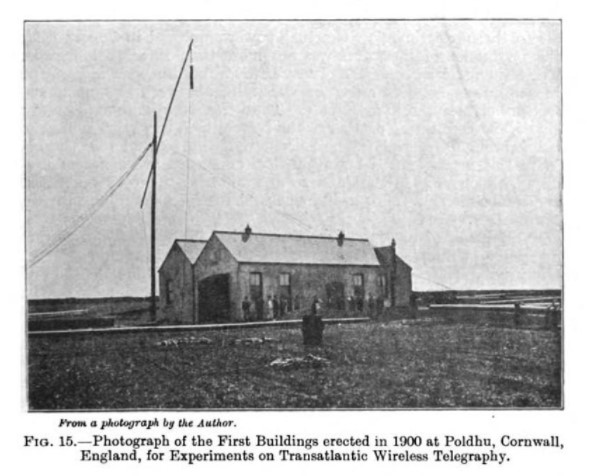
During the next four months much work was done in modifying and perfecting the wave-generating arrangements, and numerous telegraphic tests were conducted during the period by Mr. Marconi between Poldhu in Cornwall, Crookhaven, in the South of Ireland, and also with Niton in the Isle of Wight. A delay occurred owing to a storm on September -18, 1901, which wrecked a number of masts, but sufficient restoration of the aerial was made by the end of November, 1901, to enable him to contemplate making an experiment across the Atlantic. He left England on November 27, 1901, in the steamship ‘Sardinian’ for Newfoundland, having with him two assistants, Messrs. Kemp and Paget, and also a number of balloons and kites. He arrived at St. John's, Newfoundland, about December 5th. (The Wireless Age Magazine)


According to Marconi,

‘In the design and construction of the Poldhu station I was assisted by Sir Ambrose Fleming, Mr. R. N. Vyvyan and Mr. W. S. Entwistle.’

The Irish Leg at Crookhaven


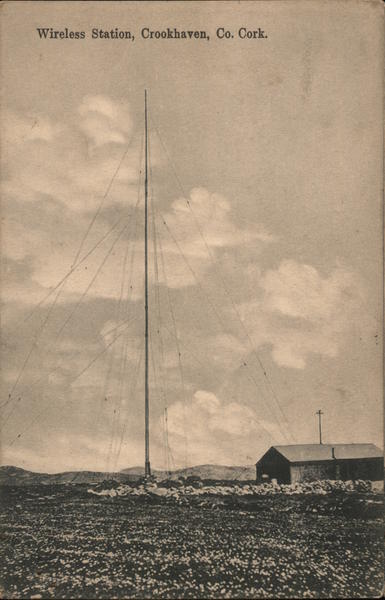
By mid June, Marconi had built his new wireless station at Brow Head near Crookhaven on the South West coast of Ireland. The County Cork headland was Ireland’s most westly promintary. A one hundred and eighty foot mast had been erected and a powerful transmitter installed to increase the range of communications for ship to shore. When Marconi first arrived at the small fishing port hundred turned out to welcome the wireless pioneer. Many of those spectators were women hoping perhaps to catch the eye of the then bachelor Marconi. His first experiment from the station was on June 16th to contact the liner Lucania which was both en-route from New York across the Atlantic and fitted with Marconi wireless equipment. A special train was organised by the local Skibereen and Schull Tramway to bring a ‘record’ number of spectators to Crookhaven to witness this breakthrough in communications. According to the Southern Star newspaper ,

‘This event is no doubt unique in the history of West Cork and we are certain that large numbers will avail of the opportunity of witnessing this epoch making experiment’


Why Crookhaven?

Crookhaven already had been the epicentre of telegraphic news. When the United States based Reuters news agency opened an office in London in 1851, an office in Queenstown (Cobh) followed two years later. Up to that stage in order to get the news scoop, reporters would travel precariously on small currachs out to liners as they reached the Irish coast to get first hands news from America and then make their way into Cork to file their stories. With the arrival of Reuters, desperate to get an advantage over their competitors including Hearst, they built a telegraph station in Crookhaven, building a telegraph line to Cork City which was then linked to Dublin and London giving the American news agency a four hour head start on other agencies who were still using reporters making the dangerous passage to the Liners.  


At the turn on the twentieth century, the ionosphere was yet to be discovered and that radio signals travelling long distances actually went upwards, bounced off the ionosphere and back down to earth. Marconi believed at that time that signals were linear and would use the ocean’s surface to conduct the signals over distances. This had been the premise of Oliver Lodge in his early Wireless Telegraphy experiments in Scotland, firstly crossing the Rover Tay and then ambitiously planning to span the Atlantic, which never got off the ground. Ireland would later be pivotal in the trans-Atlantic connection with the building of Marconi’s powerful Clifden station.


On the opposite side of the Atlantic, Marconi initially built a station at Wellfleet, Massachusetts to communicate across the Atlantic but a storm destroyed the aerial array and a new site had to be quickly chosen. Financial incentives took him north of the border from the United States initially towards Nova Scotia before finally settling at Signal Hill outside St. John’s, Newfoundland. In December 1901 he set sail for St. John's. He was under pressure from shareholders and his growing ego to deliver on his promise that wireless could commercially beat the undersea cable telegraph. He had been heavily subsidized by his financial backers who saw huge profits in the trans-Atlantic messaging. Marconi had with his travelling crew, a small stock of kites and balloons to keep a single wire aloft in stormy weather.


A site was chosen on Signal Hill, and apparatus was set up in an abandoned military hospital. A cable was sent to Poldhu, requesting that the Morse letter " S " be transmitted continuously from 3:00 to 7:00 PM local time.


On 12th December, 1901, under strong wind conditions, a kite was launched with a long wire attached beneath. The wind unfortunately carried it away. A second kite was launched. The kite bobbed and weaved in the sky, making it difficult for Marconi to adjust his new syntonic receiver which employed the new Italian Navy coherer. With hindsight and today’s knowledge it is difficult to understand how Marconi determined the frequency of tuning for his receiver.

‘The result was much more than the mere successful realization of an experiment. It was a discovery which proved that, contrary to the general belief, radio signals could travel over such great distance a those separating Europe from America and it constituted, as Sir Oliver Lodge has stated, an epoch in history’. (Marconi)


Marconi’s claim was,

‘On Monday, December 9th, barely three days after my arrival, I and my assistants began work on Signal Hill. The weather was very bad and very cold. On the Tuesday we flew a kite with 600 feet of antenna wire as a preliminary test, and on the Wednesday, we had inflated one of our small balloons, which made its first ascent during the morning. Owing, however, to the strength of the wind, the balloon soon broke away and disappeared in the mist. I then concluded that perhaps kites would answer better and decided to use them for the crucial test.


I had arranged with my assistants in Cornwall to send a series of "S's" at a prearranged speed during certain hours of the day. I chose the letter "S" because it was easy to transmit, and with the very primitive apparatus used at Poldhu I was afraid that the transmission of other Morse signals, which included dashes, might perhaps cause too much strain on it and break it down. Mr. Entwistle, Mr. George and Mr. Taylor were in charge of the English station at Poldhu during the transmission of signals to Newfoundland.


The following day the signals were reportedly again heard at Signal Hill, though not quite as distinctly. According to the Institute of Electrical and Electronic Engineers[1],

‘Marconi's ambition at the turn of the century to demonstrate long-distance wireless communication, and develop a profitable long-distance wireless telegraph service, led to his pragmatic proposal in 1900 to send a wireless signal across the Atlantic. He conceived a plan to erect two super-stations, one on each side of the Atlantic, for two-way wireless communications, to bridge the two continents together in direct opposition to the cable company (Anglo-American Telegraph Company). For the eastern terminal, he leased land overlooking Poldhu cove in southwestern Cornwall, England. For the western terminal, the sand dunes on the northern end of Cape Cod, MA at South Wellfleet, was chosen.

The aerial array comprised of 20 masts arranged in a circle. The ring of masts supported a conical aerial system of 400 wires, each insulated at the top and connected at the bottom, thus forming an inverted cone. Vyvyan, the Marconi engineer who worked on the 1901 experiment, when shown the plan, did not think the design sound. He was overruled, construction went ahead, and both aerial systems were completed in early 1901. However, before testing could begin catastrophe struck, the Poldhu aerial collapsed in a storm on 17 September, and the South Wellfleet aerial suffered the same fate on 26 November, 1901.


At Poldhu Marconi quickly erected two masts and put up an aerial of 54 wires, spaced 1 metre apart, and suspended from a triadic stay stretched between these masts. The aerial wires were arranged fan shaped and connected together at the lower end.

‘The antenna was driven by the curious two stage spark transmitter, previously discussed. There were many problems in getting it to work at the high power levels desired. Our principal concern here is the frequency generated by the Poldhu station. The oscillation frequency is determined by the natural resonant response of the antenna system, which includes the inductance of the secondary of the antenna transformer T2, since in effect the antenna system is a base-loaded monopole’.

Historians have also speculated that the transmitter might also have radiated a high-frequency signal as well, since an HF signal would have been more suitable for transatlantic communications. If, according to Belrose, Marconi had used a thin wire transmitting antenna at Poldhu, this antenna would indeed have radiated efficiently at odd harmonics of the fundamental resonant frequency. But according to Electrical engineers today that they must conclude therefore that the Cornish based spark-transmitter system radiated efficiently only on the fundamental oscillation frequency of the tuned antenna system, about 850 kHz.

When Poldhu had become operational, it was communicating successfully with stations in France and Europe and more importantly with Marconi’s new wireless station at Crookhaven in County Cork, on the southern coast. Work on building Crookhaven began in the summer of 1901.


According to Marconi, the publicist, he recounted,

‘Another similar station was erected at Cape Cod in Massachusetts. By the end of August, 1901, the erection of the masts was nearly completed when a terrific gale swept the English coasts, with the result that the masts were blown down and the whole construction wrecked. I was naturally extremely disappointed at this unforeseen accident, and for some days had visions of my test having to be postponed for several months or longer, but eventually decided that it might be possible to make a preliminary trial with a simpler aerial attached to a stay stretched between two masts 170 feet high and consisting of sixty almost vertical wires. By the time this aerial was erected another unfortunate accident, also caused by a gale, occurred in America, destroying the antenna system of the Cape Cod station.


I then decided, notwithstanding this further setback, to carry out experiments to Newfoundland with an aerial supported by balloon or kite, as it was clearly impossible at that time of the year, owing to the wintry conditions and the shortness of the time at our disposal, to erect high masts to support the receiving aerial. On the twenty-sixth of November, 1900, I sailed from Liverpool accompanied by my two technical assistants, Mr. G. S. Kemp and Mr. P. W. Paget.


We landed at St. Johns, Newfoundland, on Friday. December the sixth, and before beginning operations I visited the Governor, Sir Cavendish Boyle, and the Prime Minister. Sir Robert Bond, and other members of the Newfoundland government, who promised me their heartiest cooperation in order to facilitate my work. After taking a look round at the various sites, I considered that the best one was to be found on Signal Hill, a lofty eminence overlooking the harbour. On the top of this hill was a small plateau which I thought suitable for flying either balloons or kites. On a crag of this plateau rose the Cabot Memorial Tower and close to it was an old military barracks. It was in a room of this building that I set up my receiving apparatus in preparation for the great experiment.’


The newly constituted Marconi company knew that they were not the only Wireless Telegraph company attempting to span the Atlantic but they certainly wanted to be first and the newspapers were following the build up to the attempt on both sides of the Atlantic. Marconi knew that Professor Fessenden in the United States was making great strides and had the Atlantic in his sights as has Sir Oliver Lodge in the UK although unlike Marconi, Lodge’s plans were engineering based, while Marconi saw the commercial possibilities of being both first and the most successful to transmit across the Atlantic connecting London and New York.


According to Marconi,

‘On the morning of Thursday, the twelfth of December, the critical moment for which I had been working for so long at last arrived, and, in spite of the gale raging, we managed to fly a kite carrying an antenna wire some 400 feet long. I was at last on the point of putting the correctness of my belief to the test! Up to then I had nearly always used a receiving arrangement including a coherer, which recorded automatically signals through a relay and a Morse instrument. I decided in this instance to use also a telephone connected to a self-restoring coherer, the human ear being far more sensitive than the recorder.


Suddenly, at about half-past twelve, a succession of three faint clicks on the telephone, corresponding to the three dots of the letter S, sounded several times in my ear, beyond the possibility of a doubt. I asked my assistant, Mr. Kemp, for corroboration if he had heard anything. He had, in fact, heard the same signals that I had.


I then knew that I had been justified in my anticipations. The electric waves which were being sent out into space from Poldhu had traversed the Atlantic, unimpeded by the curvature of the earth which so many considered to be a fatal obstacle, and they were now audible in my receiver in Newfoundland. I then felt for the first time absolutely certain that the day when I should be able to send messages without wires or cables across the Atlantic and across other oceans and, perhaps, continents, was not far distant. The then enormous distance, for radio, of 1,700 miles had been successfully bridged.’


But had the Atlantic been bridged and if it had, was it from Poldhu or Crookhaven?


At the turn on the twentieth century, the ionosphere was yet to be discovered and that radio signals travelling long distances actually went upwards, bounced off the ionosphere and back down to earth. Marconi believed at that time that signals were linear and would use the ocean’s surface to conduct the signals over distances. This had been the premise of Oliver Lodge in his early Wireless Telegraphy experiments in Scotland, firstly crossing the Rover Tay and then ambitiously planning to span the Atlantic, which never got off the ground. Ireland would later be pivotal in the trans-Atlantic connection with the building of Clifden.


Initially Marconi built a station at Wellfleet, Massachusetts to communicate across the Atlantic but a storm destroyed the aerial array and a new site had to be chosen. A site was chosen on Signal Hill, and apparatus was set up in an abandoned military hospital. A cable was sent to Poldhu, requesting that the Morse letter " S " be transmitted continuously from 3:00 to 7:00 PM local time.


On 12th December, 1901, under strong wind conditions, a kite was launched with a 155 m long wire. The wind carried it away. A second kite was launched with a 152.4 m wire attached. The kite bobbed and weaved in the sky, making it difficult for Marconi to adjust his new syntonic receiver which employed the Italian Navy coherer. "Difficult" I will accept, but how he determined the frequency of tuning for his receiver is a mystery to me. Whatever, because of this difficulty, Marconi decided to use his older untuned receiver. History has assumed that he substituted the metal filings coherer previously used with this receiver for the newly acquired Italian Navy coherer, but Marconi never really said he did. He referred only to the use of three types of coherers.


‘The result was much more than the mere successful realization of an experiment. It was a discovery which proved that, contrary to the general belief, radio signals could travel over such great distance a those separating Europe from America and it constituted, as Sir Oliver Lodge has stated, an epoch in history’

Marconi celebrating his own success.


Then Marconi’s claim was,


‘On Monday, December 9th, barely three days after my arrival, I and my assistants began work on Signal Hill. The weather was very bad and very cold. On the Tuesday we flew a kite with 600 feet of antenna wire as a preliminary test, and on the Wednesday we had inflated one of our small balloons, which made its first ascent during the morning. Owing, however, to the strength of the wind, the balloon soon broke away and disappeared in the mist. I then concluded that perhaps kites would answer better and decided to use them for the crucial test.


I had arranged with my assistants in Cornwall to send a series of "S's" at a prearranged speed during certain hours of the day. I chose the letter "S" because it was easy to transmit, and with the very primitive apparatus used at Poldhu I was afraid that the transmission of other Morse signals, which included dashes, might perhaps cause too much strain on it and break it down. Mr. Entwistle, Mr. George and Mr. Taylor were in charge of the English station at Poldhu during the transmission of signals to Newfoundland. On the following day the signals were again heard, though not quite as distinctly. However, there was no further doubt possible that the experiment had succeeded.’


The experiments were suddenly brought to a halt when the Anglo American Telegraph Company sought a legal restraint claiming that he was interfering with their exclusive contract to telegraph connections across the Atlantic, as they controlled the majority of the undersea cables connecting Newfoundland and Nova Scotia with Ireland and then onto Europe.


Crookhaven

According to the IEEE,

‘Despite the crude equipment employed, and in our view the impossibility of hearing the signal, Marconi and his assistant George Kemp convinced themselves that they could hear on occasion the rhythm of three clicks more or less buried in the static, and clicks they would be if heard at all, because of the low spark rate. Marconi wrote in his laboratory notebook: Sigs at 12:30, 1:10 and 2:20 (local time). This notebook is in the Marconi Company archives and is the only proof today that the signal was received.’

Marconi himself has been evasive concerning the frequency of his Poldhu transmitter. Fleming in a lecture he gave in 1903 said that the wavelength was of 1000 feet or more, say, one-fifth to one-quarter of a mile (820 kHz is the generally quoted frequency). Marconi remained silent on this wavelength, but in 1908 in a lecture to the Royal Institution he quotes the wavelength as 1200 feet. But in 1901, anyone who believed that they could, and did, believed so as an act of faith based on the integrity of one man – Marconi.

‘The antenna was driven by the curious two stage spark transmitter, previously discussed. There were many problems in getting it to work at the high power levels desired. Our principal concern here is the frequency generated by the Poldhu station. The oscillation frequency is determined by the natural resonant response of the antenna system, which includes the inductance of the secondary of the antenna transformer, since in effect the antenna system is a base-loaded monopole’.


CONCLUSION

The first trans-Atlantic wireless telegraph message was received at Signal Hill from Crookhaven, Cork in Ireland. Not Poldhu. Despite skepticism by many historians and electrical engineers, I believe that Marconi did manage to span the Atlantic with a message through the ether using wireless telegraphy but perhaps this success was accidental, not realising his signals were being deflected by the ionosphere. But I do not subscribe to the ‘fact’ that the signal across the Atlantic emitted from Poldhu in Cornwall and arrived on the opposite side of the Atlantic at St. John’s. In fact the truth is that Poldhu tapped out the letter ‘s’ as Marconi requested but rather than reaching Newfoundland it was picked up in Crookhaven (perhaps as planned) and retransmitted from Crookhaven to Signal Hill, St. John’s. Therefore the first transatlantic message was not Poldhu to St. John’s but Crookhaven to St. Johns, Ireland to Canada rather than England to Canada. Whether this was the actual plan, is not lost in the fog of time but if it was Marconi’s belief that the oceans would conduct his signal, then the inference is that he would transmit between the two closest points, Crookhaven and St. John’s. It was also winter and the seas were unpredictable and rough, which would be another excellent argument for broadcasting between the two closets points in his network of wireless stations.


The origin of the transmission being designated as coming from Poldhu would have been important for investors and attracting others. It would demonstrate that the invested cash was being put to good work. For it to be commercially successful, a service from the UK mainland to the United States would be far more valuable than Ireland to the United States. If the transmission success was from Poldhu it would rule out the middle man, Ireland, and speed up the time of message transmission from London to New York. This would be valuable in tackling the success of the undersea cable telegraph companies.


In Orrin Dunlap’s book, ‘Marconi, The Man and his Wireless’, which celebrated the work of the Irish-Italian inventor and entrepreneur, he referred to and quoted fellow wireless telegraphy pioneer Sir Oliver Lodge. Lodge, a competitor of Marconi, wrote in his own book ‘Talks About Wireless’ published in 1925, recounting the event of the first trans-Atlantic communication, that,

‘When Signor Marconi succeeded in sending the letter ‘S’ by morse signals from Cornwall to Ireland to Newfoundland, it constituted an epoch in human history, on its physical side and was an astonishing and remarkable feat’


The first public two-way wireless telegraph communication happened on January 19th, 1903 when a message from US President Theodore Roosevelt at the White House was transmitted  via Morse code and sent to King Edward VII at Buckingham Palace in England, who in turn responded to Roosevelt.

That day, US newspaper 'The Evening World', published that “Word is Flashed from Roosevelt to King Edward” as it reported that Guglielmo Marconi and his team successfully sent the first transatlantic radio transmission from the US. Marconi and his assistants, Kemp, Taylor, Sargent, and Bradfield, were reportedly surprised that the message was received and deciphered on the first attempt. Trans-Atlantic was a reality and here to stay.


[1] ‘Fessenden and Marconi: Their Differing Technologies and Transatlantic Experiments During the First Decade of this Century’ by John S. Belrose lecture for the International Conference on 100 Years of Radio -- 5-7 September 1995


Sources

https://worldradiohistory.com/

The Irish Newspaper Archives

The British Newspaper Archives

The US Library of Congress

Marconi & Ireland , Sexton UCC

Orrin Dunlap 'Marconi & His Wireless'

The Marconi Archives

Cambridge University Libraries

Oliver Lodge 'Talks About Wireless'

The Irish Pirate Radio Archive

The Wireless Age magazines. 

Saturday, 23 May 2020

‘The Modern Swash Buckling Pirate Phenomenon’


On any given Sunday on the Dublin airwaves in 2020, the listener is treated to a melange of radio stations delivering a wide variety of speech and music entertainment. However, the Dublin airwaves are a uniquely Irish solution to an Irish problem. Radio in Ireland is the most consumed form of media with over 80% of the Irish adult population listening to the medium, whether it’s in the home, exercising or stuck in the car in a rush hour traffic jam. Because of its unique ability to connect with its audience, the listenership figures have stayed constant for the past quarter of a century and as a result, advertisers have flocked to the national, independent commercial and local radio stations across Ireland.

The Broadcasting Authority of Ireland issues licences for the independent sector, advertising different genres to accommodate all tastes. This radio industry we have today, was born in the 1970’s and 80’s when the state broadcaster RTE, had its monopoly position challenged by a plethora of pirate radio stations, stealing frequencies, listeners, and advertisers from RTE. In 1988 new stringent legislation plugged loopholes in the law and allowed for the orderly opening of legal licensed alternatives both nationally and locally. The BAI, and its predecessors the IRTC and BCI have struggled to blend listener requirements with commercial demands. Since deregulation in 1988, the market has solidified with some major media moguls commanding ownership of vast swathes of the airwaves.

In the eighties the success of the pirates was driven by market forces as a youthful market demanded to hear the music that they wanted, a direct alternative to RTE, who’s darkened halls attempted to accommodate everyone  on a national level when listeners actually wanted a local voice and perspective. RTE had failed the younger listener and even with their attempt to placate that constituency with the launch of the ‘pirate light’ RTE Radio 2, the uplifting super pirates like Radio Nova, Sunshine & ERI dominated their markets. In the quest for the local listener, once again RTE lost out to community stations like BLB and Kilkenny Community Radio and local stations like Mid-West and West National Radio 3 rapidly eroded any credibility RTE had with its listener.

Licensing has regulated the airwaves is the Government response, but even a cursory glance along the waveband on a Sunday tells a different tale. When the pirates were at the height of their success, every genre of music was catered for by individual stations, pop on Nova, rock on Phantom, C&W on TTTR, religion on ICBS or album tracks on Capitol. Today’s youth population listens to their music, dance, garage, trance, and rap but these music trends do not sell advertising and therefore find every little light on the current station playlists. That demographic is younger, usually under eighteen and therefore unimportant to current stations and their advertisers. Once again in step the pirates and as enforcement retreats like the tide, the pirates are empowered to start up their transmitters once again and fill up the Dublin FM frequencies. Not only has a need been created for these stations but technology has made it easier to get on air. Gone are the days of medium wave transmitters, home built, strewn over an attic floor with an aerial strung between the attic and a tree or telegraph post. FM transmitters are cheap and highly effective. They do not cause the interference that their Medium wave forbearers did, and computerisation has removed the need for bulky turntables and mixing desks. Because of their appeal to an under eighteen audience, these stations utilise social media avenues far better than their legal counterparts.

In Dublin on FM on a Sunday there are a number of national and quasi national stations like RTE, Radio na Gaeltachta, Newstalk and Spirit Radio, there are community stations including Dublin City FM, Near FM and Phoenix Radio and there are five legal local franchises 98FM, Radio Nova, Sunshine 106, Spin 1038 and FM 104 all competing for the listeners ear and you would say to yourself that surely that is a comprehensive choice but yet despite five Dublin licensed stations, on Sunday April 19th 2020 there were thirteen pirates radio stations on FM, one on Medium Wave, Energy 1395 and four on short wave broadcasting to the world. The majority of these pirate stations were broadcasting some form of dance music but other genres were being catered for that licensed stations seemed to have covered but yet pirate station were on the airwaves covering similar including The 90s Network and Easy FM.

Some legal stations are now voice tracked removing that personal touch with the listeners. This is simply a cost saving exercise for the media conglomerates that own them. This would be obvious if they used in studio cameras like watching RTE’s Today programme with the now retired Sean O’Rourke. A camera could show the DJ actually choosing and enjoying the music he is playing. The pirate DJ is not hampered by the playlist or the format. The reasonable pirate example of this is Phever FM.

The inertia caused by the lack of enforcement has given pirate radio a new lease of life with a number of them including Club, Pure and Pirate FM carrying a significant amount of advertising, not just relying on advertising club nights to generate revenue. Despite the coronavirus lockdown, the closure of venues and therefore the closure of those station revenue streams, the FM band is alive with pirate radio. These stations are catering for audiences ignored by mainstream stations who have once seen themselves as cutting edge, but the commercial reality has diluted their position. None of these pirates broadcast salacious, threatening or terrorist content and are simply on-air to entertain their constituency, they give airtime to new and struggling dance and rap artists and without causing interference they do little harm. They are however illegal and subject to a minimum of €10,000 fine either for broadcasting, advertising or providing transmission land and if Comreg continue to not implement the law and the BAI fail miserably to cater for the people who are actually listening to the radio, not the listeners that stations wishes to portray to advertisers, then pirate radio will continue to blossom. Is it too early to claim ‘long live the pirates’?

Friday, 1 May 2020

Radio Survives and Thrives in a Pandemic


One of the earliest forms of mass entertainment was the invention of the cinema which is traced back to the late 1800's with the advances of Edison and the Lumiere brothers. Cinema has evolved over the decades in cinemas and studios, through the decades. The list includes, the silent era, the use of sound, cinemascope, 3D, animation, the different genres from slapslick to sci-fi and the evolutionary advances in CGI has changed how we consume the movies. Each development being heralded as a 'game changer'. Each new theme is an attempt to keep the audience captive, evolving as the audience evolves and matures. Each development becomes an attempt to suspend our belief in reality or to create a new reality. The cinema, like other mediums. lures us in and then through mystery, comedy, horror or action alters our perception of the world. Cinema has changed with the times, reflected the times we live in and changed how we consume the medium with the arrival of talkies, the blockbuster or propaganda films.

Cinema's cousin is television and from the time of Baird in the 1920's, television too has changed in both delivery and consumption. The early television was mechanical, then electrical became the norm and the medium evolved from 405 lines to 625 lines to HD, black and white became colour, sets originally were bulky are now flat screen and slimline, cable television, satellite TV and digital. What we consume has expanded, as has delivery systems from single channel, to multi channel, video recorders, on demand, subscription TV and online.

The internet in the past two decades has developed at a tremendous speed and its entertainment provision has expanded, sometimes unchecked. From YouTube to Tik Tok, from online gaming to social media and from porn to online movies and sports, the internet continues to evolve and to entertain. The method of consumption has also changed exponentially. Originally a hard drive and a monitor were the delivery system, today it is on lap tops, tablets and mobile phones.

One entertainment that has changed the least is the delivery of audio entertainment via the radio. The radio had been with us since the 1920's and while the method of delivery whether it is via AM/FM/SW/LW, digital or online apps the content has changed little, speech and music with no special effects or gimmicks ( not withstanding the brief relationship with AM stereo). The wireless box in the corner of the living room has morphed into a portable transistor radio, the car radio, through your mobile phone and online, often changing the definition of radio.

The radio station, like the movie studio or the television channel may have different outlooks and editorial bias, they may be state run, independent and commercial, local and community,  pirate or institutional outlets but their content changes little. That editorial direction, like a movie or TV show are often tailored for their particular audience but at the end of the broadcast it is speech delivery or music. If you tune up and down the radio bands or listen to online audio content including podcasts, speech and/or music is what you will here and unlike a cinema where having paid in and you don't like the film and rarely walk out, on radio you can easily change what you listen to.

With reflection on current events (the Covid19 pandemic 2020), the cinemas are closed and fake news confuses the consumer online and in social media, yet radio has found a new lease of life as it continues to deliver speech in the form of information and news and allows quiet reflection with music of every genre. Radio has surprised and surpassed expectations in these troubled times and we as a race of people should be thankful for the fact that radio is there, the constant companion whether you are in the kitchen, the bedroom, the car or exercising and we should show our appreciation to those who have stayed on the air whether it is from the quieter studios or home studios, they have been essential.

Friday, 24 January 2020

The Economics of Pirate Radio


THE ECONOMICS OF PIRATE RADIO


Illegal unlicensed pirate radio has been part of the airwaves from the first days of regulation. ‘Radio pirates’ initially were those who refused or failed to pay for a license to listen to radio while in later years it has referred to those who have broadcast without a licence. Pirate radio especially in the western world has been a commercial success and has created a radio industry once the preserve of state monopolies. In 2010, the British regulator OFCOM[1] claimed that some UK land based pirate radio stations were making £5,000 per week from advertising. In 1965 and 1966 before the Marine Offences Act was passed by the British parliament in 1967, Radio Caroline broadcasting from International waters off the East coast of
Britain was generating £800,000 to £900,000 per year translating into today’s terms as £14 - £15 million pounds per annum in revenue streams. The cash for Caroline was garnered from spot advertising at £160 per spot[2] having begun in 1964 charging £90 per 30 second spot, pay to play deals with record companies known as ‘Payola’ a
practice banned in many territories including the United States where one DJ, Phil Lind claimed at a Congressional hearing that he had been paid $22,000 to play one record and from US based evangelical preachers who purchased late night airtime at £150 per show transmitted. According to author Mike Barron Radio Caroline was an instant success,
‘One of London’s biggest advertising agencies was said to be planning to advertise with the pirate ships through its Dutch and French companies. On the advertising front it was Caroline which hit the jackpot. On May 11th 1964
£30,000 worth of advertising poured in.’
The pirates claimed according to Horace Robertson[3] that by broadcasting records from little known artists or recording companies they played a substantial part in breaking the record monopoly in Great Britain where in the early 1960s ninety eight percent of all records sold bore the label of only four manufacturers. According to one claim with the help of the pirates small record companies were able to get twenty present of the market in three years.
In Ireland pirate radio especially throughout the 1980s created a fledgling radio industry that thrives today as the independent commercial radio sector. The so called super pirates of the 80s including Sunshine Radio, Radio Nova, WLS and ERI earned millions of Euro in revenue through advertising but were heavily criticised as many ignored the need to pay taxes or royalties. With Government inaction the pirate stations began to expand their boundaries broadcasting for longer, with better equipment and most importantly eating into advertising revenue. Initially this was not a major problem for the State broadcaster as the adverts aired were for the local butcher or corner shop who would never be able to afford or consider on RTE radio but with the arrival of high powered professional stations with massive ratings, corporate advertisers seeking for value for money began to drift away from RTE and create large profits for many of the pirate radio stations who despite the illegal status paid their taxes.
Illegal broadcasting has many monikers and therefore many versions of financial structures. Some titles attached to this broadcasting include pirate radio, free radio, clandestine radio and bootleg radio they are however all illegal and their operators subject to the rigours of laws that differ in severity and enforcement in various jurisdictions. At a radio conference in Luxembourg in 2018[4], Jose Perez who had been involved in illegal broadcasting in Madrid felt that ‘pirate radio’ referred to commercial illegal broadcasting, ‘free radio’ was exactly that, commercial free and the station subsidised by a co-operative with DJ’s paying subscriptions to get on air while ‘clandestine radio’ is primarily seen as politically motivated.    
Illegal radio differs across the globe often dependent on the attitudes of the authorities towards the piracy of frequencies. In the United States, pirate stations are often described as amateurish, fun and quirky as the FCC pursues the broadcasters in a cat and mouse game. Stations move frequency and location regularly in an attempt to stay ahead of raids. Some stations have become part of a sub culture including Orphan Radio in Seattle. Orphan was launched by musicians Sage Redman and Joe Gillick with its first broadcast in June 2017 as a promotion tool for Orphan Records that the couple had began in 2015 but struggled to get airplay on local radio.5  

In 2018 the FCC carried out four raids across the United States with levied fines totalling $161,844. From 1998 until 2017 the FCC[5] made 2,187 visits and 148 raids on pirate stations across the country. There were Notices of Apparent Liability fines and illegal broadcasting fines totalling $ 4,701,558 (an average $425). Many of these fines remained uncollected despite the authorities in attempt to collect and court challenges. One of the largest fines levied was against a pirate television station that totalled $144,344. As of the summer of 2018, the US congress is debating a new law the ‘Preventing Illegal Radio Abuse Through Enforcement Act or the Pirate Act which would fine the pirate operator $100,000 per day broadcasting illegally and up to $2 million for each incident of conviction of pirate broadcasting.
 
In the UK the first wave of pirate radio in the 1960s was primarily based off shore with stations like Radio Caroline and the very financially successful Radio London broadcasting from ships in the North Sea with other stations based on World War Two defensive towers in the Thames Estuary. Many of today’s pirate stations especially in major cities like London and Birmingham are known as ‘tower pirate radio’ as operators base themselves on the roofs of many of the tower blocks. These pirate broadcasters air music by artistes that could not and often would not get airplay on mainstream stations whether they are BBC or ILR. OFCOM claimed not only that some of these stations were making £5,000 per week but that they were being used by criminal gangs to distribute drugs through coded message given out on air. Conservative politician James Brokenshire claimed in a House of Commons[6] debate that these so called ‘tower stations’ displayed ‘a wanton disregard for the health and safety of others’. This was based on stories that some of these stations were siphoning off electrical supplies from electric door locks and elevator power units.
Kiss FM was launched in London in October 1985 broadcasting on 94FM. Those behind the station were Gordon ‘Mac’ McNamee, Tosca, Pyers Easton and George Power. After just three days on air the station was raided by the DTI but came back on air a couple of days later. Another more aggressive raid on December 11th with McNamee claiming that the raid ‘had caused significant financial problems’. D.J.s who made a name for themselves and went onto successful careers in national radio included Tim Westwood and Trevor Nelson. Kiss claimed at one time that they had half a million listeners and in 1987 even though a pirate station they came second in an Evening Standard newspaper poll as most popular station in London second to the legitimate Capital FM. McNamee knew the power of the revenue that Kiss was creating and he set up a front company for Kiss business dealings and created another revenue stream by starting hugely popular club nights which were heavily publicised on the station capitalising on its growing listenership base.[7]
In 1988 Kiss FM the pirate closed and applied for one of the new licences in London which they won at the second attempt with the now legal Kiss launching on September 1st 1990. By 2010 Kiss was reporting £9.7m in turnover translating to a £3m profit.[8]
In 1983, Skyline Radio in South London was raided twice within 48 hours. The first raid netted the authorities £7,500 in pirate equipment and the second raid a further £13,000 was taken. The DTI complained that while fines were being issued by the courts, the fines were not been paid and the cost of collection made it financially difficult.
In October 1984 Horizon Radio broadcasting from Bellenden Road, Peckham London was raided by the DTI (Department of Trade and Industry) enforcement officers and £20,000 worth of pirate equipment was confiscated. The station owner Chris Stewart was found guilty and fined £1,000 but because the transmitter went ‘missing’ between the studio and the DTI van the prosecution were unable to prove illegal broadcasting.
OFCOM identified two strands of revenue advertising dance and rave events and DJs paying 20 per hour to be on air to get exposure.
In 2014[9] Haringey Council in London reported that there 19 pirate radio stations broadcasting in the borough. A new policy was implemented that year with proactive patrolling of tower blocks to prevent pirate stations locating both their transmitters and antenna on the high towers. Within a year the Council reported that almost all pirate radio broadcasting has ceased saving the Council £90,000 in enforcement and loss of fines. They believed that should there methods be employed across the city of London where nearly 150 pirates operated that the city could save £1 million per year.
London pirate radio has been a breathing ground for award winning music artistes like Ms Dynamite, Dizzy Rascal and Normal Jay. Ms Dynamite acknowledged her success being grounded in pirate radio as a seventeen year old. She warned in her Brit Award acceptance speech that the music industry could not rely on TV talent shows to produces stars and that a purge of pirate radio would threaten music genre such as rap, garage and house music. Jazzie B a former pirate radio broadcaster and a member of the music collective Soul II Soul said that the pirate stations (especially in London) were ‘the windows for home grown talent’[10]. There was a growing music industry around artists who only received airplay from pirate radio station.
In September 1978[11], the Irish Independent published an article under the headline
‘£1m Pirate Radio Threat to RTE Advertising’ in which RTE Assistant Controller of Radio Programming Kieran Sheedy claimed that the new wave of pirate radio stations across the country including Big D, ARD and Independent Radio Galway were a major threat to the finances of the state broadcaster. Three years later it was being reported that the figure estimated to be lost to the state broadcasters had more than doubled as the more professional super pirates took to the airwaves. On October 28, 1980 Aer Lingus a leading semi-state company, Aer Lingus, said that a statement concerning its association with a Sunshine Radio promotion that "The tie-in with Radio Sunshine involved no cash transaction." However, after Sunshine boss Robbie Robinson said he had photocopies of the Aer Lingus cheque, "which I am going to frame”, an Aer Lingus spokesman said that contrary to what had been stated previously the airline had in fact paid some money to the illegal station.
In June 1981, Taoiseach Charles Haughey called a general election. In the run up to the election political parties and independent candidates used the pirate stations like ARD and Big D to get their message across especially to the young voters who they knew listened in large numbers to these stations. The main reason for use of the pirates was that R.T.E. were unable to carry actual advertising apart from party political broadcasts which were strictly monitored and time restricted. The pirates, with no such restrictions added heavily to their bank balances for the airtime given to the political parties. The parties that on one hand promised to close the illegal operators were on the other embracing their medium to get their message across to the ever growing numbers of listeners. The leaders realised even if they did not want to admit it that the majority of the youth of the nation were now listening to the pirates all over the country. Some of the politicians who appeared on the airwaves included Mary Harney (then a Fianna Fail candidate), Michael Woods, the Minister for Health and Social Welfare and Richard Burke of Fine Gael who was interviewed on Big D. Mary Harney, who became the Tánaiste in the Fianna Fail/Progressive Democrats Coalition Government, went further than radio and appeared on the pirate television channel, Channel D who following their interview with Ms. Harney asked viewers to vote for Ms. Harney because of her support for independent television.
In 1982 a report pointed to the major pirate radio stations charging advertisers’ ir£20 – 25 per thirty second spot, RTE Radio 2 was charging ir£ 72 for the same slot and the main national station RTE Radio 1 charging 250.00 for the same advert.
As pirate radio proliferated across Ireland, the stations rarely registered themselves to pay tax, to pay wages within a statutory framework, to pay royalties but occasionally
State bodies intervened. In 1980 the Limerick based station Big L run by Mike Richardson and Hayman Harris found itself on the receiving end of a tax bill of ir£17,000. The state tax collection agency said that
‘They maybe illegal but they are a business and so they must pay tax. The amount is an estimated assessment in the absence of tax returns.’

In Ireland within two years of Radio Nova beginning broadcasting illegally in 1981[12], the station has a 40% listenership rating as compared to the legal state broadcasters pop music station RTE Radio 2 having only a 20% rating. Nova was opened by Chris Cary, a former DJ on Radio Caroline in the North Sea and he used a myriad of companies to run the station and to maximise profits. The station was so successful in its five years on air that advertising agencies and corporate Ireland were heavily using the station. The stations across Ireland, some more professionally ran than other all had high quality rate cards being produced. The station was described by David
McKenna in the Sunday Tribune newspaper as
‘a soundscape designed to produce advertising revenue. Its main aim is to make sure that listeners don’t change wavelength. Such changes would affect the figures on which Nova’s advertising rates are based. As far as possible the listener must forget that he or she is involved in a conscious activity.’
Nova’s transmitters were located in a portacabin on the grounds of the Green Acres Country Club whose owner Eugene Brady bought 26% of Radio Nova. Chris Cary estimated that the initial investment in the station was £150,000 of which he produced the other 76% with Eugene Brady. When Radio Nova was launched, Cary tried for five months to incorporate his company. The Register at the Companies Office refused to agree until November 1981 when Nova was registered under the Companies Act 1963. The company formed to oversee the running of Radio Nova was titled 'Nova Media Services Limited' and the memorandum and articles of association were drawn up by the solicitor firm of Cawley, Sheerin and Wynne.
Cary used his profits from his computer business Compshop to launch Nova while Brady in return for his 26% gave Nova the site for the transmitters and was provided free advertising for his club on Radio Nova. The property company for The Compshop was Uniminster Limited who leased 19 Herbert Street originally to the Compshop and then sub leased it to Radio Nova. With the space leased, the equipment for the station was leased from a company called Stratford Leasing. This company located in England was also owned by Chris Cary. When Radio Nova finally closed its doors in March 1986, Nova Media Services Limited's total assets was reported as a couple of chairs and eighty thousand car stickers.
In a Sunday Independent obituary piece of Chris Cary by Liam Collins in 2008, he noted that Cary claimed that his Radio Nova in its five years on air had generated €20 million in advertising revenue. At a press conference to launch the Irish Pirate Radio Archive former Nova DJ Declan Meehan said the Cary once claimed he was paying his DJ’s more than the then biggest star on BBC Radio 1, Steve Wright who presented the popular afternoon show on the British station. He also revealed that at one point a large travel agency was sponsoring a holiday giveaway on his Breakfast show when he was approached by a rival travel agency who wanted to wrestle the promotion away from their competitor and offered a larger prize plus the bonus of a free holiday for the presenter and a friend[13].
In order to boost their listening figures and therefore their advertising revenue, Nova and her sister station Kiss FM which had been set up to cope with the massive influx of advertisers, started a number of cash giveaways, for format of which were copied by various other stations over the years. In March 1983, Kiss FM announced that they would play three records in a pre-arranged order and that the fifteenth caller to the station to say 'You Did It' would win £5000.00. The winner on that occasion was Jane Biddulph from Churchtown. In September 1983, Radio Nova carried out a similar promotion, this time giving away £6,000. The records chosen in order were (i) Wanna Be Starting Something' by Micheal Jackson, (ii) 'Baby Jane' by Rod Stewart and (iii) 'Lets Dance' by David Bowie. Again the fifteenth caller when the records were played won the money but it was not always smooth sailing for Nova's promotions. Another promotion on Radio Nova ran into trouble when the phone lines jammed when the three records were played but when repair crews arrived at Stocking Lane to repair the problem they refused to pass the N.U.J. pickets. The next promotion that they ran was a written competition when they placed a cartoon in a number of daily newspapers and requested listeners to write in the funniest caption but the promotion did not have the same appeal or drama of the phone in competition.
On the charity front in 1982, 1983 and 1984, Radio Nova carried out projects called
'Operation Novacare' which in 1983 raised £14,000 for the National Rehabilitation Institute. Other revenue streams included The Nova Roadshow, a travelling disco, was based mainly at Nova Park but in the early days of the station it was based in Maxim's Nightclub on Claire Street. On a number of occasions the Nova Roadshow went to the Isle of Man where the station had a sizeable listenership. The Nova Boutique was launched from the ground floor of 144 Leeson Street. The shop sold Nova T-Shirts, pens, car stickers etc. and they also had a five pound membership club which entitled you to a sticker, a membership card and reductions to entry at Nova Park.
In 1988 just before the introduction of the new Wireless Telegraphy Act, the Law
Society in a hard hitting editorial in their magazine The Gazette criticised the Revenue Commissioners for allowing businesses to claim business expenses in their annual tax returns for advertising with illegal pirate radio stations.
There are many costs attached to operating a pirate radio (or indeed television) station.
In its final year on the air Robbie Robsinson successfully ran a number of listener competitions giving away prizes worth €20,000 in one while €50,000 was handed out in another. Like so many Irish pirate radio stations across Ireland, Sunshine closed at the end of December in accordance with the new legislation but it also unsuccessfully applied for one of the new Dublin independent commercial licences. While Robinson expended considerable finances with a High Court challenge to the awarding of the licence he did make one final profit from his pirate radio station[14] when the station’s transmitters and aerial were sold to the company that won the national radio franchise licence, Century Radio.
The activities of political pirate radio stations can also have economic repercussions. Government oppositions have often resorted to using pirate radio stations to spread their propaganda leading to national financial instability and using the illegal airwaves to encourage civil disobedience. In Northern Ireland in the late sixties and early seventies as the so called sectarian troubles intensified across Northern Ireland both side Protestant/Loyalist and Catholic/Nationalists were using pirate radio stations in their enclaves and ‘no go’ areas to encourage their listeners to stifle the economies of their opponents by issuing calls onto the streets to man barricades, to boycott shops and businesses and the generally upset daily life such as hijacking and setting fire to buses to a steep financial loss for companies across Northern Ireland.
In the era of commercial pirate radio in Northern Ireland Kiss FM opened March 13th
1985 with the station opening covered by Ulster Television. Originally broadcasting on 96.5mhz, Kiss moved to 103mhz FM announcing 102.7 and using jingles from the Chris Cary station of the same name in Dublin. The station announced that it had taken an investment of £6,000 to launch the station as a seven day a week operation but this was offset with the £4,000 in advertising revenue that the station had taken for its first week of transmissions. This boost did not sit well with the British Department of Trade and Industry and at 1.50p.m. March 21st 1985 the station was raided and closed. Pirate radio was big commercial business.

Pirate Radio Cost Analysis

Expenditure

1.               There are initial costs involved in setting up a pirate radio station. The transmitter is one of the main ingredients and the cost can vary from station to station depending on the operators plan for their station. Some stations in the 70s and 80s built homemade transmitters but even these
required the purchase of parts. Some transmitters were purchased on the black market from legal operators while other was purchased at considerable expense such as the super pirates in Ireland spending as much as € 10,000 on a good quality FM Stereo transmitter. Studio equipment is needed and while most operators purchased their own equipment others stole them from other pirate operators. An aerial is also required with proper earthing. Some stations need a location therefore studio and transmitter sites need to be rented. Other stations are located in an operator’s bedroom, the transmitter is homemade and the aerial is strung between trees and expenditure is limited but could make as much as a super pirate in advertising revenue.
2.               A transmitter and the studio needs power and while some pirates hijack some one else’s supply many have electricity bills to be paid. Some stations purchased and ran external generators to keep their pirate on the air.
3.               Some of the bigger stations paid staff and even Payroll taxes for their staff. Radio Nova in Dublin even recognised unions like the NUJ within their station even though Nova’s troubles with the unions helped to lead eventually to its demise in 1986.
4.               As with any business generating cash, the business whether covered by a registered company or not is required to pay taxes. The bigger stations often set up limited companies to limited loses or to launder cash. The setting up of a company in itself cost money. Legal radio stations are required to pay performing rights such as IMRO and PPI. In the UK stations avoided this requirement by playing artistes who had not been signed by a major label.
5.               Another cost that stations often to factor in is the cost of a raid for their illegal activities. There is a fine, court costs and the cost of replacing confiscated equipment.
6.               Publicity for the station cost money whether it was invested in stickers, mugs or pens. Stations today use social media to promote their station on twitter or instagram. In the 1940’s one Irish station promoted itself by having supporters cross the city using chalk to write the station information on the pavement, which worked well until either the police
with a bucket of water or a heavy shower washed away their promotion. 

And while there are costs involved in opening and running a pirate there are many rewards for shrew operators.

Income

1.     Advertising is key and the more powerful the stations signal and quality of that signal will lead to a wider audience. There have been many instances reported when Sales executives for the stations have disappeared with advertising revenue or stolen advertisers when a rival operation goes on air. While many mainstream stations use advertising agencies to source advertisers, pirate radio stations go into the local community and seek advertising from neighbourhood businesses, the local butcher, pub or taxi company. The authorities in many countries including Ireland and Britain have made it offence to advertise on pirate radio stations but very few have been prosecuted for doing so.
2.     At some stations DJ’s paid in contributions to get on the air. This practice was known as ‘pay to play’.
3.     While completely illegal the system of ‘payola’ is popular with pirate radio stations, this is where a record company pay a popular station or DJ to heavily promote and rotate a record.
4.     Many of the UK and Irish pirate radio stations of the 21st century play dance, rave and garage music not played by mainstream stations and operators use their stations to promote raves and dance nights at nightclubs generating another revenue stream.
5.     In the United States evangelical preachers pay radio stations to pay their shows. Similar revenue generation was carried out by pirate stations Radio Caroline and Radio Dublin.
6.     Some pirate stations have eventually earned legal status (Mid West Radio, Ireland, Radio Caroline, UK, leading to even greater profits from advertising revenues. 
7.     For many DJ’s pirate radio has been a cheap effective way of both learning the art of radio and gaining experience leading them into full time media careers across both radio and television. This pirate radio training has also benefitted legal stations as their new staff have already a good grasp of their profession. In Ireland in the 1980s when legal radio replaced the pirates, many shows were presenter driven and when the pirate DJs moved onto the legal airwaves they brought a ready made audience with them.  


[1] ‘Illegal Broadcasting – www.ofcom.org.uk
[2] ‘How a Radio Ship and 7 Men Shook Up Britain in 1964 (2014)
[3] The Suppression of Pirate Radio (1982) by Horace Robertson
[4] University of Luxemburg Summer School on Transnational Radio 5 www.seattlemet.com
[5] United States Federal Communications Commission Report
[6] Hansard – British Parliament Papers
[7] Interview with Gordon McNamee with www.smarta.com
[8] ‘Kiss FM From Radical Radio to Big Business’ by Grant Goddard
[9] YouTube
[10] Independent Newspaper UK February 22nd 2003
[11] Irish Newspaper Archives, the Irish Independent September 4th 1978
[12] The Irish Broadcasting Hall of Fame Blog
[13] Wireless on Flirt FM
[14] Radio Today interview with ‘Radio Maverick Robbie Robinson