Support Irish Radio History Archiving

Irish Pirate Radio Recordings

Showing posts with label Wireless Telegraphy. Show all posts

Monday, 28 September 2026

Wireless, War and Intelligence during the Irish War of Independence


Wireless, War and Intelligence during the Irish War of Independence

© The Irish Broadcasting Hall of Fame

Imagine a battlefield where the most valuable weapon is invisible. No rifle shot, no explosion, no military column—just a faint signal travelling silently through the air. In Ireland between 1919 and 1921, that invisible weapon was wireless. As the British authorities struggled to maintain communications across a country where telephone and telegraph lines were routinely cut, Sinn Féin and the Volunteers began to recognise that whoever could listen, intercept, disrupt or exploit the new technology might gain a crucial advantage. Wireless was still in its infancy, yet in the middle of Ireland's guerrilla war it had already become something more than a means of communication: it was becoming a weapon in the battle for information.


On June 15th, 1920, Dame Nellie Melba sang into a microphone at Chelmsford. This was radio broadcasting as we know it today: entertainment transmitted by wireless. Across the Irish Sea, however, wireless was being used for a completely different purpose: war. During the Irish War of Independence, wireless technology became part of an evolving struggle over communication, intelligence and military control. While neither side was able to exploit its full potential, the technology increasingly influenced how the British authorities attempted to communicate with their forces and how Sinn Féin and the Volunteers sought to intercept, disrupt and exploit those communications.


In 1916, the Easter rebels used their ingenuity, knowledge and tactical awareness to repair a closed wireless school, and Ireland became the first nation in the world to be declared by wireless. The rebels circumvented the strict Defence of the Realm Act (DORA), which attempted to censor and control the airwaves during the midst of the First World War. The war ended on November 11th, 1918, but within two months the first shots of the Irish War of Independence were fired. The British authorities, with the military taking the lead, attempted to maintain strict control over the new communication medium. While wireless would not have a significant impact on the guerrilla-style war, it did exercise military planners on both sides.


On February 1st, 1919, the police raided a Sinn Féin hall on Clonliffe Road, and twelve of the forty men present found themselves before the courts. The Freeman’s Journal reported that, when questioned, Inspector O’Flaherty stated:

‘The Inspector said they found an old bayonet and some singlesticks. A small wooden model, apparently of wireless apparatus, was also produced, and Mr O'Flaherty said it was a model from which a lot could be learned.’

Throughout the war, both sides would experiment with the use of wireless, and both would encounter problems that limited its effectiveness. In February 1919, British newspapers reported on ‘Sinn Fein Wireless’, their communications system. The Empire News reported:

‘I hear a curious tale of the Sinn Fein method of disseminating instructions and news. The system was traced to the so called ‘creameries. Whence information and messages were carried and disseminated by every market cart.’

As the war intensified throughout 1919, the Volunteers attempted to curtail the British military and police's ability to call out reinforcements or direct raids by cutting telephone and telegraph lines. The intelligence services of Sinn Féin included sympathisers in local post offices, in telephone exchanges and in the communications department of Dublin Castle. Michael Collins always believed that safest and most effective way of communication through a highly sophisticated network of human couriers and physical written despatches rather than radio transmissions. But nevertheless, wireless was a weapon of war that either needed to be harnessed or disrupted.

Towards the end of 1919, the British were relying increasingly on wireless communications. This method linked rural RIC barracks with major troop concentrations. Even the fledgling RAF was using one-way communications from surveillance aircraft to the ground. The aircraft were not capable of two-way communication. One of the problems that the Volunteers would have encountered was coded messages. This had been developed on the battlefields of the First World War, with the British attempting to prevent the Germans from understanding intercepted messages. For an observer in an aircraft, it would have been difficult, with little time and cramped facilities on board, to properly send coded messages and for someone on the ground to decode them. These delays would have made it almost impossible to send patrols quickly to an identified area. First World War military wireless technology transitioned from bulky, primitive spark-gap telegraphy into the foundation of modern two-way voice and radio communication, and this is what was to be deployed in Ireland.

By January 1920, the decision was made to furnish as many RIC county headquarters as possible with wireless telegraphy. Complaints were coming from the field. One correspondent wrote:

“I am stationed in a very special centre and on several Sundays, I’ve seen Special men[1] complain that they cannot get in touch with Dublin Castle though they have very important messages to transmit, Post Offices are closed on those days and consequently telegrams could not be sent.[2]”

In March, the Daily Mail reported that:

‘owing to the frequency with which telephone and telegraph wires are cut in Ireland, the Government authorities have decided to make extensive use of the wireless telephone there. Operators are drawn from the signal section of the navy which explains the frequent arrival in Ireland of the sailors with mysterious appliances in their bags.’[3]

Throughout May, newspapers widely reported the installation of wireless telegraphy stations in Kerry. On May 1st, wireless communications were established between the military and police barracks in Tralee and other barracks in the county. On May 15th, the Freeman’s Journal reported that naval wireless mechanics had installed a wireless apparatus in Listowel.

An advertisement in the Birmingham Evening Dispatch on May 21st, 1920, indicates the rapid advancement of wireless communications in Ireland as the War of Independence continued. The authorities, while seeking ‘wireless operators and wireless electricians, fitters and instrument makers’, singled out discharged naval men, as many would already have completed their wireless proficiency while serving at sea. The headline stated:

‘£100 Army Bounties For Wireless Operators and £50 Bounties For Wireless Electricians, Fitters and Instrument Makers.’[4]

On June 20th, a newspaper report highlighted the difficulties facing the British authorities:

‘In official Irish circles it is now admitted that the situation in Ireland is not improving but rather getting worse. Sir Hamar Greenwood and Sir Nevil Macready have been back in London without any fresh grounds for the hope that the end of the outrages is as yet in sight.

One of the main difficulties experienced by the Irish Government turns upon the communication of local news and an efficient system of intelligence. From the earliest stages of the trouble Sinn Fein has beaten the Government hollow in that particular. People who are not supporters of Sinn Fein are intimidated.

The enemy knows everything, and the Irish Government knows next to nothing. Telephone and telegraph wires can easily be cut down, but wireless cannot be so treated. The wireless installations in Ireland are wholly inadequate to cover the distances as required. A large expenditure upon wireless communication has become a necessity of the situation.

Steps will now be taken to get the wireless service made efficient as a means by which the military and police may have an improved chance of anticipating attacks upon buildings which the enemy has marked for destruction.’

These newspaper reports were having the desired effect on the Intelligence Department of Sinn Féin. When the Volunteers were raiding RIC barracks or the premises of sympathisers, they not only sought guns and ammunition to commandeer, but also attempted to seize wireless sets. Where the equipment could not be removed, it was destroyed beyond further use.

A raid on Kilbrittain RIC barracks was described by Michael Crowley in his Bureau of Military History Witness Statement:

‘This success netted us fifteen rifles and approximately 10,000 rounds of .303. Before leaving, we dismantled and removed wireless transmitter. The disarmed Marines were soon evacuated, and the building was subsequently burned by the local Volunteers. The wireless transmitter was set up with technical assistance of post office linesmen from, I think, Bandon, to the best of my recollection. Some messages between the R.I.C. barracks were intercepted, but the quickening tempo of operations in the area made it difficult effectively to operate without detection.’

Further witness statements provide an insight into how Sinn Féin and the Volunteers viewed wireless technology. Patrick McKenna from Ardfert, Kerry, stated:

“About the end of the year, Paddy Cahill, Brigade O/C, asked me if I knew of anyone in the area who understood wireless telegraphy. It so happened that a man named John Joe Sullivan, a wireless operator on one of the British Merchant ships, was home on leave at the time. Cahill suggested that we should ask his assistance in erecting a wireless station in our area, out of wireless equipment at Ballymacquinn wireless station which was not being used at the time. I contacted O'Sullivan and, with the help of the local Volunteers, dismantled and removed some of the equipment at Ballymacquinn. When it was examined and tested by the Brigade Engineer, it was found to be useless for our purpose. O'Sullivan later joined the Volunteers and did not rejoin his ship.”

Meanwhile, Liam Archer stated:

“Towards the end of 1920, or else early in 1921, we procured a British Aircraft W & T receiver and set up a listening station in a house in Nelson Street. We engaged full time on this a trained wireless operator - Delargy - but I do not recollect that we secured any tangible results. Later we secured a transmitter and receiver which we took one day to R. Barton’s in Wicklow and experimented with it, but again I recollect no tangible results.”

In early 1920, the British authorities believed they could circumvent the stalling tactics created by the Volunteers' cutting of telegraph lines by using wireless telegraphy. But just as battlefield tactics evolve to counter an opponent, Sinn Féin not only built crude wireless receivers to intercept messages but also stole wireless sets from the military and used them in an attempt to stay one step ahead of the enemy.

This was apparent when messages being sent from spotter RAF aircraft back to base were reportedly intercepted, allowing Volunteers to abandon positions and melt back into the countryside before military trucks arrived.

‘The mails and telegraph services are in the hands of Sinn Fein. Not only are mails at the stations regularly raided, trains and mail-carts held up, but Sinn Fein have their agents in the telegraph offices, who transmit to Sinn Fein agents all telegrams connected with official and military business. Some of these agents are known. When discovered they are not dismissed the Service but moved to another place where they cannot do much harm.

At Limerick station I saw baskets of homing pigeons being placed in the train under military escort. On inquiry I was told that these were for out-lying military stations to communicate with headquarters.

Listowel police barracks have been fitted with wireless, but Sinn Fein have also their wireless stations, and recently the destroyers lying in Kenmare River have been picking up Bolshevist messages from Sinn Fein, urging the crews to throw their capitalist officers overboard.

The Sinn Fein intelligence service is wonderfully complete. Their spies and agents are everywhere. There seems little doubt that Inspector Redmond was murdered as the result of a traitor in the Dublin police. The fact that certain arrests were carried out successfully when ordered by the military authorities could only be due to the fact that the “wanted persons” were warned in time, and when their houses were raided, they were gone.’[5]

The battle over the wireless airwaves continued unabated. Rural wireless continued to be rolled out, with local newspapers reporting that stations in County Limerick, including Abbeyfeale, were having wireless telegraphy installed.[6]

The authorities did have some success in hitting back in the wireless war. In August 1920, it was reported that James Merne, described as a technical instructor from Drumsna, County Leitrim, was arrested when police and military raided his house and seized a complete wireless installation.

The Daily Express in London reported on July 9th:

‘a small portable wireless has been carried about by numerous Sinn Fein secret service agents. It is chiefly employed in intercepting military wireless messages from station to station and was used during a recent search by Royal Air Force pilots and observers.’

The Daily Mail reported:

‘The National Telephone [7] premises at Cork have been raided. Several sets of wireless and telephonic instruments were taken away. Wireless is playing a prominent part in the Sinn Feiners’ campaign. They are manufacturing portable sets in the hundreds. This accounts for the rapid concentration of men in unexpected places and Sinn Fein’s knowledge of the movement of troops. A portable set is easily carried and does not demand great electrical energy[8]. It is quite satisfactory for distances of 20 or 30 miles, and the collapsible aerial which Sinn Fein is employing can be quickly set up and as quickly taken down. The source of the messages can of course be traced but when the military appear on scene, the birds have flown.’

In October, the Kerryman newspaper reported that the wireless station at Cahirsiveen was raided and ‘valuable wireless and telegraphic instruments’ were taken.

By the end of 1920, neither side had been able to take full advantage of wireless. While the Irish Volunteers had an extensive network of informers, spies, messengers and sympathisers, the British authorities were increasingly unable to rely on telephone or telegraph communications. Wireless also proved problematic, whether because of the destruction or seizure of sets, difficulties in operating equipment, or the interception of messages.

Much of the scaremongering about the failures and defects of wireless telegraphy on the battlefield came from the British press. The British military had expanded and developed the use of Marconi’s invention on the battlefields of France during the First World War. In the newly developed guerrilla warfare employed by Sinn Féin and the Volunteers, however, the British authorities sought explanations for their difficulties, and wireless was one of the factors identified.

To provide balance to the British press point of view, the Irish Independent, in a piece titled ‘What Is The Object?’, wrote:

‘For the past month or so, curious little paragraphs have been appearing in London newspapers about the success of the Irish Volunteers in tapping wireless communications sent from military commands in this country. One report stated that the Volunteers had small wireless apparatus with receiving radius of five miles, by --which they “read” messages sent from aeroplanes sent out to search for General Lucas. A later paragraph told the arrival of carrier pigeons at Dublin Castle to keep up military communications in this country. A still later item mentioned the discovery somewhere in the West of Ireland of what the military believed to be a complete wireless installation, and the latest is to the effect that the wireless apparatus in the hands of the Volunteers was captured from the military, and must be operated by ex-service men, who had experience of it at the front.

Now, whoever is responsible for the giving out of all this gratuitous information must have no very exalted opinion of the intelligence of the British public, for whose consumption it is intended. If the Volunteers are in possession of the handy five-mile-radius apparatus they are the last people in the world to give the show away. The surmise of the military who were trying to locate General Lucas, that their messages were “read” lacks confirmation from the only persons who can give it. We fancy most of the military messages are sent in code, so that more than a receiving set would be required to tap them.

But if the Volunteers are in possession of wireless apparatus, where is the occasion for surprise, considering that loyal British firms are prepared to supply anyone with wireless sets for a few pounds. One has only to take up any of the semi-scientific periodicals to find offers of everything required for wireless telegraphy, and there is no stipulation made as to the nationality or “loyalty” of the purchaser. English electric apparatus makers appear just as willing to trade with any customer as were Birmingham traders to supply guns in the good old days.’

In July 1921, shortly before the declaration of the Truce, the Daily Mirror reported on a raid in Tralee where a ‘Sinn Fein Wireless was Seized’, along with signalling flags, revolvers, ammunition and gelignite.

Conclusion

Wireless communication occupied an important, if often overlooked, position within the technological history of the Irish War of Independence. The evidence demonstrates that its significance lay less in transforming the conflict into a technologically driven war than in becoming another contested means of communication, intelligence gathering and counter-intelligence. The British authorities increasingly recognised wireless as a potential solution to the vulnerability of telephone and telegraph networks, particularly as lines were repeatedly cut and local communications were disrupted. At the same time, Sinn Féin and the Volunteers sought to exploit the same technology through interception, acquisition and experimentation.

Contemporary newspaper reports frequently presented wireless in dramatic terms, sometimes attributing considerable effectiveness to Sinn Féin's interception capabilities. However, the surviving witness statements suggest a more complicated reality. Volunteers encountered technical difficulties, unreliable equipment and a shortage of suitably trained operators. British installations faced similar problems, while the mobile and clandestine nature of guerrilla warfare limited the practical value of fixed communications infrastructure. Wireless therefore became part of a wider intelligence system that also incorporated sympathetic officials, postal and telephone workers, couriers, informers and traditional methods of communication.

The history of wireless during the conflict consequently illustrates an important transitional moment in Irish communications history: new technology was being introduced into an old struggle for information, but its effectiveness remained dependent upon people, infrastructure, technical knowledge and the circumstances in which it was deployed.

© The Irish Broadcasting Hall of Fame

 Notes

[1] Special Branch, plain-clothes detectives.

[2] A letter signed ‘Aerial’ and published in the Constabulary Gazette, January 31st, 1920.

[3] Edinburgh Evening Dispatch, March 29th, 1920.

[4] Evening Daily Dispatch, May 21st, 1920.

[5] Roscommon Herald, June 19th, 1920.

[6] July 10th, 1920.

[7] The National Telephone Company was formed in 1893, replacing the Telephone Company of Ireland.

[8] Most wireless transmitting sets, especially portable sets, required battery power rather than mains electricity.

Sources

The Bureau of Military History

The World Radio Online Archive

The US Library of Congress Newspaper Archive

The Irish Newspaper Archives

The British Newspaper Archives

The National Library of Ireland

The National Archives of Ireland

The National Archives Kew Gardens


Tuesday, 25 May 2021

Marconi's First Trans-Atlantic Transmission was Crookhaven to St. John's Newfoundland, NOT Poldhu, Cornwall


For over a century, a ‘fact’ has dominated communications history but now doubts have weakened its veracity and we ask, is any part of this historical story actually true? Has the wrong location and country undeservedly received credit? It’s now time to address and correct these inaccuracies.


The Fact: On December 11th 1901, Marconi received the first trans-Atlantic wireless message when the Morse code ‘S’ was sent from Poldhu in Cornwall to St. John’s Newfoundland.’


This is the commonly recognized fact in most textbooks but is there any truth to it and more importantly was that message really sent from Poldhu or has the Cornish town falsely claimed the heritage to this event for over one hundred years?


The first question one needs to ask, is this. If you were to travel across the Atlantic and you were unsure of the range of the craft in which you were travelling as it had never completed the journey before, would you want to travel 3,425km or 3,164Km? At almost 300km closer, the shorter distance would provide the greatest opportunity for success. That distance is a vital number in this story as the perceived truth unravels.


The Background


The desire to span the Atlantic by means of communications gathered pace from the mid-19th century. With the invention of the telegraph, attempts to lay an undersea cable connecting Europe and America began in the 1850’s. The first successful messages dispatched across the ocean were in 1858 from a telegraph office in Valentia, County Kerry to Trinity Bay, Nova Scotia. The cable failed within weeks. Eventually finances were raised and the job was completed in 1865 and 1866 but the cables were susceptible to bad weather, damage, salt water and breakages which were often very expensive to locate and repair. For the main ‘Anglo-American Telegraph Company’, messaging across the Atlantic was a lucrative business as trade and global commerce increased rapidly.


Marconi Invents and Disrupts the status quo.


Guglielmo Marconi was born in Bologna Italy in 1874. His parents were an Italian merchant Guiseppe, who married for a second time, following the death of his first wife, to Irish woman Annie Jameson, a member of the famous whiskey distilling family. Marconi began his first experiments in wireless telegraphy in his native Italy. His Irish mother encouraged the young inventor, who was gathering ideas and information from many pioneers attempting to harness the ether, to go to London. In London he was introduced to William Preece, the chief engineer with the GPO. He saw huge advantage in wireless communications and helped the young Italian demonstrate the ability and power of the new medium.


While Marconi was the engineer, his cousin Henry Jameson Davis saw huge financial prospects in the success of the wireless telegraphy. In 1897, the formed the Marconi Wireless Telegraph Company to raise finance to protect Marconi’s patents and generate commercial possibilities for radio. Marconi was a publicist in an era prior to Google searches and social media. He and Jameson Davis were known to exaggerate or even falsify successes with experiments to gain press attention and the interest of potential financial backers.


Marconi needed to keep the British post office and UK Government on his side to allow him to continue with the experiments and to gain access to lucrative contacts and contracts. The British began to see huge potential in wireless communications to maintain their grip on the Empire and it’s position as the dominant nation on the planet. In 1898 following a successful demonstration of radio to deliver sports journalism and news at Dun Laoghaire (Kingstown Regatta), wireless telegraphy was demonstrated to the King at the regatta in Cowes shortly after.


The Building of Poldhu & connecting it with Ireland


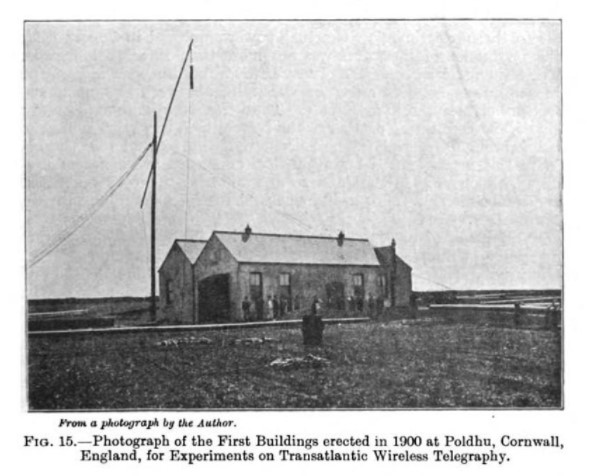
During the next four months much work was done in modifying and perfecting the wave-generating arrangements, and numerous telegraphic tests were conducted during the period by Mr. Marconi between Poldhu in Cornwall, Crookhaven, in the South of Ireland, and also with Niton in the Isle of Wight. A delay occurred owing to a storm on September -18, 1901, which wrecked a number of masts, but sufficient restoration of the aerial was made by the end of November, 1901, to enable him to contemplate making an experiment across the Atlantic. He left England on November 27, 1901, in the steamship ‘Sardinian’ for Newfoundland, having with him two assistants, Messrs. Kemp and Paget, and also a number of balloons and kites. He arrived at St. John's, Newfoundland, about December 5th. (The Wireless Age Magazine)


According to Marconi,

‘In the design and construction of the Poldhu station I was assisted by Sir Ambrose Fleming, Mr. R. N. Vyvyan and Mr. W. S. Entwistle.’


The Irish Leg at Crookhaven


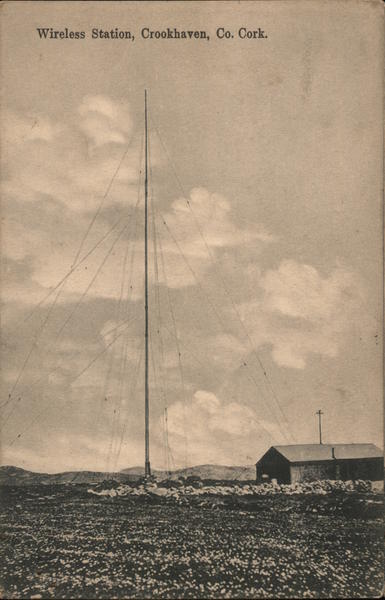
By mid June, Marconi had built his new wireless station at Brow Head near Crookhaven on the South West coast of Ireland. The County Cork headland was Ireland’s most westly promintary. A one hundred and eighty foot mast had been erected and a powerful transmitter installed to increase the range of communications for ship to shore. When Marconi first arrived at the small fishing port hundred turned out to welcome the wireless pioneer. Many of those spectators were women hoping perhaps to catch the eye of the then bachelor Marconi. His first experiment from the station was on June 16th to contact the liner Lucania which was both en-route from New York across the Atlantic and fitted with Marconi wireless equipment. A special train was organised by the local Skibereen and Schull Tramway to bring a ‘record’ number of spectators to Crookhaven to witness this breakthrough in communications. According to the Southern Star newspaper ,

‘This event is no doubt unique in the history of West Cork and we are certain that large numbers will avail of the opportunity of witnessing this epoch making experiment’


Why Crookhaven?

Crookhaven already had been the epicentre of telegraphic news. When the United States based Reuters news agency opened an office in London in 1851, an office in Queenstown (Cobh) followed two years later. Up to that stage in order to get the news scoop, reporters would travel precariously on small currachs out to liners as they reached the Irish coast to get first hands news from America and then make their way into Cork to file their stories. With the arrival of Reuters, desperate to get an advantage over their competitors including Hearst, they built a telegraph station in Crookhaven, building a telegraph line to Cork City which was then linked to Dublin and London giving the American news agency a four hour head start on other agencies who were still using reporters making the dangerous passage to the Liners.  


At the turn on the twentieth century, the ionosphere was yet to be discovered and that radio signals travelling long distances actually went upwards, bounced off the ionosphere and back down to earth. Marconi believed at that time that signals were linear and would use the ocean’s surface to conduct the signals over distances. This had been the premise of Oliver Lodge in his early Wireless Telegraphy experiments in Scotland, firstly crossing the Rover Tay and then ambitiously planning to span the Atlantic, which never got off the ground. Ireland would later be pivotal in the trans-Atlantic connection with the building of Marconi’s powerful Clifden station.


On the opposite side of the Atlantic, Marconi initially built a station at Wellfleet, Massachusetts to communicate across the Atlantic but a storm destroyed the aerial array and a new site had to be quickly chosen. Financial incentives took him north of the border from the United States initially towards Nova Scotia before finally settling at Signal Hill outside St. John’s, Newfoundland. In December 1901 he set sail for St. John's. He was under pressure from shareholders and his growing ego to deliver on his promise that wireless could commercially beat the undersea cable telegraph. He had been heavily subsidized by his financial backers who saw huge profits in the trans-Atlantic messaging. Marconi had with his travelling crew, a small stock of kites and balloons to keep a single wire aloft in stormy weather.


A site was chosen on Signal Hill, and apparatus was set up in an abandoned military hospital. A cable was sent to Poldhu, requesting that the Morse letter " S " be transmitted continuously from 3:00 to 7:00 PM local time.


On 12th December, 1901, under strong wind conditions, a kite was launched with a long wire attached beneath. The wind unfortunately carried it away. A second kite was launched. The kite bobbed and weaved in the sky, making it difficult for Marconi to adjust his new syntonic receiver which employed the new Italian Navy coherer. With hindsight and today’s knowledge it is difficult to understand how Marconi determined the frequency of tuning for his receiver.

‘The result was much more than the mere successful realization of an experiment. It was a discovery which proved that, contrary to the general belief, radio signals could travel over such great distance a those separating Europe from America and it constituted, as Sir Oliver Lodge has stated, an epoch in history’. (Marconi)


Marconi’s claim was,

‘On Monday, December 9th, barely three days after my arrival, I and my assistants began work on Signal Hill. The weather was very bad and very cold. On the Tuesday we flew a kite with 600 feet of antenna wire as a preliminary test, and on the Wednesday, we had inflated one of our small balloons, which made its first ascent during the morning. Owing, however, to the strength of the wind, the balloon soon broke away and disappeared in the mist. I then concluded that perhaps kites would answer better and decided to use them for the crucial test.


I had arranged with my assistants in Cornwall to send a series of "S's" at a prearranged speed during certain hours of the day. I chose the letter "S" because it was easy to transmit, and with the very primitive apparatus used at Poldhu I was afraid that the transmission of other Morse signals, which included dashes, might perhaps cause too much strain on it and break it down. Mr. Entwistle, Mr. George and Mr. Taylor were in charge of the English station at Poldhu during the transmission of signals to Newfoundland.


The following day the signals were reportedly again heard at Signal Hill, though not quite as distinctly. According to the Institute of Electrical and Electronic Engineers[1],

‘Marconi's ambition at the turn of the century to demonstrate long-distance wireless communication, and develop a profitable long-distance wireless telegraph service, led to his pragmatic proposal in 1900 to send a wireless signal across the Atlantic. He conceived a plan to erect two super-stations, one on each side of the Atlantic, for two-way wireless communications, to bridge the two continents together in direct opposition to the cable company (Anglo-American Telegraph Company). For the eastern terminal, he leased land overlooking Poldhu cove in southwestern Cornwall, England. For the western terminal, the sand dunes on the northern end of Cape Cod, MA at South Wellfleet, was chosen.

The aerial array comprised of 20 masts arranged in a circle. The ring of masts supported a conical aerial system of 400 wires, each insulated at the top and connected at the bottom, thus forming an inverted cone. Vyvyan, the Marconi engineer who worked on the 1901 experiment, when shown the plan, did not think the design sound. He was overruled, construction went ahead, and both aerial systems were completed in early 1901. However, before testing could begin catastrophe struck, the Poldhu aerial collapsed in a storm on 17 September, and the South Wellfleet aerial suffered the same fate on 26 November, 1901.


At Poldhu Marconi quickly erected two masts and put up an aerial of 54 wires, spaced 1 metre apart, and suspended from a triadic stay stretched between these masts. The aerial wires were arranged fan shaped and connected together at the lower end.

‘The antenna was driven by the curious two stage spark transmitter, previously discussed. There were many problems in getting it to work at the high power levels desired. Our principal concern here is the frequency generated by the Poldhu station. The oscillation frequency is determined by the natural resonant response of the antenna system, which includes the inductance of the secondary of the antenna transformer T2, since in effect the antenna system is a base-loaded monopole’.

Historians have also speculated that the transmitter might also have radiated a high-frequency signal as well, since an HF signal would have been more suitable for transatlantic communications. If, according to Belrose, Marconi had used a thin wire transmitting antenna at Poldhu, this antenna would indeed have radiated efficiently at odd harmonics of the fundamental resonant frequency. But according to Electrical engineers today that they must conclude therefore that the Cornish based spark-transmitter system radiated efficiently only on the fundamental oscillation frequency of the tuned antenna system, about 850 kHz.

When Poldhu had become operational, it was communicating successfully with stations in France and Europe and more importantly with Marconi’s new wireless station at Crookhaven in County Cork, on the southern coast. Work on building Crookhaven began in the summer of 1901.


According to Marconi, the publicist, he recounted,

‘Another similar station was erected at Cape Cod in Massachusetts. By the end of August, 1901, the erection of the masts was nearly completed when a terrific gale swept the English coasts, with the result that the masts were blown down and the whole construction wrecked. I was naturally extremely disappointed at this unforeseen accident, and for some days had visions of my test having to be postponed for several months or longer, but eventually decided that it might be possible to make a preliminary trial with a simpler aerial attached to a stay stretched between two masts 170 feet high and consisting of sixty almost vertical wires. By the time this aerial was erected another unfortunate accident, also caused by a gale, occurred in America, destroying the antenna system of the Cape Cod station.


I then decided, notwithstanding this further setback, to carry out experiments to Newfoundland with an aerial supported by balloon or kite, as it was clearly impossible at that time of the year, owing to the wintry conditions and the shortness of the time at our disposal, to erect high masts to support the receiving aerial. On the twenty-sixth of November, 1900, I sailed from Liverpool accompanied by my two technical assistants, Mr. G. S. Kemp and Mr. P. W. Paget.


We landed at St. Johns, Newfoundland, on Friday. December the sixth, and before beginning operations I visited the Governor, Sir Cavendish Boyle, and the Prime Minister. Sir Robert Bond, and other members of the Newfoundland government, who promised me their heartiest cooperation in order to facilitate my work. After taking a look round at the various sites, I considered that the best one was to be found on Signal Hill, a lofty eminence overlooking the harbour. On the top of this hill was a small plateau which I thought suitable for flying either balloons or kites. On a crag of this plateau rose the Cabot Memorial Tower and close to it was an old military barracks. It was in a room of this building that I set up my receiving apparatus in preparation for the great experiment.’


The newly constituted Marconi company knew that they were not the only Wireless Telegraph company attempting to span the Atlantic but they certainly wanted to be first and the newspapers were following the build up to the attempt on both sides of the Atlantic. Marconi knew that Professor Fessenden in the United States was making great strides and had the Atlantic in his sights as has Sir Oliver Lodge in the UK although unlike Marconi, Lodge’s plans were engineering based, while Marconi saw the commercial possibilities of being both first and the most successful to transmit across the Atlantic connecting London and New York.


According to Marconi,

‘On the morning of Thursday, the twelfth of December, the critical moment for which I had been working for so long at last arrived, and, in spite of the gale raging, we managed to fly a kite carrying an antenna wire some 400 feet long. I was at last on the point of putting the correctness of my belief to the test! Up to then I had nearly always used a receiving arrangement including a coherer, which recorded automatically signals through a relay and a Morse instrument. I decided in this instance to use also a telephone connected to a self-restoring coherer, the human ear being far more sensitive than the recorder.


Suddenly, at about half-past twelve, a succession of three faint clicks on the telephone, corresponding to the three dots of the letter S, sounded several times in my ear, beyond the possibility of a doubt. I asked my assistant, Mr. Kemp, for corroboration if he had heard anything. He had, in fact, heard the same signals that I had.


I then knew that I had been justified in my anticipations. The electric waves which were being sent out into space from Poldhu had traversed the Atlantic, unimpeded by the curvature of the earth which so many considered to be a fatal obstacle, and they were now audible in my receiver in Newfoundland. I then felt for the first time absolutely certain that the day when I should be able to send messages without wires or cables across the Atlantic and across other oceans and, perhaps, continents, was not far distant. The then enormous distance, for radio, of 1,700 miles had been successfully bridged.’


But had the Atlantic been bridged and if it had, was it from Poldhu or Crookhaven?


At the turn on the twentieth century, the ionosphere was yet to be discovered and that radio signals travelling long distances actually went upwards, bounced off the ionosphere and back down to earth. Marconi believed at that time that signals were linear and would use the ocean’s surface to conduct the signals over distances. This had been the premise of Oliver Lodge in his early Wireless Telegraphy experiments in Scotland, firstly crossing the Rover Tay and then ambitiously planning to span the Atlantic, which never got off the ground. Ireland would later be pivotal in the trans-Atlantic connection with the building of Clifden.


Initially Marconi built a station at Wellfleet, Massachusetts to communicate across the Atlantic but a storm destroyed the aerial array and a new site had to be chosen. A site was chosen on Signal Hill, and apparatus was set up in an abandoned military hospital. A cable was sent to Poldhu, requesting that the Morse letter " S " be transmitted continuously from 3:00 to 7:00 PM local time.


On 12th December, 1901, under strong wind conditions, a kite was launched with a 155 m long wire. The wind carried it away. A second kite was launched with a 152.4 m wire attached. The kite bobbed and weaved in the sky, making it difficult for Marconi to adjust his new syntonic receiver which employed the Italian Navy coherer. "Difficult" I will accept, but how he determined the frequency of tuning for his receiver is a mystery to me. Whatever, because of this difficulty, Marconi decided to use his older untuned receiver. History has assumed that he substituted the metal filings coherer previously used with this receiver for the newly acquired Italian Navy coherer, but Marconi never really said he did. He referred only to the use of three types of coherers.


‘The result was much more than the mere successful realization of an experiment. It was a discovery which proved that, contrary to the general belief, radio signals could travel over such great distance a those separating Europe from America and it constituted, as Sir Oliver Lodge has stated, an epoch in history’

Marconi celebrating his own success.


Then Marconi’s claim was,


‘On Monday, December 9th, barely three days after my arrival, I and my assistants began work on Signal Hill. The weather was very bad and very cold. On the Tuesday we flew a kite with 600 feet of antenna wire as a preliminary test, and on the Wednesday we had inflated one of our small balloons, which made its first ascent during the morning. Owing, however, to the strength of the wind, the balloon soon broke away and disappeared in the mist. I then concluded that perhaps kites would answer better and decided to use them for the crucial test.


I had arranged with my assistants in Cornwall to send a series of "S's" at a prearranged speed during certain hours of the day. I chose the letter "S" because it was easy to transmit, and with the very primitive apparatus used at Poldhu I was afraid that the transmission of other Morse signals, which included dashes, might perhaps cause too much strain on it and break it down. Mr. Entwistle, Mr. George and Mr. Taylor were in charge of the English station at Poldhu during the transmission of signals to Newfoundland. On the following day the signals were again heard, though not quite as distinctly. However, there was no further doubt possible that the experiment had succeeded.’


The experiments were suddenly brought to a halt when the Anglo American Telegraph Company sought a legal restraint claiming that he was interfering with their exclusive contract to telegraph connections across the Atlantic, as they controlled the majority of the undersea cables connecting Newfoundland and Nova Scotia with Ireland and then onto Europe.


Crookhaven

According to the IEEE,

‘Despite the crude equipment employed, and in our view the impossibility of hearing the signal, Marconi and his assistant George Kemp convinced themselves that they could hear on occasion the rhythm of three clicks more or less buried in the static, and clicks they would be if heard at all, because of the low spark rate. Marconi wrote in his laboratory notebook: Sigs at 12:30, 1:10 and 2:20 (local time). This notebook is in the Marconi Company archives and is the only proof today that the signal was received.’

Marconi himself has been evasive concerning the frequency of his Poldhu transmitter. Fleming in a lecture he gave in 1903 said that the wavelength was of 1000 feet or more, say, one-fifth to one-quarter of a mile (820 kHz is the generally quoted frequency). Marconi remained silent on this wavelength, but in 1908 in a lecture to the Royal Institution he quotes the wavelength as 1200 feet. But in 1901, anyone who believed that they could, and did, believed so as an act of faith based on the integrity of one man – Marconi.

‘The antenna was driven by the curious two stage spark transmitter, previously discussed. There were many problems in getting it to work at the high power levels desired. Our principal concern here is the frequency generated by the Poldhu station. The oscillation frequency is determined by the natural resonant response of the antenna system, which includes the inductance of the secondary of the antenna transformer, since in effect the antenna system is a base-loaded monopole’.


CONCLUSION

The first trans-Atlantic wireless telegraph message was received at Signal Hill from Crookhaven, Cork in Ireland. Not Poldhu. Despite skepticism by many historians and electrical engineers, I believe that Marconi did manage to span the Atlantic with a message through the ether using wireless telegraphy but perhaps this success was accidental, not realising his signals were being deflected by the ionosphere. But I do not subscribe to the ‘fact’ that the signal across the Atlantic emitted from Poldhu in Cornwall and arrived on the opposite side of the Atlantic at St. John’s. In fact the truth is that Poldhu tapped out the letter ‘s’ as Marconi requested but rather than reaching Newfoundland it was picked up in Crookhaven (perhaps as planned) and retransmitted from Crookhaven to Signal Hill, St. John’s. Therefore the first transatlantic message was not Poldhu to St. John’s but Crookhaven to St. Johns, Ireland to Canada rather than England to Canada. Whether this was the actual plan, is not lost in the fog of time but if it was Marconi’s belief that the oceans would conduct his signal, then the inference is that he would transmit between the two closest points, Crookhaven and St. John’s. It was also winter and the seas were unpredictable and rough, which would be another excellent argument for broadcasting between the two closets points in his network of wireless stations.


The origin of the transmission being designated as coming from Poldhu would have been important for investors and attracting others. It would demonstrate that the invested cash was being put to good work. For it to be commercially successful, a service from the UK mainland to the United States would be far more valuable than Ireland to the United States. If the transmission success was from Poldhu it would rule out the middle man, Ireland, and speed up the time of message transmission from London to New York. This would be valuable in tackling the success of the undersea cable telegraph companies.


In Orrin Dunlap’s book, ‘Marconi, The Man and his Wireless’, which celebrated the work of the Irish-Italian inventor and entrepreneur, he referred to and quoted fellow wireless telegraphy pioneer Sir Oliver Lodge. Lodge, a competitor of Marconi, wrote in his own book ‘Talks About Wireless’ published in 1925, recounting the event of the first trans-Atlantic communication, that,

‘When Signor Marconi succeeded in sending the letter ‘S’ by morse signals from Cornwall to Ireland to Newfoundland, it constituted an epoch in human history, on its physical side and was an astonishing and remarkable feat’


The first public two-way wireless telegraph communication happened on January 19th, 1903 when a message from US President Theodore Roosevelt at the White House was transmitted  via Morse code and sent to King Edward VII at Buckingham Palace in England, who in turn responded to Roosevelt.

That day, US newspaper 'The Evening World', published that “Word is Flashed from Roosevelt to King Edward” as it reported that Guglielmo Marconi and his team successfully sent the first transatlantic radio transmission from the US. Marconi and his assistants, Kemp, Taylor, Sargent, and Bradfield, were reportedly surprised that the message was received and deciphered on the first attempt. Trans-Atlantic was a reality and here to stay.


[1] ‘Fessenden and Marconi: Their Differing Technologies and Transatlantic Experiments During the First Decade of this Century’ by John S. Belrose lecture for the International Conference on 100 Years of Radio -- 5-7 September 1995


Sources

https://worldradiohistory.com/

The Irish Newspaper Archives

The British Newspaper Archives

The US Library of Congress

Marconi & Ireland , Sexton UCC

Orrin Dunlap 'Marconi & His Wireless'

The Marconi Archives

Cambridge University Libraries

Oliver Lodge 'Talks About Wireless'

The Irish Pirate Radio Archive

The Wireless Age magazines.