Support Irish Radio History Archiving

Irish Pirate Radio Recordings

Showing posts with label Dublin. Show all posts

Thursday, 21 July 2022

The Irishman who shaped Scottish Radio with 5MG in 1922


Editors Note: On an episode of the excellent podcast BBCentury with Paul Kerensa, which is telling and celebrating the centenary of the BBC (although nothing officially to do with the BBC), an episode looked at the experimental stations in Scotland such as 2BP and 5MG and I was amazed to find that it was a Dublin man who was behind 5MG and so I began to research this important pioneers story. This is it. - Eddie Bohan, Radio Historian

A draper’s assistant, born on the Upper Rathmines Road, Dublin, would become both a pioneer in radio broadcasting in Scotland and pave the way for another giant of global communications, Ryanair, to gain a foothold in affordable air transportation into Scotland. Months before the newly formed British Broadcasting Company (as the Corporation was originally known) launched their official Glasgow radio station, 5SC, in March 1923, Frank Milligan provided the Glaswegians with their own radio station, becoming a pioneer before the arrival of the BBC.


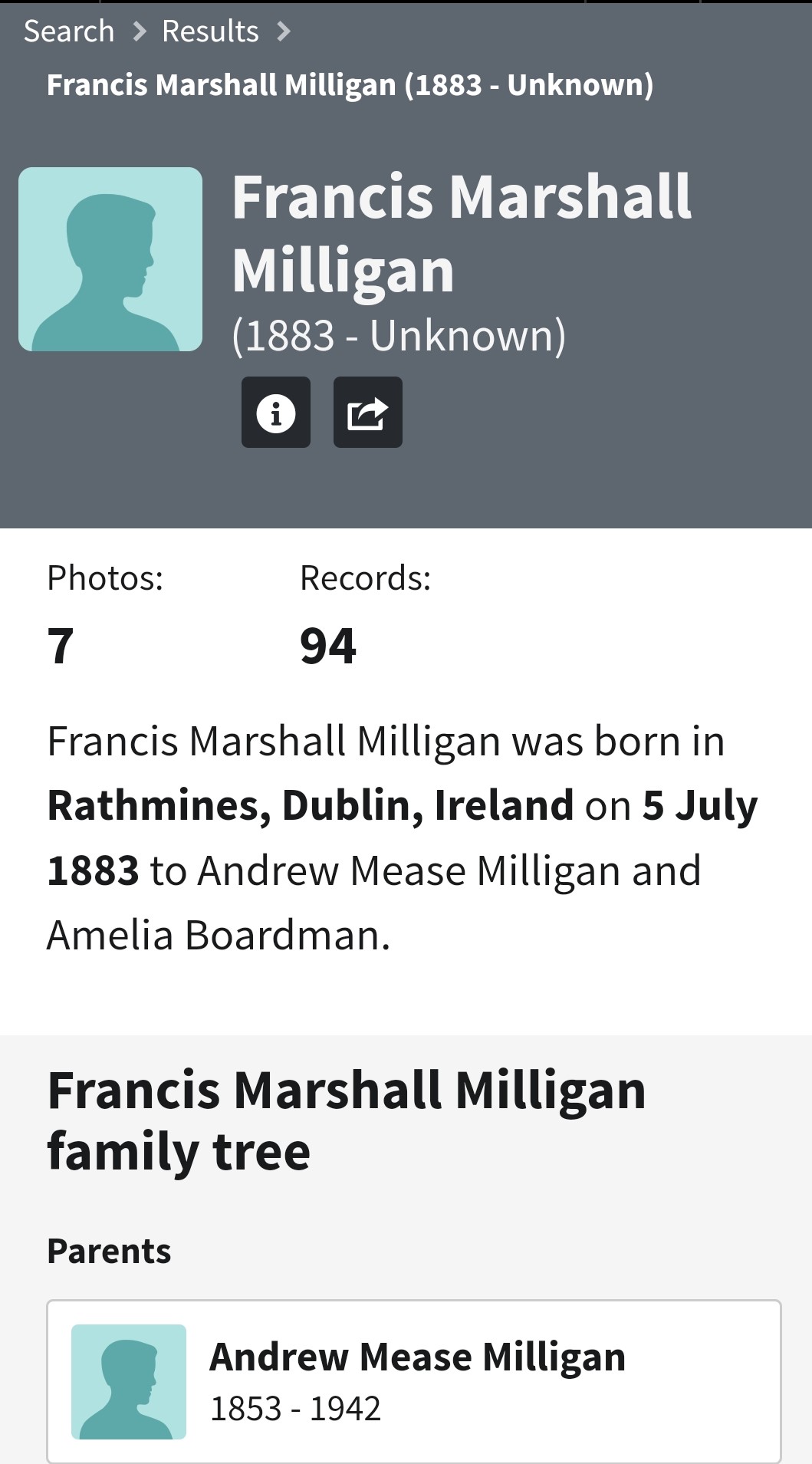
Francis Marshall Milligan was born on July 5th 1883 at 111 Upper Rathmines Road, the eldest son of the seven children of Wicklow born accountant Andrew Mease[1] and Tipperary born Amelia Boardman. After a brief education, he began work as a drapery assistant in Rathmines but in February 1901 he joined the Imperial Yeomanry [2] of the British Army and found himself on the frontlines of the battlefields of the Boer War in South Africa. After being demobbed, he made his way to London and met and fell in love with Elise Adriene Barrett. Elise was better known as Elise Barone (b. London 1883 – d. Scotland 1971) and was an actress starring in silent movies such as ‘Tom Cringle in Jamaica’ in 1913 and ‘A Flirtation at Sea’ also that year. She also appeared in numerous, what became known as, cliff-hanger serials, an early form of soap opera. Her acting career ended when she married Frank in Paddington in July 1913.


The couple made their way to Glasgow, where Frank, having learned about the use of wireless in South Africa, opened a wireless sales business at 23-25 Renfrew Street in Glasgow. Milligan then found a partner to help him expand his fledgling business in George Garscadden, who ran a domestic appliance business at nearby 202 Bath Street in the city. In October 1922, the two men gather the necessary equipment to broadcast on the fourth floor of 141 Bath Street[3]. The Milligan and Garscadden’s station would be known as 5MG (also known as Milligan’s Wireless Station) and broadcast on 440m medium wave. At a of the meeting of the Wireless Club held in the Scout Hall, Southbridge Street on Saturday October 14th 1922, it was revealed that a concert from Writtle[4] would be listened to,

‘Also, a concert specially transmitted for the meeting by the direction of the demonstrator Mr. F.M. Milligan FRGS from his own station.’

The first broadcast from 5MG took place from 7pm on Tuesday October 17th 1922[5].


For their opening broadcasts the station broadcast gramophone records using a ‘Algraphone’. The ‘Algraphone’ was made between 1922 and 1926 by Alfred Graham & Co, who were better known for their Amplion loudspeakers, for whom Milligan was the franchisee in Glasgow. Live concerts began in the cramped studios with Herbert Carruthers on piano and Garscadden’s daughter Kathleen singing. Kathleen later revealed,

‘I and my choir, in which I sang, and my organist Mr Carruthers were invited to that little flat to come and experiment to see if we could send our voices through the air. It was really a comical set-up with cables from the kitchen to the dining room in the little flat, and a microphone like a soup-plate suspended from the ceiling. And we played and we sang night after night, but nothing happened But I'll never forget the night I was heard and my mother heard me in Sauchiehall Street, and of course that was a miracle.’[6]

The station continued to entertain ever evening from 7pm with the Glasgow Herald saying that,

‘The entertainment has been of first class quality’.[7]


While Frank Milligan was creating radio history, he was also looking after a newly born daughter of his own, Madeline Primrose Milligan, born in April 1920. Primrose would go onto have her own stellar career in radio, initially as an impressionist and also on another new medium, television. According to her obituary in the Stage newspaper following her death on August 19th 1999,

"I was always in there, trying," she once told me. "Then one day I 'plunked' school to go to Glasgow and audition for a bigger contest at the Empire." That show, Brian Michie's ‘Youth Takes a Bow’, is part of history because of two teenagers who competed with Primrose. They were Eric Bartholomew and Ernest Wiseman, remembered today as Morecambe and Wise. The girl from Prestwick (where she lived for most of her life) had savoured an early taste of showbusiness, running around her father's embryonic radio station. Those years were recalled when she featured prominently on the BBC Scottish Home Service as a leading member of the Jimmy Logan/Stanley Baxter comedy series ‘It's All Yours’. Primrose joined in with all the show's gags, sketches and catchphrases. The series still well-remembered was an early landmark in a career that embraced music hall, seaside summer shows, revue, drama productions and a tour to North America with plays from Glasgow's Tron Theatre. Primrose also worked in films in London and, in-between the performing jobs, as a fashion show compere. More recently, in her sixth and seventh decades, 'Primmie' enjoyed the fun of team camaraderie in the studio and on Loch Lomond-side location, playing Mrs Woods, a villager of fictional Glendarroch, in popular Scottish soap Take High Road. She also took cameo roles in Rab C. Nesbitt and other TV series.”[8]


In early 1923 there was a buzz created into city as a second temporary station took to the airwaves when Marconi on behalf of the Daimler motor company launched a brief station 2BP to promote the sale of in car radios. On March 6th 1923, the BBC station 5SC came on the air in studios above Garscadden’s shop on Bath Street and using much of the equipment that had brought 5MG to the airwaves. 

The 5SC studios on Bath Street
Kathleen followed her father’s footsteps and the now experienced Kathleen Garscadden and Herbert Carruthers would join the new station, Carruthers as musical director and Kathleen as a singer and entertainer known on air as Auntie Kathleen. Lavinia Dervent writing in Dundee Courier[9] recalled,

‘The BBC under Lord Reith kept such a tight hold on the purse strings that the habit was difficult to break and employees hesitated before requisitioning even a new pencil. Yet, in spite of such restrictions, Auntie Kathleen in her day was a power in the land and will always inhabit a special niche in the annals of broadcasting, along with Uncle Mac (Derek McCulloch) who operated from London. For many years Kathleen's was the best-known voice in Scotland, eagerly listened to in cot and castle. She provided wholesome entertainment for myriads of young listeners—for old ones, too’.

Kathleen Garscadden died in Glasgow on February 20th 1991.

Kathleen pictured outside the original 5SC studios in Glasgow

The Milligan’s, once their station was closed and competition increased in the radio sales, moved to Prestwick where Frank was appointed the Provost of Prestwick.  A Provost is the convenor of the local authority, the civic head and the lord-lieutenant of one of the principal cities of Scotland. In that position, after the end of the Second World War, he pushed hard for the former air base at Prestwick to adapted as an international airport. His persistence was rewarded and in his role as Provost was on hand to meet and greet famous celebrities including Princess Margaret in 1950 as she holidayed in Scotland and Queen Juliana of the Netherlands who stopped off as she made her way to the United States. Prestwick Airport also made global headlines when it is one of the few places in the UK where Elvis Presley landed.


Frank Milligan died on November 1st 1956[10].


[1] Ancestry.com

[2] UK Military Records, Kew Gardens

[3] Scotland On Air

[4] 2MT

[5] The Airdrie and Coatbridge Advertiser

[6]Carrocher in Conversation', BBC Radio Scotland, 3 April 1980.

[7] Glasgow Herald December 1922

[8] The Stage August 26th 1999

[9] February 19th 1990

[10] The Stage trade newspaper.


Sources:

The Irish Newspaper Archives

The British Newspaper Archives

Ancestry.com

World Radio History

Scotland on the Air

B B Century & Paul Kerensa

Wireless World Magazine

Google Maps

RadioSix.com

British Pathe News

UK Archives Kew Gardens

BBC Scotland


Wednesday, 5 January 2022

1972, Irish Pirate Radio, Calendar of Events 50 Years Ago


With the greats efforts of pirate.ie, radiowaves.fm and the Irish Pirate Radio Archive at Dublin City University, so much of the golden era of Irish pirate radio (1978-1988) is being preserved, digitized and archived. This follows on from the excellent work carried out by the DX Archive in archiving Irish pirate radio history. But by 1978 pirate radio was not a new phenomenon. A half a century ago in 1972, the activities of pirate radio stations across the island of Ireland exercised the journalists of the day, the authorities and most importantly the listeners, who found pirate radio to be entertaining, informative and a unique way of rebelling against the status quo. So, what happed in 1972? Here is a calendar of events.

January 5th 1972

The first reports of Armagh Resistance Radio began to appear in the newspaper in the North. A nationalist pirate radio station described in February as being located in Lurgan, Reports of the station’s broadcasts were still being reported in the Belfast Newsletter in September.

Armagh Resistance Radio broadcast on medium wave and was believed by the British Army to be located in the Slieve Gullion area of Armagh, having begun broadcasting over Christmas 1971. The station was reported to be broadcasting advice to listeners about the ‘Rent and Rates’ strike that was taking place as a form of resistance to British rule in Northern Ireland at the time.  The station was picked up in many of the border counties and included requests for Republican internees. In January 1972 a similar station was heard calling itself ‘Radio Free Armagh’ broadcasting on 240m. Reporter Barry White writing in the Belfast Telegraph wrote that when he heard the station as the track ‘The Old Fenian Gun’ faded the chant on air was,

‘Who do we want free? Every last internee’.

The station was still being reported as being on the air from the Lurgan area in September 1972[1].

January 22nd 1972

The first newspaper reports of a new Dublin station, Channel 70, appeared in the Evening Herald. The station broadcasting on 224m (later 227m) but the station had been sporadically on the air since 1970. Channel 70 was one of the stations that formed the United Pirates of Dublin in the 1970’s. Channel 70 used a 150watt transmitter to broadcast on Tuesday’s midnight to 1AM, Saturdays from midnight for 30 minutes and Sunday afternoons from 1970 until 1973.


April 2nd 1972            

Radio na Gaeltachta is officially opened by the President of Ireland Eamon DeValera from their headquarters in the Gaeltacht area of Galway. The station followed on from the pirate station Radio Saor Connemara, which had been on air agitating for an all Irish language radio service two years earlier. A number of those who operated the pirate station were in top positions at the new State funded service.

April 2nd 1972

The Official IRA station Workers Radio, on 232m (later 242m), began broadcasting on Easter Sunday April 2nd 1972 operating from the Falls Road Belfast. The station would air the Republican song ‘The Belfast Brigade’ as their signature closedown. Just two weeks after going on air the station was abruptly closed when members of The Provisional IRA raided the house where the station was located and the man and woman on air were warned not to interfere with the transmitter’s destruction or they would be shot. The Official IRA claimed the house was owned by a pregnant woman. The station had made a name for itself by broadcasting requests for Republican prisoners in Long Kesh prison who had been interned.

The Workers Radio studio in Belfast
May 3rd 1972 

The first broadcasts of the Official IRA’s station Radio Saoirse was heard in Dublin on 218m. The station was broadcasting anti-EEC referendum propaganda and began each broadcast at 6.30pm and 7.15pm with the Henry Joy McCracken quote ‘the rich always betray the poor.’ Saoirse was an anti EEC station that broadcast for the duration of the referendum campaign in 1972. The newspapers reported that it had been set up by the Official IRA, who had been denied access to the State airwaves. The first test broadcast was heard on Monday May 1st and then every second day until the referendum on May 10th. The station began each transmission with a quotation from the 1798 rebel Henry Joy McCracken ‘the rich betray the poor.’ The station, which translated as ‘Freedom Radio’, was set up with the assistance of Tony Boylan.

June 20th 1972

This was the first broadcast of the loyalist pirate station in Belfast known as The Gnomes of Ulster Radio also known as GNU Radio.

June 25th 1972

The free radio fan magazine ‘Script’ reported that test transmissions from Liberty Radio began on June 25th 1972 but unlike many of the political pirate stations Liberty broadcast on 6815khz short wave. In November 1972 the World DX Club magazine ‘Contact’ reported that the station was ‘located in a block of flats in Northern Ireland’ which was most likely the Divis flats in Belfast as 1969 there were very few Blocks of flats in Northern Ireland. The Divis flats briefly housed a station that broadcast on medium wave in 1971 identifying itself as Radio Divis. Liberty Radio was heard up to early 1973[2].  Another non-political station that played a homage to the offshore pirate radio station Radio Caroline[3] was Belfast located Radio Caroline International. According to DX Archivist Ian Biggar,


“Radio Caroline International broadcast around 1333 kHz[4] and was most active in 1972, for example heard on Wednesday 22nd November with a test transmission from 0000-0030, saying they would be on regularly in a couple of weeks. Programmes commenced just after midnight on various nights of the week with music ranging from Irish C&W to Top 20 pop. They used a mailing address in County Louth and their signal was clearly received some 200 miles from the transmitter, albeit using a good radio and external aerial.”

July 4th 1972

Radio Free Nick was broadcasting on 245m as a UDA operated station from the Shankill Road area of Belfast.

According to the front page of the Cork Examiner on July 6th 1972

"Radio Free Nick" is the obscure title of latest pirate radio station operated from a location within the Shankill Road ‘No Go area' run principally by supporters of the UDA, reports Walter Ellis. On 245 metres on the medium wave, it broadcasts mostly record requests and appeals to join the UDA. The songs between openly Loyalist numbers like "The Amazing Sash" and "Our Flag’ include ballads by the Irish showbands and artists like, the late Jim Reeves. One unusual appeal - from woman dee jay "Our Sal" was to the people of Ballymurphy and Andersonstown, to take in their Tricolours, she said and fly your Ulster flags instead. You are sons and daughters of Ulster, too"

A Still taken from an ITV World in Action programming featuring Terry Tartan on the microphone with Our Sal standing beside her.

The station broadcast the dates and times of planned protests and mobilisations interspersed with calls to follow ‘Rangers’[5], ‘news from the front’ and rallying the Belfast Protestant community against the spectre of Vatican influence on the province. In an attempt to put the station off the air, a house on Ceylon Street off the Shankill Road was raided by the British Army and some of the station’s equipment was confiscated but they were back on the air within days. No arrests were made.


The station was one of the most listened to in Belfast at the time for the loyalist community as they broadcast coded messages and calls for people to man barricades in their area. The station became required listening and while much of their broadcasts were anti-Catholic and anti-Nationalist, they kept their own local community informed. In July 1972 most Protestants and especially Loyalist paramilitaries were getting all their information from Radio Free Nick. At one stage it told all UDA units not to move from their areas until further notice as it announced that an alleged statement asking units to move to Legadoon was false propaganda.


On the opposite side of the sectarian divide an IRA pirate station was operating in the Lenadoon area broadcasting public information and requests for the local residents of the Catholic area.

(This history was taken from the forthcoming book

‘The Illegal Voice of Ulster, Sectarian Pirate Radio’.)

July 23rd 1972

Originally calling itself ‘The Voice of Ireland’, Radio Valleri began broadcasting from a garden shed with a thirty-watt transmitter on July 23rd 1972 originally located in Drumcondra before moving to Baldoyle. The station named after the Monkey’s hit was operated by Derek Jones and Mike Anderson. The station originally went on air broadcasting on medium wave from Jones’s shed before moving to short wave. The station continued intermittently until the early 1980’s. This is a history of the station compiled by the DX Archive,

‘Anyone tuning across the 48 metre free radio shortwave band during the 1970's would probably remember hearing the song "Valleri" by The Monkees.  It signified the sign-on and sign-off of Radio Valleri, one of the longest running stations of the decade. The station however wasn't always on shortwave.   Radio Valleri was actually one of the early free radio stations to transmit to the Dublin area. It began broadcasting during the Summer of 1972 on a medium wave frequency of 1525kHz with 30 watts of power.  The station started operating from a garden shed in North Dublin on a Sunday by two young radio enthusiasts, Derek Jones and Mike Anderson.  Radio Valleri first transmitted on Sunday 23rd July 1972 between 12 mid-day and 1pm with a half hour from each of the founding members.  Transmission times were extended as they were joined by Arno St Jude[6] and Edward LeRoy and operated regular Sundays until late September of that year when they closed down due to transmitter problems.  


At this point, Arno St Jude left to be on Radio Melinda.  The station's next broadcast was in 1973, but this time they had moved to shortwave.  The operators had been persuaded by their engineer to try this band, and a suitable transmitter was built.  The change to shortwave was a great success, with letters being received from listeners all across Europe.  As Ireland did not have a government operated International Service at this time (this had closed decades before), Radio Valleri became the 'Voice of Ireland' on shortwave.  The frequency used during this period was initially 6317kHz, moving to 6260kHz and finally 6210kHz prior to the station closing in October 1974 after a year of Sunday transmissions.    


The station returned in Autumn 1975, and regular Sunday broadcasts were made until December, when heavy Post Office activity in Dublin caused a cessation of broadcasts until May 1976.  Following the return in May 1976, Radio Valleri operated for several years on a number of frequencies starting on 6260kHz.  In late 1976 there were reports in the Free Radio press of a new station called Premier Radio about to start from Dublin on 6260kHz.  Although no signals from this new station were ever logged, Radio Valleri moved to 6202kHz in January 1977. (Note: 6260kHz was later used in 1979 by Radio Cill Dara International).


In February 1977 the English magazine 'Free Radio Waves' featured a history of Radio Valleri in its 3rd issue.  6202kHz continued to be used for a time, but transmissions eventually ceased, possibly during mid-1979.  Radio Valleri was next heard during the 1980's on 6400kHz, although the signal was never as strong as it had been during the 1970's. 
July 31st 1972

Radio Saoirse began operating in Derry City beginning each broadcast with the song ‘A Nation Once Again’

September 30th 1972 

Although not operating illegally, Radio Ballinasloe went to great lengths to announce that their loudspeaker system throughout the Galway town for the local festival, was not a pirate radio station.

December 17th 1972

At 11am on September 9th 1971, Radio Milinda (sometimes referred to as Radio Melinda) went on air from about a Youth Club on the Sean McDermott Street area just off Dublin’s main thoroughfare O’Connell Street. The men originally behind the station were Jimmy McCabe who built the transmitter, Jimmy Lynch and Ritchie Kearns.                                                                                   

Soon after the launch two more young men became involved Mark Storey and Declan Meehan both of whom would go onto to work for RTE. With the assistance of a nearby record shop owner on Talbot Street, Milinda began to play the top ten every week, the first station in Ireland to do that.


When RTE reporter Kevin O’Kelly reported on a meeting he had with a senior member of the IRA and when in November 1972 he refused to identify his informant, he was jailed for contempt of court. As a result, the RTE authority was sacked and some staff threatened Christmas industrial action and this would leave Radio Milinda as the only radio station on air in Dublin. Milinda announced that the station would be broadcasting twenty four hours a day over the festive period but the authorities had other plans.


On December 17th 1972, almost one hundred Gardai and Department of Posts and Telegraphs officials raided the station located above the Diamond public house. The final song being played was Donovan’s hit ‘Sunshine Superman’. On February 3rd the following year the resultant court case led to the conviction of five of the seven men charged with illegal broadcasting and they were each were fined £2.


In December there were numerous newspaper reports of a mutiny on board the offshore pirate radio ship Radio Caroline, anchored in the North Sea. Caroline could be heard at night in Ireland was popular since the days one of its ships was anchored off the Isle of Man. The fact that it was an Irishman, Ronan O’Rahilly who was behind the station made it newsworthy in Ireland. You can read more about Radio Caroline in 1972 here.


Sundown Radio initially began broadcasting in July 1968[7] founded by Con McParland. Broadcasting on 230m MW (later 242m), it was originally ‘a mixture of records and good chat, no mention of anything political’[8] and located in a derelict shop on the Old Lodge Road. By 1969 and the rise of tensions in the city the output from the station became more sectarian. The station closed and McParland left Northern Ireland where he moved to Cork and set up another version of Radio Sundown broadcasting on 240m which stayed on air from 1972 until 1975 when a lack of funds led to its demise


Reports throughout 1972 reported on a Radio 99 broadcasting from along the border between Northern Ireland and the Republic. In April 1971, Radio 99 had begun broadcasting on 199m and was set up by four friends to broadcast non-political content with a diet of country and western music. Radio 99 was originally located in a disused house just inside the County Fermanagh border and was on air three hours Saturday and Sunday nights from 9.30pm opening each night with their signature tune Slim Whitman’s ‘What’s the World a Coming To’. The station provided a postal address for requests of 6, Millbrook, Clones, County Monaghan but after just a couple of weeks on air the station was closed by loyalist paramilitaries who intimidated the young broadcasters forcing them to close and move their transmitter south of the nearby border.


The station operators moved to Dunsrim near Scotshouse in County Monaghan with studios now housed in a caravan. The transmitter was built by Clones man Sean McQuillan[9] using an ex-army transmitter. The station had three small transmitters two located south of the border and one north of the border across the River Finn. They periodically broadcast over the next four years with a name change to Radio Caroline North, but it would all come to an end on November 21st 1975 when the Gardai raided the station. Three men Owen Smyth (aged 24) Charles Smyth (23) both from Knox, Scotshouse and Andrew Slowey from Cootehill, Cavan were found guilty of illegal broadcasting and fined ten pounds each.


Another station reported in band scans as being on the air in 1972 was Radio Six a Dublin 6 based station that operated from 1972 until 1973.


The influence of pirate radio in the Republic of Ireland is colourful. It led to political, broadcasting and social change, It added colour to a dark period in Ireland’s history. In Northern Ireland, illegal broadcasting took a different, darker path but they were never the less an important part of the history of Irish radio.


If you enjoyed this article and you would like to purchase a coffee and help financially in the archiving project, click the KOFI sign at the top of the page, Thanks


[1] The Evening Herald September 4th 1972

[2] The World DX Club and Ian Biggar (DX Archive).

[4] 225m Medium Wave

[5] Glasgow Rangers FC

[6] Arno St Jude was the on air name of Declan Meehan

[7] Front Page Belfast Telegraph July 30th 1968

[8] The Belfast Memories Forum

[9] In Interviews with the McQuillan Family in Monaghan

Saturday, 29 May 2021

Radio Product Placement in 1925 - 2RN Style

Today when we watch television, we often notice a small letter 'P' in the corner of the screen, this refers to the fact, as one of the revenue tools of the station broadcasting, there is product placement. This can range from the sponsored drinks cups on the table in front of the ‘X Factor’ judges to the shop used on the set of the soap ‘Fair City’. For an older generation of listener, they will fondly remember the sponsored programmes like the Hospital Sweepstakes, Fry’s or the Walton’s programme. It may seem like a modern development in Irish media, taken from the cinema (check out the product placement deals for a Bond film, eye watering amounts) but subliminal product placement dates back to the test transmissions of 2RN in December 1925, 2RN the forerunner of today's RTE Radio. 


There was no advertising initially allowed on the new Irish Free State radio station, 2RN, and the station depended on the Government to provide its entire funding budget. But businesses found ways around the 'no advertising' issue in creative ways. In the weeks prior to the official first broadcast on January 1st 1926, a series of test transmissions on 390m were conducted throughout December, intensifying from December 14th 1925. 


The 2RN studios were located on Little Denmark Street, just of Henry Street. Much of the early tests consisted of Station director Seamus Clandillon and Musical Director Vincent O'Brien playing the in studio piano and singing traditional Irish songs. But this changed on December 16th with the first outside broadcast relayed by the station. Firstly, it would be a boost for the venue used, the La Scala Theatre on Princess Street beside the GPO. Having opened in August 1920, the opening did not go exactly according to plan according to the website Early Irish Cinema,

'When proprietors Frank Chambers and George Fleming chose the week beginning 9th August 1920 for the opening, few people would have been surprised that they timed it to coincide with Horse Show week, the city’s busiest entertainment week of the year during the Royal Dublin Society’s longstanding horse show at its show grounds in Ballsbridge. But things didn’t go quite to plan as opening day approached. A split in the electricians between those affiliated with the London-based Electrical Workers’ Union and the ITGWU on what union the projectionists should belong to looked like it would leave the cinema unable to open because of a strike. Last minute negotiations meant that while La Scala did open during Horse Show week, it was not on the Monday as planned but on Tuesday, 10th August. In the process, the unions had sent a message to the management about the power of organized labour that seems to have been heeded months later.'


But the new venue was thirsty for publicity and to coincide with the test transmissions, the theatre put on a special week of entertainment titled 'All Irish Week' with music and entertainment before and after the showing of the film 'Wicklow Gold[1]' starring Jimmy O'Dea. With quality entertainment on offer especially the type of musical acts that played well on the fledgling medium of radio and its proximity to the station studios, the La Scala was a perfect choice for the new station's first outside broadcast. Not only did the Theatre receive credit during the broadcast but extensive newspaper coverage provided valuable advertising. The test transmissions also included music from the in house La Scala orchestra under the direction of John Moody. Moody had joined the new theatre as musical director having spent many years at the more famous Theatre Royal on the opposite side of the River Liffey on Hawkins Street.


The arrival of radio stations in various markets around the world was eagerly anticipated by listeners but not by the media already in situ and Dublin was no different as newspapers were deeply concerned at the arrival of the instant medium of broadcasting. The Irish Independent was one of the major morning dailies along with the Freeman's Journal and deeply worried about the arrival of radio. But the proprietors of the paper saw an opportunity in promoting their newspaper firstly over the radio and secondly ahead of its rival publications. The La Scala featured the 'Irish Independent Choir' also referred to as the 'Irish Independent Choral Society'. They insured that they were booked to perform during the 'Irish Week' and therefore in pole position to be used in the test transmissions from 2RN. The All Male choir were ideal for radio and were popular with listeners on their first appearance. Even the Freeman's Journal in reviewing those first broadcasts had to refer to the choir as 'The Irish Independent Choir'. The choir was conducted by William McGouran and had won multiple awards and prizes at competitions including Feis Ceoil's. 


The test broadcast on Wednesday December 16th featured the La Scala orchestra playing for Opera singer Renee Flynn (see the Story of 2BP) and then the Irish Independent Choir contributed four songs. One in Irish, a lament arranged by 2RN musical director Vincent O’Brien and then three songs in English, ‘JohnPeel’ arranged by Mr. Percy, ‘Three are Women’ from an opera written by Ashton Oakley and ‘Comrades in Arms’ written by Adolph Adam. The Theatre owner George Fleming was in the 2RN studio’s listening to the relay from his venue around the corner.


Another test broadcast was conducted on Thursday 17th with an in studio music selection from William Manahan and his band playing Irish airs.  Before and after each test broadcast Seamus Clandillon in his own form of advertising for his station implored listeners to purchase a wireless receiving license as required by law for radio 'listening-in'. A proportion of the license would be directed to the station to improve its facilities, pay the artistes and extend transmission relays and power. Further test transmissions included relays of 2LO from London and 2BE from Belfast.

If you want to support my work in preserving and presenting the history of Irish radio and archive as much broadcasting history as I can, then for the price of a cup of coffee (takeaway these days) you can financially support the work at -              https://ko-fi.com/irishbroadcastinghistory

Interestingly on the day that 2RN launched, the Independent newspaper moved to new head offices on Middle Abbey Street from their location on Dame Lane. Their move consumed more column inches than the launch of their competitor 2RN.


[1] The cast of Wicklow Gold included Jimmy O'Dea (Larry), Ria Mooney (Kitty O'Byrne), Chris Sylvester (Ned O'Toole), Kathleen Carr (Widow O'Byrne), Nan Fitzgerald (Moira Cullen), Fred Jeffs (Dr McCarthy), Joan Fitzgerald, Frank Fay. Released in 1922 it was set on Fair Day in Avoca, Co Wicklow, an old farmer, Ned O'Toole, determines to 'make a match' for his browbeaten son, Larry, but Larry is courting Kitty, Widow O'Byrne's daughter. Ned wants Larry to marry a |g| wealthy farmer's daughter. Ned is thwarted in his ambition when Kitty and her mother trick him into believing that there is a gold deposit in the river that runs through the O'Byrne’s land. As a result, Ned gives his consent to the marriage of Larry and Kitty. The film was produced by Irish Photo-Plays Limited