Support Irish Radio History Archiving

Irish Pirate Radio Recordings

Showing posts with label Pirate Radio History. Show all posts

Friday, 3 March 2023

Donegal's Unique 1980's Festival Radio Experiment


It was the closure of the pirate radio station Radio Donegal in 1981 after eighteen months on the air that created one of the most unique pirate radio experiments in the country[1]. Don Clark who worked for Radio Donegal saw an opportunity to help publicise the various festivals around the country by creating a mobile service in a caravan travelling from town in town.


For many listeners to the radio in Donegal, the national station RTE Radio was Dublin based and had little influence on the events of Donegal. In the 1970’s, in an attempt to generate business in small towns, committees formed to create unique festivals. To help to generate publicity, to inform visitors and provide local businesses with advertising opportunities, a radio station was operated but rather than traditional AM or FM transmissions, these station operated on a wired loudspeaker system, sometimes referred to as ‘lamppost radio stations’. Some of the tons to adopt this system included Letterkenny for the Folk Festival and in Ballyshannon. This created a local attachment to the familiar nature of their own radio station. Radio Ramelton was another station that ‘broadcast’ via a wired system. The Donegal News reported,

‘This year again ‘Radio Ramelton’ will be in operation, when the whole town is " Wired up ". to receive local programmes. Mr. Mervyn Corry will be in charge of the " mike," but special programmes have been set aside for the children and the ladies.’

The station, set to promote the ‘Lennon Festival’, was initially fronted by Jim Birney, known on air as ‘Slim Jim’ and later by Mervyn Corry.


In 1976, a new radio station arrived courtesy of the State broadcaster RTE, when their mobile community radio station and transmitter arrived in Donegal. With a medium transmitter on 202m and a low powered FM transmitter, RTE’s service, under the then direction of Pauric O’Neill, covered three areas over six days. The local organisers in Fintown, Downings and Dungloe would see the broadcast unit spend two days in each town. 


The days in Dungloe coincided with the most popular and famous festival in Donegal the Mary from Dungloe Festival. As the mobile unit continued to tour Ireland introducing towns and villages to community radio, towns in Donegal reverted to the lamppost radio services. The RTE service did travel at various times to The Glenties, Letterkenny, Ardara and Bundoran.


In 1981, RTE announced that the mobile unit would visit Dungloe for the entire now expanded festival. Advertisements appeared in the newspapers informing listeners how to tune into Community Radio Dungloe. At the last minute the visit was cancelled by RTE. 

This provided an opportunity for some ex staff of the pirate station Radio Donegal that had closed in April after eighteen months on air. With a standby transmitter built by Paul Millar and broadcasting on 257m, Radio Dungloe took to the airwaves for the festival. The newspapers reported,

‘Operating for most of the Festival was Radio Dungloe in association with Radio Donegal on 257m. with the studio based at the Festival caravan on Upper Main Street and making its own contribution to the spirit of the event.’


The station was operated by Don Clark with former Radio Donegal DJ Tommy Rosney assisting. Their numbers augmented by local DJ’s. Rosney told me in an interview[2] that at that time he was working at Dunnes Stores in Letterkenny and that he would take two weeks holidays around the Mary from Dungloe festival so that he could work on air. He also said that while there was not too much financial reward, the on air personalities were looked after with a quid pro quo advertising deals with restaurants that would deliver to the DJ’s meals. According to Rosney, he and his colleagues would stay in the mobile home while it was in operation with the transmitter housed in one of the utility rooms. Once the festival was finished, a tractor hitched up the mobile home and moved it to the next town or village.


With the success of Radio Dungloe in 1981, Clark saw an opportunity to take his station mobile and operate for various festivals around the county.  The next visit for their mobile home was Radio Downings with the station now broadcasting on a regular 192m MW. This was followed by Radio Ceilteach (Celtic Radio) for the Ceilteach festival held in Falcarragh opening at midday on Saturday July 11th 1981 and then broadcasting each evening for the next five days from seven in the evening.


In 1982 the small village of Bonagee hosted Radio Bonagee for the local spring show in May. The Donegal Democrat reported,

‘Radio Bonagee, which will be under the supervision of the very popular ex-Radio Donegal D. J., Don Clarke, will be on the air on 192 mts. medium wave, which is beside Radio Luxemburg. Don will be on the air on Wednesday and Thursday between 2 and 5 p.m. and he will be on the air all day Friday, Saturday and Sunday. His many fans will surely be phoning in requests to his popular show.’

Meanwhile when the station, now based in the mobile home, arrived back in Dungloe, it was based in the carpark of the Ostan na Rosann Hotel.


In 1983 the mobile home was back at Radio Dungloe, followed by Radio Lifford which operated just for a weekend. Radio Twin Towns was on air for the festival that connected the two ‘twin’ towns of Ballybofey and Stranolar. Radio Letterkenny was on the air once again for the Folk Festival, not as a loudspeaker station but with a medium transmitter, while in 1985 the mobile station was known as Radio Cunamh was based in Stranolar with Pat Reid and Kevin Duffy assisting Clarke and Rosney. Also, in May 1983 Radio Bonagee was back on the air with the Donegal Democrat once again reporting,

The station continued to travel to various towns across Donegal, always revisiting Dungloe. In 1985, they visited as Radio Killybegs based next to the Artic Fish Company near the quays. Radio Killybegs was back once more in 1986, this time moving frequency slightly to 205m MW. The mobile station also visited another Donegal fishing port transforming into Radio Burtonport, which according to Tommy Rosney was located next to the co-op in the town.


The experiment came to an end when the new 1988 legislation came into force, forcing the end of the pirate era.


My thanks to Tommy Rosney, Russ Padmore, John Breslin at Highland Radio, Ocean FM, Donegal Live and the Donegal Democrat


[1] In Dublin a similar operation was operated by the Community Broadcasting Cooperative which broadcast from various suburb festivals including Radio Glasnevin, Radio Sandymount and Radio Ringsend.

[2] Interviewed in Letterkenny February 16th 2023

Friday, 20 January 2023

Linkage Radio, the New York pirate & the FCC Chase


In 2022 I was lucky enough to walk the streets of Flatbush and Brooklyn with Professor David Goren, the creator of the ‘Brooklyn Pirate Radio Sound Map’, seeking out the myriad of pirate radio stations that were located in that area. In 2023 I came across an excellent video from Ringway Manchester about pirates in the New York area and they mentioned how a new crackdown had begun in New York by the FCC against the illegal broadcasters.


At this point we must mention President Donald Trump (yes, I must) as during his singular term in office in January 2020 he signed a new Act that would attempt to tackle the issue. The PIRATE ACT, standing for Preventing Illegal Radio Abuse Through Enforcement, was designed like legislation in Ireland not just to go after the transmitters and studios of pirate broadcasters but also to implement penalties against landlords and landowners who provide space for the stations. In the video they spoke about a landlord, Michelle Hepburn, in Mount Vernon who had received a notice from the FCC that pirate transmissions had been traced to a building she owned and that as a result she was liable for fines in excess of two million dollars. This set me off on a trawl to find out more about this station which was broadcasting Caribbean music.


When I searched for pirate radio activity in the Mount Vernon area of the Bronx in New York, the name Dexter Blake appeared and he is a fascinating character. His first brush with the FCC dates to August 13th 2008 when the FCC traced broadcasts on 101.5mhz FM to Mount Vernon and a Caribbean restaurant known as The Linkage based at 78 East 3rd Street. The radio station was known as Linkage Radio. In March 2009, Dexter was issued with an official ‘Notice of Apparent Liability for Forfeiture’. Dexter was deemed as ‘apparently, wilfully and repeatedly violated Section 301 of the Broadcasting Act 1934.’


Dexter was born in Jamaica before immigrating to the United States. He made the headlines in 2017, when it was reported that when Dexter attempted to bring his two young children from the Caribbean Island to join him in the Big Apple, part of the visa process that a DNA test was required from both children and to his shock and horror it turned out that he was not the father to either child. According to reporter Claude Mills,

‘A popular Jamaican radio disc jockey is devastated this afternoon after he got a letter from a DNA agency informing him that the two kids he had fathered with two Jamaican women were not his biological children. He said that he had spent close to US$300,000 on both his kids since their birth.

DNA tests are required by the US Embassy in Kingston as a vital part of its immigrant visa process over the years has confirmed that a number of women are assigning paternity of their children to the wrong man, a term called ‘jackets’ in the Jamaican vernacular. The number of ‘jackets’ was contained in a diplomatic cable captioned ‘fraud summary’ and covered the period March 2009 to August 2009. According to the leaked diplomatic cable, the US Embassy in Kingston “often requests applicants to undergo DNA testing because their fathers’ name is either not on the birth certificate at all, or was added many years after their birth”.

However, one in every 10 men who turns up at the US Embassy is told the DNA test proves that he is not the biological father of the child he is filing for.’


According to the Radio World newsletter in July 2010

‘The Federal Communications Commission has confirmed a $10,000 fine in the case of a radio pirate in New York. The Enforcement Bureau said Dexter Blake didn’t respond to a notice of apparent liability it issued in March of last year for an unlicensed transmitter on 101.5 MHz in Mt. Vernon, N.Y., northeast of Manhattan.

In the summer of 2008, agents out of the New York Enforcement Bureau office traced transmissions to the Linkage Caribbean Restaurant and spotted an FM antenna on the roof. Taken up by the building super, they saw coaxial cable going through a duct to the first floor where Linkage Caribbean Restaurant operated.

The agents said they talked to restaurant workers, who called Blake; one of the agents spoke to Blake, who admitted to operating the station, according to the commission. The commission staff also reported it had done an Internet search and found a website called “Linkage Radio,” which identified Dexter Blake, “DJ Linkage,” as the owner of the station and restaurant.


The FCC remained on his trail and in May 2010 transmissions on 101.5mhz was traced to 238 3Rd Street, Mount Vernon. The building owner, NWO Properties Corporation received a NUO a Notice of Unlicensed Operation’.


Dexter Blake championed Caribbean artistes in New York giving them an outlet on the air and even created an annual awards ceremony to celebrate the music. In May 2016 in a report published by the New York State Broadcasters Association, ‘Field Measurements of Unauthorized FM Band Radio Signals In New York, NY Metropolitan Area’, they identified 2874 Grand Concourse Bronx, NY as the location of pirate transmissions on 104.5 which was a second frequency now being used by Linkage Radio. They described the signals as a ‘very strong pirate signal’.

On the left is a photo taken for the New York Broadcasters association highlighting the FM aerial on the roof in 2016. On the right is a Google Map image from 2023, the aerial has gone.

The Notice of Forfeiture did not put him off the air and his next brush with the law was in 2017 when the landlord of the restaurant he was now located in received a NUO, the owner of the 53 Sea Lounge, Bar and Restaurant, George Brown received the notice to his business at 53 Mount Vernon Avenue. The station was now broadcasting on 104.5mhz FM. The station was described in an article in The Radio World as not only the HQ for Linkage Radio but also as ‘a cosy spot to play checkers and chow down on curry shrimp’


His most recent brush with the FCC was when transmissions on 104.5 were traced to Michelle Hepburn building at 159 South 13th Avenue, Mount Vernon. As the landlord, Ms. Hepburn received the notification and was threatened with fines in excess of $2million if the broadcasts continued from her building. 


The building on South 13th Avenue with the FM aerial on the roof. (2022 Google Map)

The station continues today playing their cat and mouse game with the FCC. A check on MapQuest shows the location of the station at 5 Fulton Avenue, Mount Vernon. We hope that Dexter and Linkage Radio has many more years of out running the law and entertaining his loyal listeners. His station can be found on Tune-In


Thursday, 22 September 2022

The Rise & Sudden Fall of London Irish Community Radio in 1988


The late Jimmy Smith made his name in Irish radio and made his pirate radio station TTTR (Tallaght, Templeogue, Ternure Radio) the number one country and Irish music station having helped the careers of many of the rising stars of Irish country music. In 1988, Jimmy, with the impending arrival of new legislation that would silence his beloved station, making way for a new legal independent commercial landscape, he decided to spread his wings but had those wings firmly clipped by the authorities.
 
With a staff of seven and broadcasting twenty four hours a day on 89.6mhz FM, Jimmy set up London Irish Community Radio, a pirate station dedicated to one of the largest ethnic groups in the UK's capital. The station was located on Hope Lane in Acton and followed the same successful formula as TTTR back in Dublin.
 

There had been an explosion of pirate radio stations in London from 1988. According to the Dazed website

‘Needless to say, it (pirate radio) wasn’t going anywhere, and between 1988 and 89, pirate radio stations rapidly started to appear to serve a youth hungry for new sounds that weren’t being catered to by mainstream radio. By 1989, there were over 60 pirate radio stations operating in London alone.

According to the fanzine ‘Anoraks UK’ from July 1st – 5th there were ‘40 pirate radio stations, 11 in stereo’ operating in London. There was numerous ethnic based stations including London Greek Community Radio, London Asian Community Radio and London Turkish Community Radio.

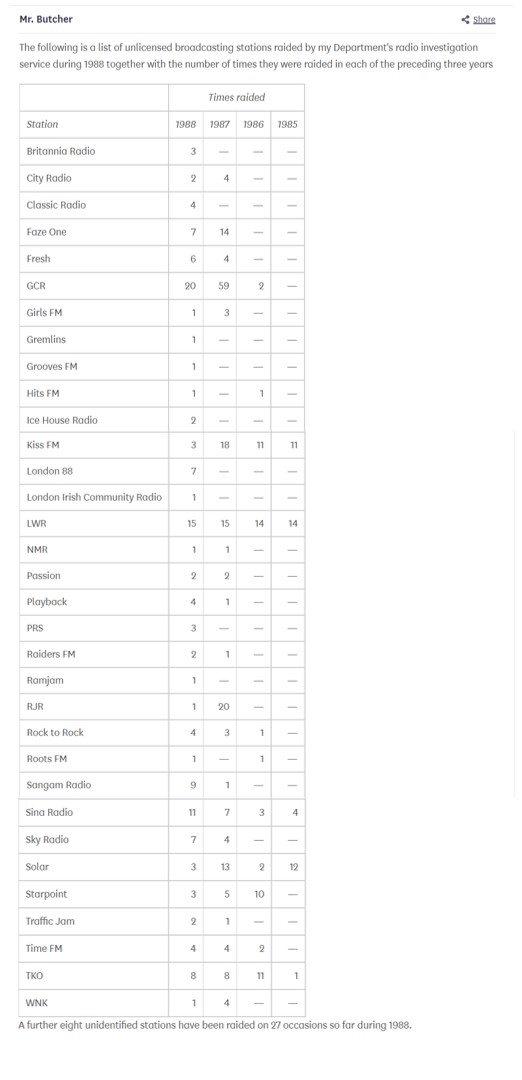
From The House of Commons Hansard page on written MP answers

Just weeks after going on air at noon March 10th 1988, their powerful 500w transmitter blanking out smaller low powered pirates that broadcast on the 89-90mhz FM frequency. This included the ‘obliteration’ according to Anoraks UK’s London correspondent of long running pirate station ‘London Rock’ also on 89.5. Prior to the arrival of LICR, the Irish in the capital could tune on a Sunday lunchtime on the Brent based pirate station JBC on 104.3mhz. By mid April, LICR’s overnight programming of recorded shows was being relayed on another London pirate station ICE FM on 90.5mhz.

Whether it was his reputation preceding him or a suspicion of any Irish content on the radio as the troubles continued in Northern Ireland, in the first week in May the station was raided by the DTI and the police, closed after just five weeks of broadcasting. Jimmy managed to get the station back on the air within a fortnight on low power but he was quickly raided once again putting an end to LICR. In August backers were fined £400 plus £295 costs.

Alan Whelan and ex-pat and a councillor with the Social Liberal democrats said,
"I am against pirating but his radio station proved there is a need to be met".
Local Ealing North MP Harry Greenway made representations to the Home Secretary but to no avail as there would be no legal community license given to a station serving the large Irish diaspora at that time. For any Irish living in London today, to keep in touch with all things Irish tune in to https://www.irishradio.org/


Sources.
Hansard, the House of Commons Archive
Anoraks UK
The British Newspaper Archives
The Irish Post, London
The DX Archive
Radiowaves.fm
Dazed
AMFM.org

Sunday, 24 April 2022

New York & Brooklyn Radio 2022 - Legal, Illegal and Fragmented


In April 2022 I visited New York principally as a holiday but having visited all the major tourist sites in the past, this visit I concentrated on the media aspects of the Big Apple. I organised a visit to the Paley Centre formerly known as the Museum of Radio and Television located near 30 Rock. It is a fascinating place to visit and the staff are so accommodating and friendly. The main exhibition at that time focused on the achievements of the black stars of television. Their inventory of archives from radio and television is extensive and easily accessible. We could learn a lot here from their work. (My personal thanks to Jane Klain). I also happily had a ticket to attend a recording of the Stephen Colbert Late Show at the Ed Sullivan Theatre located on Broadway. You can read more about that visit HERE.


Radio though is my first love and one of my first pieces of business was a proper band scan in the borough of Queens where I was staying. I was able to hear stations in New York, some from New Jersey and even Connecticut. To help me identify the stations, I looked up the list of FM stations on  

https://worldradiomap.com/us-ny/new-york

There were 42 FM stations on my dial. What I wasn’t able to receive except when I was in the car was the HD additions for some stations. FM stations can divide their data stream into sub-channels (e.g., 88.1 HD‑1, HD‑2, HD‑3) of varying audio quality. For example, WPLJ which describes itself as a Christian Contemporary station broadcasts on 95.5mhz FM but had three further sub channels on that same frequency.


According to the website statista.com:

Radio is one of the most powerful mediums in the United States, with a weekly reach of around 82.5 percent among adults. There are over 15,445 radio stations in the U.S., all competing for a piece of this massive market. WTOP, a station operating out of Washington D.C. is the largest of its kind in the U.S., pulling in 69.8 million U.S. dollars in yearly revenueOnline radio is also playing an increasing role in the radio market, with an estimated 974 minutes spent listening to online radio on a monthly basis in 2021. IHeartRadio is the biggest online radio company in the United States by a significant margin, boasting an average active sessions figure over 300 thousand. American radio stations generated total revenue of over 10 billion U.S. dollars in 2020, of which 940 million dollars was generated through online radio streaming. In addition to the massive national stations and broadcasts, local public radio stations also appear to be thriving. Public radio station revenue has increased from around 624 million U.S. dollars in 2009 to over 970 million in 2020. ‘Country’ is by far the most popular format, with 2,200 individual stations broadcasting music from this genre. As of 2020, Americans averaged 99 minutes of radio listening time per day, with much of this time being spent while commuting.

One of my major observations was the amount of advertising per hour on the commercial stations as compared to Irish radio. While listening to alternative rock station WBMP-FM ("ALT 92.3 FM") for one hour there was one ad break that contained 8 advertisements lasting seven minutes. In total there was 16 minutes of advertisements on the station in one hour. It is estimated by advertising agencies that news/talk shows drew an average of over 17 minutes of commercials per hour, compared to 14 minutes for music shows on stations like Z100. The other observations are the repetition of a contact telephone number in the add. 'Call 212-555-1234, that's 212-555-1234.' Then when medicines are being advertised, the list of reasons why a patient should not take that particular brand lasts longer than the original advertisement itself. 

For true freedom of choice you can check out 326 New York radio stations that broadcast on FM, AM and online at https://www.radio.net/city/new-york-city


I was then invited to visit the studios of WBAI located on the upper floors of a building on Atlantic Avenue in Brooklyn behind a plain brown door. The station is listener-supported radio. As a member of the Pacifica chain of radio stations, it provides a vast array of original programming to listeners in the Metropolitan New York City region and worldwide online. My guide was John McDonagh, the co-host of the Radio Free Eireann show along with Malachy McCourt. The station is still recovering from the pandemic restrictions with only one member of staff monitoring the output. The presenters do their shows remotely using an app called ‘Luci Live Lite’ (https://luci.eu/luci-live-lite/) which seems to provide excellent broadcast quality.


My next radio adventure was another visit to Brooklyn and my host Professor David Goren, who has created the excellent Brooklyn Pirate Sound Map which tracks pirate radio in that borough. It was definitely two radio ‘anoraks’ getting their fix discussing pirate radio in both the United States and Ireland, relating our archiving experiences. In his office on the upper floor of his beautiful period house in Brooklyn, we did a band scan on the FM. To my absolute astonishment, bearing in mind my Queens band scan identified 42 FM stations, in Brooklyn David and I identified 25 pirate radio stations broadcasting on FM in that borough alone. Most of the stations catered for listeners from the Caribbean areas including Haiti, the Dominican Republic and Grenada, there were also Jewish stations and local religious church broadcasts. There were also some pirates located in the boroughs of Queens and the Bronx but these were limited due to pressure from the FCC (Federal Communications Commission). The problem in Brooklyn, explained Professor Goren, was that there were so many stations it was hard to close them all and when they did raid a station they were quickly back on the air. David then took me on a walking tour of the neighbourhood and was able to point out a number of FM aerials on roofs where these pirates were hiding in plain sight, and like a true anorak, he had a transistor radio with him and was able to tune in outside these buildings. One was located on Jean Jacques Dessalines Boulevard in the Church of Christ Christian Temple. The first photo was taken from Google Maps dated August 2021, while the second photo is one that I took in April 2022 with a new folded dipole added. (see 96.5mhz on the list)


87.9 Radio Lumiere (H) —dead carrier
88.5 Fierte Haitienne (H)
88.7 Kol Hasholom
—dead carrier for Jewish Sabbath observance
88.9 Radio Telemiracle (aka Radyo Tele Mirak La)
90.1 S & S H
90.5 Radio Comedy (H)
90.9 Radyo Independans (H)
91.3 Brother Gary’s station (aka The Carribean)
91.7 La Voix du Peuple (H)
91.9 In the Street Radio
92.1 Grace Deliverance Radio aka GD radio
92.5 Krystal FM (H)
92.9 Unknown religious station


95.3 New York Kreyol FM (H)
95.9 Boom Station

96.5 Christ Christian Temple Radio

98.5 Yawd Vibes Radio

98.9 Radio Gospel Train
99.3 New Radio
99.9 Triple9HD
100.7 Irie Storm
101.5 Brooklyn Mix
102.3 Red Hot Radio
105.5 Crossroads Family Radio
106.3 Wild FM
107.9 JWonder FM
(H) denotes broadcasts aimed at the Haitian community in Brooklyn

In Queens, the only pirate I identified was a weak signal reaching me from Triple9 Radio.


This pirate activity is extensive, regular and popular. This does not end radio choice for the citizens of Brooklyn, a diverse borough (2.6m residents at the last census 2019), as on Streema you'll find a further 160 online stations including one I visited the last time I was in New York and Brooklyn 'KPISS, The Golden Stream'. Some of the Streema stations while saying they are web based were also pirates identified by myself and Professor Goren on my visit to the borough. There are further radio stations (with full daily scgedules of live programming) on the Radio Garden App including Brooklyn FM which is aimed at the large Russian immigrant community that live near Coney Island in Brooklyn. Other stations are aimed at the smartphone generation including WRSR 108. Their acronym stands for 'We Are Smartphone Radio' and according to their website, 

WRSR 108 is a faith and family forward radio station. 

FUN FACT...did you know that 70% of radio listeners tune in on their smartphones? 

WRSR is an acryonym for We.ARE...Smartphone.Radio.


Our broadcasting day is full of family fun programming  and music that will uplift and take you all the way, to back-in-the-day. 

 I’ll discuss the New York AM radio band in a later post.

My thanks to Professor David Goren, John McDonagh, WBAI, the Paley Centre, Triple9 Radio, the Brooklyn Pirate Sound Map, Brooklyn Free Radio & DJ Wonder