Support Irish Radio History Archiving

Irish Pirate Radio Recordings

Saturday, 29 May 2021

Radio Product Placement in 1925 - 2RN Style

Today when we watch television, we often notice a small letter 'P' in the corner of the screen, this refers to the fact, as one of the revenue tools of the station broadcasting, there is product placement. This can range from the sponsored drinks cups on the table in front of the ‘X Factor’ judges to the shop used on the set of the soap ‘Fair City’. For an older generation of listener, they will fondly remember the sponsored programmes like the Hospital Sweepstakes, Fry’s or the Walton’s programme. It may seem like a modern development in Irish media, taken from the cinema (check out the product placement deals for a Bond film, eye watering amounts) but subliminal product placement dates back to the test transmissions of 2RN in December 1925, 2RN the forerunner of today's RTE Radio. 


There was no advertising initially allowed on the new Irish Free State radio station, 2RN, and the station depended on the Government to provide its entire funding budget. But businesses found ways around the 'no advertising' issue in creative ways. In the weeks prior to the official first broadcast on January 1st 1926, a series of test transmissions on 390m were conducted throughout December, intensifying from December 14th 1925. 


The 2RN studios were located on Little Denmark Street, just of Henry Street. Much of the early tests consisted of Station director Seamus Clandillon and Musical Director Vincent O'Brien playing the in studio piano and singing traditional Irish songs. But this changed on December 16th with the first outside broadcast relayed by the station. Firstly, it would be a boost for the venue used, the La Scala Theatre on Princess Street beside the GPO. Having opened in August 1920, the opening did not go exactly according to plan according to the website Early Irish Cinema,

'When proprietors Frank Chambers and George Fleming chose the week beginning 9th August 1920 for the opening, few people would have been surprised that they timed it to coincide with Horse Show week, the city’s busiest entertainment week of the year during the Royal Dublin Society’s longstanding horse show at its show grounds in Ballsbridge. But things didn’t go quite to plan as opening day approached. A split in the electricians between those affiliated with the London-based Electrical Workers’ Union and the ITGWU on what union the projectionists should belong to looked like it would leave the cinema unable to open because of a strike. Last minute negotiations meant that while La Scala did open during Horse Show week, it was not on the Monday as planned but on Tuesday, 10th August. In the process, the unions had sent a message to the management about the power of organized labour that seems to have been heeded months later.'


But the new venue was thirsty for publicity and to coincide with the test transmissions, the theatre put on a special week of entertainment titled 'All Irish Week' with music and entertainment before and after the showing of the film 'Wicklow Gold[1]' starring Jimmy O'Dea. With quality entertainment on offer especially the type of musical acts that played well on the fledgling medium of radio and its proximity to the station studios, the La Scala was a perfect choice for the new station's first outside broadcast. Not only did the Theatre receive credit during the broadcast but extensive newspaper coverage provided valuable advertising. The test transmissions also included music from the in house La Scala orchestra under the direction of John Moody. Moody had joined the new theatre as musical director having spent many years at the more famous Theatre Royal on the opposite side of the River Liffey on Hawkins Street.


The arrival of radio stations in various markets around the world was eagerly anticipated by listeners but not by the media already in situ and Dublin was no different as newspapers were deeply concerned at the arrival of the instant medium of broadcasting. The Irish Independent was one of the major morning dailies along with the Freeman's Journal and deeply worried about the arrival of radio. But the proprietors of the paper saw an opportunity in promoting their newspaper firstly over the radio and secondly ahead of its rival publications. The La Scala featured the 'Irish Independent Choir' also referred to as the 'Irish Independent Choral Society'. They insured that they were booked to perform during the 'Irish Week' and therefore in pole position to be used in the test transmissions from 2RN. The All Male choir were ideal for radio and were popular with listeners on their first appearance. Even the Freeman's Journal in reviewing those first broadcasts had to refer to the choir as 'The Irish Independent Choir'. The choir was conducted by William McGouran and had won multiple awards and prizes at competitions including Feis Ceoil's. 


The test broadcast on Wednesday December 16th featured the La Scala orchestra playing for Opera singer Renee Flynn (see the Story of 2BP) and then the Irish Independent Choir contributed four songs. One in Irish, a lament arranged by 2RN musical director Vincent O’Brien and then three songs in English, ‘JohnPeel’ arranged by Mr. Percy, ‘Three are Women’ from an opera written by Ashton Oakley and ‘Comrades in Arms’ written by Adolph Adam. The Theatre owner George Fleming was in the 2RN studio’s listening to the relay from his venue around the corner.


Another test broadcast was conducted on Thursday 17th with an in studio music selection from William Manahan and his band playing Irish airs.  Before and after each test broadcast Seamus Clandillon in his own form of advertising for his station implored listeners to purchase a wireless receiving license as required by law for radio 'listening-in'. A proportion of the license would be directed to the station to improve its facilities, pay the artistes and extend transmission relays and power. Further test transmissions included relays of 2LO from London and 2BE from Belfast.

If you want to support my work in preserving and presenting the history of Irish radio and archive as much broadcasting history as I can, then for the price of a cup of coffee (takeaway these days) you can financially support the work at -              https://ko-fi.com/irishbroadcastinghistory

Interestingly on the day that 2RN launched, the Independent newspaper moved to new head offices on Middle Abbey Street from their location on Dame Lane. Their move consumed more column inches than the launch of their competitor 2RN.


[1] The cast of Wicklow Gold included Jimmy O'Dea (Larry), Ria Mooney (Kitty O'Byrne), Chris Sylvester (Ned O'Toole), Kathleen Carr (Widow O'Byrne), Nan Fitzgerald (Moira Cullen), Fred Jeffs (Dr McCarthy), Joan Fitzgerald, Frank Fay. Released in 1922 it was set on Fair Day in Avoca, Co Wicklow, an old farmer, Ned O'Toole, determines to 'make a match' for his browbeaten son, Larry, but Larry is courting Kitty, Widow O'Byrne's daughter. Ned wants Larry to marry a |g| wealthy farmer's daughter. Ned is thwarted in his ambition when Kitty and her mother trick him into believing that there is a gold deposit in the river that runs through the O'Byrne’s land. As a result, Ned gives his consent to the marriage of Larry and Kitty. The film was produced by Irish Photo-Plays Limited


Tuesday, 25 May 2021

Marconi's First Trans-Atlantic Transmission was Crookhaven to St. John's Newfoundland, NOT Poldhu, Cornwall


For over a century, a ‘fact’ has dominated communications history but now doubts have weakened its veracity and we ask, is any part of this historical story actually true? Has the wrong location and country undeservedly received credit? It’s now time to address and correct these inaccuracies.


The Fact: On December 11th 1901, Marconi received the first trans-Atlantic wireless message when the Morse code ‘S’ was sent from Poldhu in Cornwall to St. John’s Newfoundland.’


This is the commonly recognized fact in most textbooks but is there any truth to it and more importantly was that message really sent from Poldhu or has the Cornish town falsely claimed the heritage to this event for over one hundred years?


The first question one needs to ask, is this. If you were to travel across the Atlantic and you were unsure of the range of the craft in which you were travelling as it had never completed the journey before, would you want to travel 3,425km or 3,164Km? At almost 300km closer, the shorter distance would provide the greatest opportunity for success. That distance is a vital number in this story as the perceived truth unravels.


The Background


The desire to span the Atlantic by means of communications gathered pace from the mid-19th century. With the invention of the telegraph, attempts to lay an undersea cable connecting Europe and America began in the 1850’s. The first successful messages dispatched across the ocean were in 1858 from a telegraph office in Valentia, County Kerry to Trinity Bay, Nova Scotia. The cable failed within weeks. Eventually finances were raised and the job was completed in 1865 and 1866 but the cables were susceptible to bad weather, damage, salt water and breakages which were often very expensive to locate and repair. For the main ‘Anglo-American Telegraph Company’, messaging across the Atlantic was a lucrative business as trade and global commerce increased rapidly.


Marconi Invents and Disrupts the status quo.


Guglielmo Marconi was born in Bologna Italy in 1874. His parents were an Italian merchant Guiseppe, who married for a second time, following the death of his first wife, to Irish woman Annie Jameson, a member of the famous whiskey distilling family. Marconi began his first experiments in wireless telegraphy in his native Italy. His Irish mother encouraged the young inventor, who was gathering ideas and information from many pioneers attempting to harness the ether, to go to London. In London he was introduced to William Preece, the chief engineer with the GPO. He saw huge advantage in wireless communications and helped the young Italian demonstrate the ability and power of the new medium.


While Marconi was the engineer, his cousin Henry Jameson Davis saw huge financial prospects in the success of the wireless telegraphy. In 1897, the formed the Marconi Wireless Telegraph Company to raise finance to protect Marconi’s patents and generate commercial possibilities for radio. Marconi was a publicist in an era prior to Google searches and social media. He and Jameson Davis were known to exaggerate or even falsify successes with experiments to gain press attention and the interest of potential financial backers.


Marconi needed to keep the British post office and UK Government on his side to allow him to continue with the experiments and to gain access to lucrative contacts and contracts. The British began to see huge potential in wireless communications to maintain their grip on the Empire and it’s position as the dominant nation on the planet. In 1898 following a successful demonstration of radio to deliver sports journalism and news at Dun Laoghaire (Kingstown Regatta), wireless telegraphy was demonstrated to the King at the regatta in Cowes shortly after.


The Building of Poldhu & connecting it with Ireland


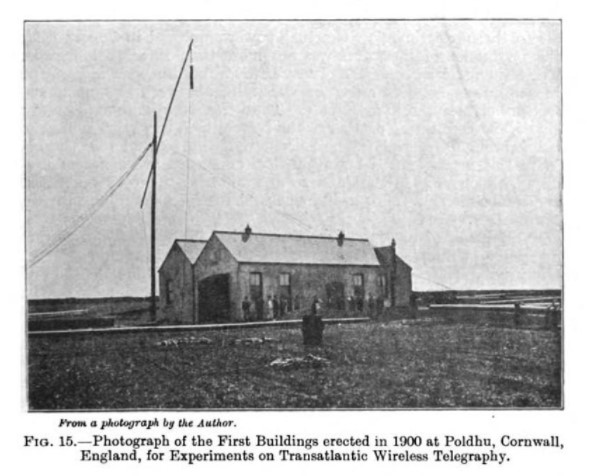
During the next four months much work was done in modifying and perfecting the wave-generating arrangements, and numerous telegraphic tests were conducted during the period by Mr. Marconi between Poldhu in Cornwall, Crookhaven, in the South of Ireland, and also with Niton in the Isle of Wight. A delay occurred owing to a storm on September -18, 1901, which wrecked a number of masts, but sufficient restoration of the aerial was made by the end of November, 1901, to enable him to contemplate making an experiment across the Atlantic. He left England on November 27, 1901, in the steamship ‘Sardinian’ for Newfoundland, having with him two assistants, Messrs. Kemp and Paget, and also a number of balloons and kites. He arrived at St. John's, Newfoundland, about December 5th. (The Wireless Age Magazine)


According to Marconi,

‘In the design and construction of the Poldhu station I was assisted by Sir Ambrose Fleming, Mr. R. N. Vyvyan and Mr. W. S. Entwistle.’


The Irish Leg at Crookhaven


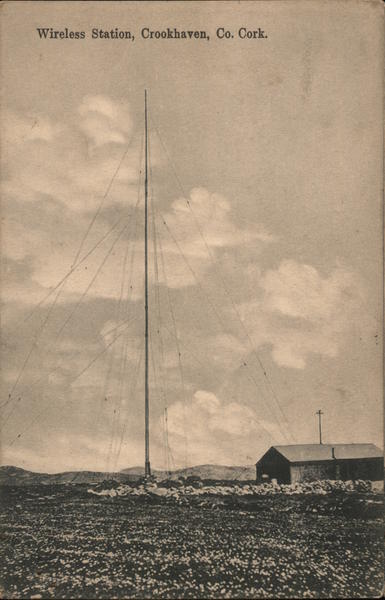
By mid June, Marconi had built his new wireless station at Brow Head near Crookhaven on the South West coast of Ireland. The County Cork headland was Ireland’s most westly promintary. A one hundred and eighty foot mast had been erected and a powerful transmitter installed to increase the range of communications for ship to shore. When Marconi first arrived at the small fishing port hundred turned out to welcome the wireless pioneer. Many of those spectators were women hoping perhaps to catch the eye of the then bachelor Marconi. His first experiment from the station was on June 16th to contact the liner Lucania which was both en-route from New York across the Atlantic and fitted with Marconi wireless equipment. A special train was organised by the local Skibereen and Schull Tramway to bring a ‘record’ number of spectators to Crookhaven to witness this breakthrough in communications. According to the Southern Star newspaper ,

‘This event is no doubt unique in the history of West Cork and we are certain that large numbers will avail of the opportunity of witnessing this epoch making experiment’


Why Crookhaven?

Crookhaven already had been the epicentre of telegraphic news. When the United States based Reuters news agency opened an office in London in 1851, an office in Queenstown (Cobh) followed two years later. Up to that stage in order to get the news scoop, reporters would travel precariously on small currachs out to liners as they reached the Irish coast to get first hands news from America and then make their way into Cork to file their stories. With the arrival of Reuters, desperate to get an advantage over their competitors including Hearst, they built a telegraph station in Crookhaven, building a telegraph line to Cork City which was then linked to Dublin and London giving the American news agency a four hour head start on other agencies who were still using reporters making the dangerous passage to the Liners.  


At the turn on the twentieth century, the ionosphere was yet to be discovered and that radio signals travelling long distances actually went upwards, bounced off the ionosphere and back down to earth. Marconi believed at that time that signals were linear and would use the ocean’s surface to conduct the signals over distances. This had been the premise of Oliver Lodge in his early Wireless Telegraphy experiments in Scotland, firstly crossing the Rover Tay and then ambitiously planning to span the Atlantic, which never got off the ground. Ireland would later be pivotal in the trans-Atlantic connection with the building of Marconi’s powerful Clifden station.


On the opposite side of the Atlantic, Marconi initially built a station at Wellfleet, Massachusetts to communicate across the Atlantic but a storm destroyed the aerial array and a new site had to be quickly chosen. Financial incentives took him north of the border from the United States initially towards Nova Scotia before finally settling at Signal Hill outside St. John’s, Newfoundland. In December 1901 he set sail for St. John's. He was under pressure from shareholders and his growing ego to deliver on his promise that wireless could commercially beat the undersea cable telegraph. He had been heavily subsidized by his financial backers who saw huge profits in the trans-Atlantic messaging. Marconi had with his travelling crew, a small stock of kites and balloons to keep a single wire aloft in stormy weather.


A site was chosen on Signal Hill, and apparatus was set up in an abandoned military hospital. A cable was sent to Poldhu, requesting that the Morse letter " S " be transmitted continuously from 3:00 to 7:00 PM local time.


On 12th December, 1901, under strong wind conditions, a kite was launched with a long wire attached beneath. The wind unfortunately carried it away. A second kite was launched. The kite bobbed and weaved in the sky, making it difficult for Marconi to adjust his new syntonic receiver which employed the new Italian Navy coherer. With hindsight and today’s knowledge it is difficult to understand how Marconi determined the frequency of tuning for his receiver.

‘The result was much more than the mere successful realization of an experiment. It was a discovery which proved that, contrary to the general belief, radio signals could travel over such great distance a those separating Europe from America and it constituted, as Sir Oliver Lodge has stated, an epoch in history’. (Marconi)


Marconi’s claim was,

‘On Monday, December 9th, barely three days after my arrival, I and my assistants began work on Signal Hill. The weather was very bad and very cold. On the Tuesday we flew a kite with 600 feet of antenna wire as a preliminary test, and on the Wednesday, we had inflated one of our small balloons, which made its first ascent during the morning. Owing, however, to the strength of the wind, the balloon soon broke away and disappeared in the mist. I then concluded that perhaps kites would answer better and decided to use them for the crucial test.


I had arranged with my assistants in Cornwall to send a series of "S's" at a prearranged speed during certain hours of the day. I chose the letter "S" because it was easy to transmit, and with the very primitive apparatus used at Poldhu I was afraid that the transmission of other Morse signals, which included dashes, might perhaps cause too much strain on it and break it down. Mr. Entwistle, Mr. George and Mr. Taylor were in charge of the English station at Poldhu during the transmission of signals to Newfoundland.


The following day the signals were reportedly again heard at Signal Hill, though not quite as distinctly. According to the Institute of Electrical and Electronic Engineers[1],

‘Marconi's ambition at the turn of the century to demonstrate long-distance wireless communication, and develop a profitable long-distance wireless telegraph service, led to his pragmatic proposal in 1900 to send a wireless signal across the Atlantic. He conceived a plan to erect two super-stations, one on each side of the Atlantic, for two-way wireless communications, to bridge the two continents together in direct opposition to the cable company (Anglo-American Telegraph Company). For the eastern terminal, he leased land overlooking Poldhu cove in southwestern Cornwall, England. For the western terminal, the sand dunes on the northern end of Cape Cod, MA at South Wellfleet, was chosen.

The aerial array comprised of 20 masts arranged in a circle. The ring of masts supported a conical aerial system of 400 wires, each insulated at the top and connected at the bottom, thus forming an inverted cone. Vyvyan, the Marconi engineer who worked on the 1901 experiment, when shown the plan, did not think the design sound. He was overruled, construction went ahead, and both aerial systems were completed in early 1901. However, before testing could begin catastrophe struck, the Poldhu aerial collapsed in a storm on 17 September, and the South Wellfleet aerial suffered the same fate on 26 November, 1901.


At Poldhu Marconi quickly erected two masts and put up an aerial of 54 wires, spaced 1 metre apart, and suspended from a triadic stay stretched between these masts. The aerial wires were arranged fan shaped and connected together at the lower end.

‘The antenna was driven by the curious two stage spark transmitter, previously discussed. There were many problems in getting it to work at the high power levels desired. Our principal concern here is the frequency generated by the Poldhu station. The oscillation frequency is determined by the natural resonant response of the antenna system, which includes the inductance of the secondary of the antenna transformer T2, since in effect the antenna system is a base-loaded monopole’.

Historians have also speculated that the transmitter might also have radiated a high-frequency signal as well, since an HF signal would have been more suitable for transatlantic communications. If, according to Belrose, Marconi had used a thin wire transmitting antenna at Poldhu, this antenna would indeed have radiated efficiently at odd harmonics of the fundamental resonant frequency. But according to Electrical engineers today that they must conclude therefore that the Cornish based spark-transmitter system radiated efficiently only on the fundamental oscillation frequency of the tuned antenna system, about 850 kHz.

When Poldhu had become operational, it was communicating successfully with stations in France and Europe and more importantly with Marconi’s new wireless station at Crookhaven in County Cork, on the southern coast. Work on building Crookhaven began in the summer of 1901.


According to Marconi, the publicist, he recounted,

‘Another similar station was erected at Cape Cod in Massachusetts. By the end of August, 1901, the erection of the masts was nearly completed when a terrific gale swept the English coasts, with the result that the masts were blown down and the whole construction wrecked. I was naturally extremely disappointed at this unforeseen accident, and for some days had visions of my test having to be postponed for several months or longer, but eventually decided that it might be possible to make a preliminary trial with a simpler aerial attached to a stay stretched between two masts 170 feet high and consisting of sixty almost vertical wires. By the time this aerial was erected another unfortunate accident, also caused by a gale, occurred in America, destroying the antenna system of the Cape Cod station.


I then decided, notwithstanding this further setback, to carry out experiments to Newfoundland with an aerial supported by balloon or kite, as it was clearly impossible at that time of the year, owing to the wintry conditions and the shortness of the time at our disposal, to erect high masts to support the receiving aerial. On the twenty-sixth of November, 1900, I sailed from Liverpool accompanied by my two technical assistants, Mr. G. S. Kemp and Mr. P. W. Paget.


We landed at St. Johns, Newfoundland, on Friday. December the sixth, and before beginning operations I visited the Governor, Sir Cavendish Boyle, and the Prime Minister. Sir Robert Bond, and other members of the Newfoundland government, who promised me their heartiest cooperation in order to facilitate my work. After taking a look round at the various sites, I considered that the best one was to be found on Signal Hill, a lofty eminence overlooking the harbour. On the top of this hill was a small plateau which I thought suitable for flying either balloons or kites. On a crag of this plateau rose the Cabot Memorial Tower and close to it was an old military barracks. It was in a room of this building that I set up my receiving apparatus in preparation for the great experiment.’


The newly constituted Marconi company knew that they were not the only Wireless Telegraph company attempting to span the Atlantic but they certainly wanted to be first and the newspapers were following the build up to the attempt on both sides of the Atlantic. Marconi knew that Professor Fessenden in the United States was making great strides and had the Atlantic in his sights as has Sir Oliver Lodge in the UK although unlike Marconi, Lodge’s plans were engineering based, while Marconi saw the commercial possibilities of being both first and the most successful to transmit across the Atlantic connecting London and New York.


According to Marconi,

‘On the morning of Thursday, the twelfth of December, the critical moment for which I had been working for so long at last arrived, and, in spite of the gale raging, we managed to fly a kite carrying an antenna wire some 400 feet long. I was at last on the point of putting the correctness of my belief to the test! Up to then I had nearly always used a receiving arrangement including a coherer, which recorded automatically signals through a relay and a Morse instrument. I decided in this instance to use also a telephone connected to a self-restoring coherer, the human ear being far more sensitive than the recorder.


Suddenly, at about half-past twelve, a succession of three faint clicks on the telephone, corresponding to the three dots of the letter S, sounded several times in my ear, beyond the possibility of a doubt. I asked my assistant, Mr. Kemp, for corroboration if he had heard anything. He had, in fact, heard the same signals that I had.


I then knew that I had been justified in my anticipations. The electric waves which were being sent out into space from Poldhu had traversed the Atlantic, unimpeded by the curvature of the earth which so many considered to be a fatal obstacle, and they were now audible in my receiver in Newfoundland. I then felt for the first time absolutely certain that the day when I should be able to send messages without wires or cables across the Atlantic and across other oceans and, perhaps, continents, was not far distant. The then enormous distance, for radio, of 1,700 miles had been successfully bridged.’


But had the Atlantic been bridged and if it had, was it from Poldhu or Crookhaven?


At the turn on the twentieth century, the ionosphere was yet to be discovered and that radio signals travelling long distances actually went upwards, bounced off the ionosphere and back down to earth. Marconi believed at that time that signals were linear and would use the ocean’s surface to conduct the signals over distances. This had been the premise of Oliver Lodge in his early Wireless Telegraphy experiments in Scotland, firstly crossing the Rover Tay and then ambitiously planning to span the Atlantic, which never got off the ground. Ireland would later be pivotal in the trans-Atlantic connection with the building of Clifden.


Initially Marconi built a station at Wellfleet, Massachusetts to communicate across the Atlantic but a storm destroyed the aerial array and a new site had to be chosen. A site was chosen on Signal Hill, and apparatus was set up in an abandoned military hospital. A cable was sent to Poldhu, requesting that the Morse letter " S " be transmitted continuously from 3:00 to 7:00 PM local time.


On 12th December, 1901, under strong wind conditions, a kite was launched with a 155 m long wire. The wind carried it away. A second kite was launched with a 152.4 m wire attached. The kite bobbed and weaved in the sky, making it difficult for Marconi to adjust his new syntonic receiver which employed the Italian Navy coherer. "Difficult" I will accept, but how he determined the frequency of tuning for his receiver is a mystery to me. Whatever, because of this difficulty, Marconi decided to use his older untuned receiver. History has assumed that he substituted the metal filings coherer previously used with this receiver for the newly acquired Italian Navy coherer, but Marconi never really said he did. He referred only to the use of three types of coherers.


‘The result was much more than the mere successful realization of an experiment. It was a discovery which proved that, contrary to the general belief, radio signals could travel over such great distance a those separating Europe from America and it constituted, as Sir Oliver Lodge has stated, an epoch in history’

Marconi celebrating his own success.


Then Marconi’s claim was,


‘On Monday, December 9th, barely three days after my arrival, I and my assistants began work on Signal Hill. The weather was very bad and very cold. On the Tuesday we flew a kite with 600 feet of antenna wire as a preliminary test, and on the Wednesday we had inflated one of our small balloons, which made its first ascent during the morning. Owing, however, to the strength of the wind, the balloon soon broke away and disappeared in the mist. I then concluded that perhaps kites would answer better and decided to use them for the crucial test.


I had arranged with my assistants in Cornwall to send a series of "S's" at a prearranged speed during certain hours of the day. I chose the letter "S" because it was easy to transmit, and with the very primitive apparatus used at Poldhu I was afraid that the transmission of other Morse signals, which included dashes, might perhaps cause too much strain on it and break it down. Mr. Entwistle, Mr. George and Mr. Taylor were in charge of the English station at Poldhu during the transmission of signals to Newfoundland. On the following day the signals were again heard, though not quite as distinctly. However, there was no further doubt possible that the experiment had succeeded.’


The experiments were suddenly brought to a halt when the Anglo American Telegraph Company sought a legal restraint claiming that he was interfering with their exclusive contract to telegraph connections across the Atlantic, as they controlled the majority of the undersea cables connecting Newfoundland and Nova Scotia with Ireland and then onto Europe.


Crookhaven

According to the IEEE,

‘Despite the crude equipment employed, and in our view the impossibility of hearing the signal, Marconi and his assistant George Kemp convinced themselves that they could hear on occasion the rhythm of three clicks more or less buried in the static, and clicks they would be if heard at all, because of the low spark rate. Marconi wrote in his laboratory notebook: Sigs at 12:30, 1:10 and 2:20 (local time). This notebook is in the Marconi Company archives and is the only proof today that the signal was received.’

Marconi himself has been evasive concerning the frequency of his Poldhu transmitter. Fleming in a lecture he gave in 1903 said that the wavelength was of 1000 feet or more, say, one-fifth to one-quarter of a mile (820 kHz is the generally quoted frequency). Marconi remained silent on this wavelength, but in 1908 in a lecture to the Royal Institution he quotes the wavelength as 1200 feet. But in 1901, anyone who believed that they could, and did, believed so as an act of faith based on the integrity of one man – Marconi.

‘The antenna was driven by the curious two stage spark transmitter, previously discussed. There were many problems in getting it to work at the high power levels desired. Our principal concern here is the frequency generated by the Poldhu station. The oscillation frequency is determined by the natural resonant response of the antenna system, which includes the inductance of the secondary of the antenna transformer, since in effect the antenna system is a base-loaded monopole’.


CONCLUSION

The first trans-Atlantic wireless telegraph message was received at Signal Hill from Crookhaven, Cork in Ireland. Not Poldhu. Despite skepticism by many historians and electrical engineers, I believe that Marconi did manage to span the Atlantic with a message through the ether using wireless telegraphy but perhaps this success was accidental, not realising his signals were being deflected by the ionosphere. But I do not subscribe to the ‘fact’ that the signal across the Atlantic emitted from Poldhu in Cornwall and arrived on the opposite side of the Atlantic at St. John’s. In fact the truth is that Poldhu tapped out the letter ‘s’ as Marconi requested but rather than reaching Newfoundland it was picked up in Crookhaven (perhaps as planned) and retransmitted from Crookhaven to Signal Hill, St. John’s. Therefore the first transatlantic message was not Poldhu to St. John’s but Crookhaven to St. Johns, Ireland to Canada rather than England to Canada. Whether this was the actual plan, is not lost in the fog of time but if it was Marconi’s belief that the oceans would conduct his signal, then the inference is that he would transmit between the two closest points, Crookhaven and St. John’s. It was also winter and the seas were unpredictable and rough, which would be another excellent argument for broadcasting between the two closets points in his network of wireless stations.


The origin of the transmission being designated as coming from Poldhu would have been important for investors and attracting others. It would demonstrate that the invested cash was being put to good work. For it to be commercially successful, a service from the UK mainland to the United States would be far more valuable than Ireland to the United States. If the transmission success was from Poldhu it would rule out the middle man, Ireland, and speed up the time of message transmission from London to New York. This would be valuable in tackling the success of the undersea cable telegraph companies.


In Orrin Dunlap’s book, ‘Marconi, The Man and his Wireless’, which celebrated the work of the Irish-Italian inventor and entrepreneur, he referred to and quoted fellow wireless telegraphy pioneer Sir Oliver Lodge. Lodge, a competitor of Marconi, wrote in his own book ‘Talks About Wireless’ published in 1925, recounting the event of the first trans-Atlantic communication, that,

‘When Signor Marconi succeeded in sending the letter ‘S’ by morse signals from Cornwall to Ireland to Newfoundland, it constituted an epoch in human history, on its physical side and was an astonishing and remarkable feat’


The first public two-way wireless telegraph communication happened on January 19th, 1903 when a message from US President Theodore Roosevelt at the White House was transmitted  via Morse code and sent to King Edward VII at Buckingham Palace in England, who in turn responded to Roosevelt.

That day, US newspaper 'The Evening World', published that “Word is Flashed from Roosevelt to King Edward” as it reported that Guglielmo Marconi and his team successfully sent the first transatlantic radio transmission from the US. Marconi and his assistants, Kemp, Taylor, Sargent, and Bradfield, were reportedly surprised that the message was received and deciphered on the first attempt. Trans-Atlantic was a reality and here to stay.


[1] ‘Fessenden and Marconi: Their Differing Technologies and Transatlantic Experiments During the First Decade of this Century’ by John S. Belrose lecture for the International Conference on 100 Years of Radio -- 5-7 September 1995


Sources

https://worldradiohistory.com/

The Irish Newspaper Archives

The British Newspaper Archives

The US Library of Congress

Marconi & Ireland , Sexton UCC

Orrin Dunlap 'Marconi & His Wireless'

The Marconi Archives

Cambridge University Libraries

Oliver Lodge 'Talks About Wireless'

The Irish Pirate Radio Archive

The Wireless Age magazines. 

Saturday, 10 April 2021

The 'Dublin to Kilcullen Turnpike' in 1729 to Ian Dempsey at Today FM in 2021, Six Degrees of Separation


Communications takes many forms. It can be communicating verbally to each other or travelling from one town to another with news and information. Modern communications include wireless telegraphy as in ship to shore or the radio broadcasting of today as voices through the ether communicates with their listeners. ‘Six degrees of separation’ is the idea that on average people and events are six, or fewer, social connections away from each other. With this in mind, one can postulate that without the building of the first turnpike road in Ireland in the 1730’s we would not be able to listen to Morning Ireland on RTE, Ian Dempsey on Today FM, the Strawberry Alarm Clock on FM 104 or the breakfast show on 96FM in Cork. That journey from the innovative turnpike to entertaining tones of Ian Dempsey, will take us from the first toll road and creating the connection with rural Ireland, to the first major mass transportation company in Ireland described as the Ryanair of its day, to the greatest Irish whiskey export of all time and onwards to harnessing the radio waves, eventually reaching the multitude of radio studios and bedroom podcasters across Ireland and of course Ian Dempsey.


In the mid-18th century people rarely travelled further than a day’s walk from home. A person of means would have access to a horse and buggy but the roads were bad often subject to flooding and damage as the loads increased. The result was the Turnpike, a tolled road of better quality that often varied in both length and cost but massively improved transportation across the country. The first Irish turnpike road was opened from Dublin to Kilcullen in County Kildare in 1729. They expanded quickly. A major investment in better roads led directly to the success of one entrepreneur who made use of the growing number of these toll roads which initially radiated from Dublin but later connected many of the growing towns in the South East and South of the island.


As the network of turnpikes expanded, far away from Ireland in the Lombardy region of Italy, Carlo Bianconi was born in 1786. According to his biographer, Samuel Smiles,

‘learning took little effect on him’.

Regarded as a ‘dunce’ in school, his parents wanted him to gain experience outside their small enclave and importantly for them, allow their son to avoid the compulsory military service enforced at the time. A family friend, Andrea Faroni, agreed to take the young sixteen year old and a couple of other local lads on an apprenticeship in painting framing and selling. The young Bianconi left behind his parents as well as three brothers and a sister, walking out of Italy into Switzerland and eventually reaching England. This was the original plan but Faroni decided to go one step further to the edge of Europe and travelled across the Irish Sea to Dublin.


After arriving in Dublin in 1802, Faroni and his charges stayed in Temple Bar near the Essex Bridge. They began selling framed prints around Dublin but the young Italian found it difficult without any grasp of the English language. The young Carlo knew however he had a better chance of success by increasing his English and by anglicizing his name to Charles. Like pioneers or explorers Faroni and the four apprentices left the sanctuary of Dublin and headed south to Waterford, where much of the gold they used to guild the picture frames were imported. At one point Charles Bianconi was arrested in Passage when he was caught selling prints of the disgraced Napoleon, who had just been defeated by the British at Waterloo. After a couple of nights in the police cells he was released. The team carried their heavy load of wares from town to town, walking many miles, it was back breaking work. In 1804, his apprenticeship ended with Faroni and the young Bianconi rejected the offer to return home to Italy. While in Waterford he had met with Edmund Rice, the founder of the Christian Brothers, and was the beneficiary of an education which opened his eyes to a multitude of possibilities in now his adopted homeland.


In 1806, Bianconi moved to Carrick-on-Suir. He travelled to Waterford on Tom Morrissey’s boat along the River Suir to obtain the gold for his gilding process. By boat it was a distance of twenty miles and was subject to the vagaries of the tides. By road, it was a distance of only 12 miles but it had to be walked and with a heavy load, the boat, despite its slow speed of travel, was the better option. In 1809, he moved once again to Clonmel and continued to earn a good living selling prints, travelling by foot and the slow boat back to Carrick – on – Suir and Waterford.


It was now that the young Italian struck upon an idea that would revolutionize travel in Ireland. On July 5th 1815 at Hearn’s Hotel in Clonmel, a horse and buggy were readied for the departure of the first Bianconi car that would travel the twelve miles from Clonmel to Cahir. That first trip carried a driver and six passengers. It was not overly popular but the shrewd Bianconi put a slower coach on the route and pointed to how efficient his brightly yellow coloured ‘Bian’ car was. The following year the Clonmel to Waterford and to Carrick-on-Suir routes were added. The new regular passenger service, despite not having any protection against the inclement Irish weather, departed, and arrived on time and travelled even if there were no paying passengers on board. The convenience of the cars and its affordability became popular and the routes continued to expand. Bianconi was able to connect with both the Royal[1] and the Grand Canals[2] that travelled from Dublin to the River Shannon. From one horse and a cart, the Bianconi Cars developed into two, four and six horse transports carrying more and more passengers and cargo. He delivered the mail from outlying areas to central hubs for the Royal Mail and earned a reputation as being punctual and safe, employing his own security guards on dangerous routes or for expensive cargos.


Charles Bianconi became an important member of the Clonmel community earning himself Irish (British ruled Ireland) citizenship. He married the daughter of a well-known Dublin stockbroker, Eliza Hayes in 1827, who was twenty years his junior. He would move into a palatial house known as Longfield and the couple would have three children. The first born daughter died relatively young as did his son. His son had married the granddaughter of the Great Emancipator Daniel O’Connell, whom Bianconi was a great supporter of. Charles Bianconi became Mayor of Clonmel and continued to expand his flourishing business. His cars were affordable for the working/farmer classes and opened up Ireland for exploration and business development. From Dublin his cars departed from the Hibernian Hotel on Dawson Street and as they journeyed, Bianconi Inns opened along routes providing rest periods, overnight stays and changing facilities for fresh horses. Even when the railways arrived in Ireland, the first section opening in 1837 and they expanded rapidly, he adapted. The rail lines made some of his routes redundant but he adjusted connecting new towns to the railway stations hubs, his web was radiating across much of Ireland.


He provided employment for over one hundred and sixty drivers on his one hundred cars, known as ‘Finn McCool’s’ and ‘Massey Dawson’s’[3]. His drivers were regarded as very civil, well turned out, wearing similar hat wear to identify their position. Bianconi required punctuality, truthfulness, honesty and most importantly sobriety. In many cases, drivers who proved themselves ‘Bianconi men’ could pass on their position to a family member upon retirement. When a driver became too ill to work or died, Bianconi insured that the family were looked after financially and educationally. Workers were only required to work six days, a novel approach in the mid 1800’s. He was the largest employer in Clonmel especially when he opened his own factory to build and repair his fleet of vehicles. Along his routes, there were changing stations for the horses each employing grooms and blacksmiths. The so called ‘Bianconi Inns’ developed in over one hundred and fifty stops each one providing direct employment and indirect employment through supplies. He put many smaller coach companies out of business or bought them out, these were usually operator by owners of Inns or Taverns. One commentator wrote about a rival company, McCarthy’s in Kanturk,

‘his cars in shape and size resemble Bianconi’s, but here the comparison ends. McCarthy’s horses are poor starved hacks, whereas those of Bianconi are fine, well fed and strong’.[4]


When Bianconi began, his timing was perfect as there was an abundance of good horses available that had been readied to fight in the Napoleonic Wars, but with the defeat of Napoleon, there was over supply and he was able to purchase horses relatively cheaply. At the height of his business in 1857, Bianconi had 1,300 horses travelling 3,800miles on 23 routes. The local farmers and economies boomed as he purchased 4,000 tons of hays and 30,000 barrels of oats per year. He was as generous to his horses as his men. Despite his demand leading to price increases, he purchased the best of horses and they were well treated. He once wrote,

‘Experience teaches me that I can work a horse eight miles per day, six days in the week, much better than I can six miles for seven days; and by not working on Sundays, I effect a saving of 12 per cent.’

This from a speech delivered by Bianconi at the Cork meeting of the British Association for the Advancement of Science on August 19th, 1843.


With the continued improvements of the turnpikes, the arrival of the canals and the railways, the time spent traveling greatly reduced for the Irish passengers. For example, in 1757 a traveller from Dublin to Kilkenny would be on the road for almost two days with an overnight stay at Athy on the outward journey and in Kilcullen on the inward return journey. By 1825 that journey time had been reduced to eleven hours and with the arrival of the railway by 1860, it took only 3 hours and twenty minutes. Similarly Dublin to Cork in 1793 was advertised as taking over two days, in 1820 that was reduced to just over one day and to 6 hours and 50 minutes when the first train ran on that route.


By 1866, the transport entrepreneur had decided to retire and with his son and heir having predeased him, he rewarded the hard work of those who ran his business by selling off his routes and Inns to the workers of the Bianconi company for reasonable and affordable amounts.


During his tenure as the head of the company, he wanted to ensure that his livestock received the best of treatment and decided to ask for a nephew in Italy to be despatched to Ireland to become the senior veterinarian, looking after both the horses and the other vets in his employ. Giuseppe Marconi arrived in Ireland and was based in both Clonmel and Waterford. Giuseppe was born in the village of Porretta in the shadow of the Apennine Hills on July 5th 1823. He had inherited some of his father’s wealth but was himself a hard worker and generated considerable wealth. He married Giulia De Renoli in January 1855 and their son Luigi was born the following October. Just a couple of years later Giulia died, leaving Giuseppe a single father and a widower.  In 1860, he was in London where he invested in a café selling penny ices and a music hall near Charing Cross with former neighbours from Italy, the Gatti brothers. His journey then to Ireland was short when summoned by Bianconi. He would travel to and from the Hibernian Hotel on Dawson Street on a Bianconi coach to Clonmel. He would make the return journey through Waterford to New Ross, Enniscorthy and onwards towards Arklow and Bray before reaching Dublin.


Meanwhile Andrew Jameson, son of whiskey magnate John Jameson, departed from the Bow Street Distillery in Dublin and set up his own whiskey still on the River Urrin, a tributary of the Slaney, at Fairfield outside Enniscorthy in 1818. The area is still known as The Stil. Andrew and his second wife Margaret Millar acquired nearby Daphne Castle in 1823 from the Pounden family. Andrew and Margaret had five daughters, all born at Daphne − Elizabeth, Helen, Janet, Isabella, and the youngest Annie was born in 1839[5].  Annie’s family also bought an elegant house in Dublin known as Montrose House. Montrose House, perhaps more familiar to you all now as a backdrop to many RTE News reports. Montrose House is today part of the RTE complex in Donnybrook.


According to Maria Marconi, Annie Jameson, her grandmother was.

‘a lovely girl, charming and vivacious. The whole family had a passion for music. It was their favourite occupation and they used to play different instruments together in the evenings. Annie played the piano and she also had a beautiful soprano voice. To her family’s disapproval (it was quite out of the question for a young girl of good family to become an opera singer in those days), she was offered an engagement to sing at the Covent Garden Opera House in London. She was forbidden to accept but after much discussion and argument she was allowed to go to Italy to study singing with a famous teacher of the time. The Jameson company had contacts with a Bologna banker named De Regoli and Annie went to stay with his family. De Regoli’s daughter had died while giving birth to a son, Luigi, and their widowed son-in-law Giuseppe Marconi spent much of his time with them. He was charming and lively with a good sense of humour and he and Annie soon fell in love.


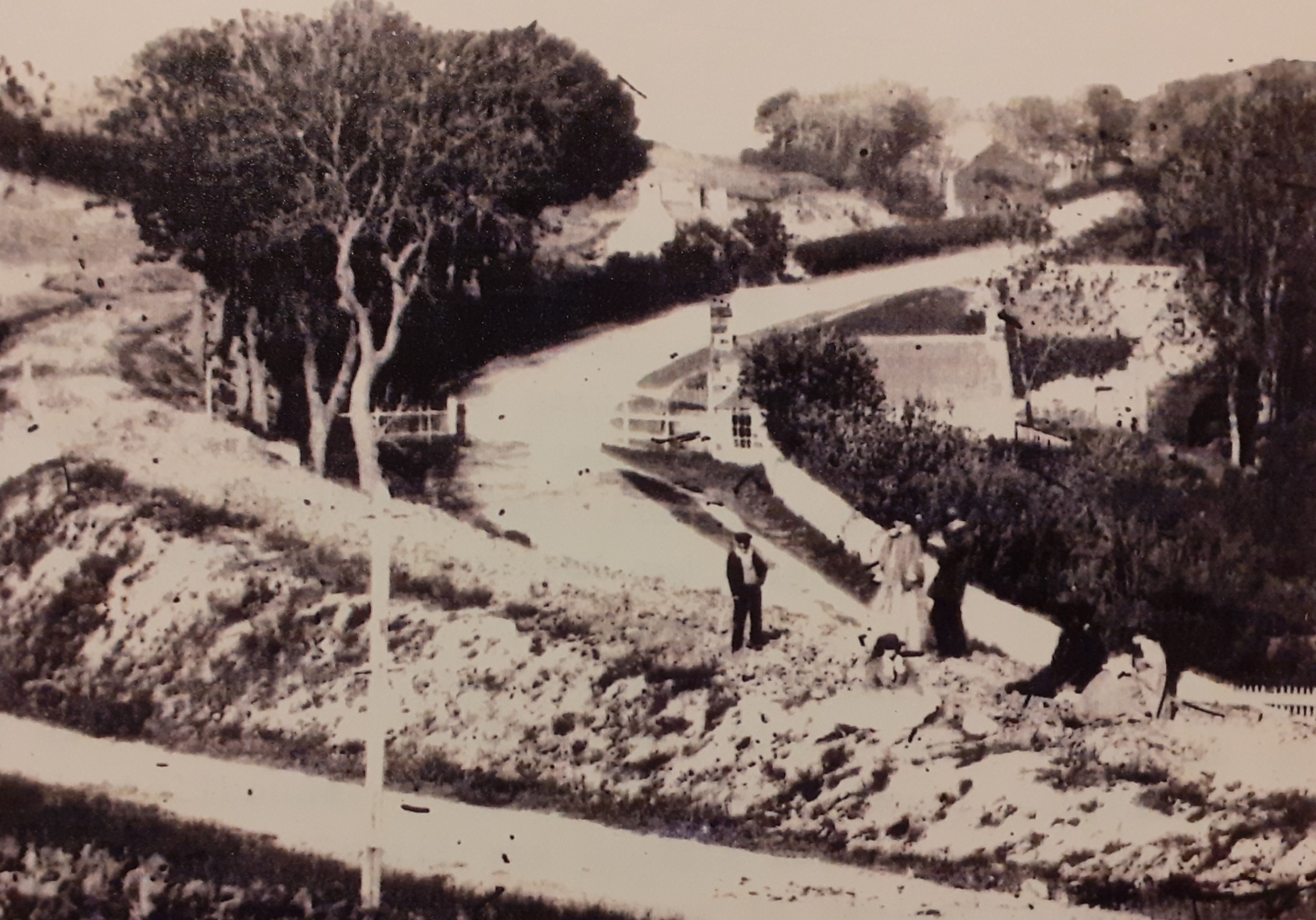
When Annie returned home to Ireland, she asked permission to marry Giuseppe[6]. Her family was just as shocked at Annie’s choice of husband as they had been at the thought of her singing at Covent Garden and they refused consent to the marriage. Annie was ordered to forget him and, apparently obedient, she remained at home and led a social life going to parties and meeting suitable young men approved by her family. However, she continued to correspond secretly with Giuseppe. When she came of age she ran away from home and crossed the stormy water of the channel to France while Giuseppe drove his carriage across the Alps. They met in Boulogne-Sur-Mer, a romantic town by the sand dunes and were married there on April 16th 1864. ‘

Giuseppe Marconi

It is perhaps a more honest explanation as to the joining of Signor Marconi and Annie Jameson, that they had met while Marconi was still in Ireland. Secretly carrying on their liaison when Marconi continued on his travels. According to a report in the Weekly Irish Times newspaper on July 1st 1901, it stated,

‘After some time, he sent to Italy for his nephew to act as veterinary superintendent of his stables and this man from his daring riding, his knowledge of horses and his attractive appearance, soon was golden opinions for himself in County Tipperary. His first stay in Ireland was not however of long duration, for having fallen deeply in love with a young Irish lady, whom he had met in the hunting field. He married her without the consent of her parents and it was thought better both by her people and by Mr. Bianconi, that the youthful couple should begin their married life in Italy,’


They settled at Villa Griffone, outside Bologna. Annie was reconciled with her Jameson family after the birth of her first child Alfonso in 1865 but it would be the birth of her second son nine years later that would lead to another communication revolution. Guglielmo Marconi was born on April 25th 1874. For four years, from the age of two, Guglielmo and Alfonso were brought up by Annie in the English town of Bedford. As children, the family would often make summer visits home to Daphne Castle. Annie ensured that Guglielmo spoke excellent English but he laboured in school. Guglielmo Marconi was as much Irish as he was Italian and without that Irish connection and the finances it generated, he would not be seen today as The Father of Radio.

In 1894 Marconi began experiments at his home in Bologna but despite his best efforts to get the Italian authorities to embrace the importance of his wireless telegraphy, He needed a commercial backer and it was one of his mother’s cousins Henry Jameson Davis who stepped in and began to publicise Marconi’s Wireless Telegraphy system. Annie’s fathers’ distillery at Fairfield in Enniscorthy was put out of business in 1840 by a temperance crusade led by Father Theobald Mathew, who had actually been a friend of Bianconi. Jameson rented his property to a local businessman Abraham Davis who would marry Annie’s older sister Helen in 1850. Their second son was Henry Jameson Davis was born in 1854.


Marconi, who had been encouraged to learn English by his Irish born mother travelled to England in 1896 to demonstrate his invention to the British post office. Jameson Davis became the first Managing Director of the newly incorporated Wireless Telegraph and Signal Company in 1897 generating almost £100,000 in capital to obtain the patent rights for the Marconi system worldwide. Some of the other investors were James Fitzgerald Bannatyne from Limerick. He would serve as Deputy Lord Mayor of Limerick and was involved in the milling business until his company was bought by the Goodbody Milling Company. Henry Obre, a Cork Merchant who lived at Fort Villa, Queenstown (died 1906), Thomas Wiles, SW Ellerby, Frank Wilson, Cyril Bennet, Robert Patterson, and Goodbody’s who were all involved in the Milling and granary business.


Some of Marconi’s most exciting progressions in wireless technology happened in Ireland. His first experiments linked Rathlin Island with Ballycastle in 1898. In that same year, the first use of the new medium in sports journalism took place in Dun Laoghaire when reports on the local annual regatta were sent by Marconi from the Flying Huntress steam paddle tugboat in Dublin Bay to a receiving station in the harbourmasters house on the quayside and then telephoned to the Daily Express Office who immediately published the race updates. In 1916 it was a 1.5 kilowatt Marconi transmitter that was used to broadcast communiques to the listening world making Ireland the first nation in the world to be declared by radio. In 1923 Marconi operated the first licensed radio station in Ireland 2BP in August 1923 and it was a Marconi transmitter that was used by 2RN to get on the air in January 1926. 2RN would morph into Radio Eireann and then on to today’s Radio Telifis Eireann (RTE). It would be also the Marconi Company whose television transmission equipment that would outlast John Logie Baird’s experimental equipment when the BBC launched a television service.


The Flying Huntress

Marconi also married an Irish woman, Lady Beatrice O’Brien, the daughter of the Lord of Inchiquin whose home was Dromoland Castle in County Clare. She was the great niece of the Irish Nationalist William Smith O’Brien. She married Marconi on March 16th 1905 but separated in 1918 and divorced in 1924. The Belfast Newsletter reported,

‘He asked her to become his wife, ' but her mother objected, saying so many weddings turned out badly that she refused to let her" daughter marry if the bond was indissoluble, as it was for Roman Catholics. This difficulty was only overcome by Senator Marconi entering into an agreement, not only with the Hon. Beatrice O’Brien but also with her mother, whereby it was expressly stated that cither party could sue for divorce, at any time he or she thought fit.’


(c) pirate.ie

The success of radio is global with thousands of stations broadcasting news, sports, opinions and entertainment. Ireland fell in love with radio and in the seventies and eighties a revolution took place which broke RTE’s monopoly. The proliferation of pirate radio drove the campaign to create a new broadcasting landscape in Ireland. These stations came on air using Marconi technology and equipment. One of those illegal broadcasters was Ian Dempsey on Alternative Radio Dublin who found himself going legit when he joined the State broadcaster’s second channel RTE Radio 2. When the clamour for independent radio and television reached a crescendo, a demand created by the choice offered by pirate radio, independent commercial radio became a reality. Following the ill-fated Century Radio, the national franchise was won by Radio Ireland which was rebranded as Today FM. One of the major rating winners on Today FM is Ian Dempsey.


The lineage of Marconi’s efforts in Ireland from the first turnpike built, has eventually led to Ian Dempsey at Today FM, the independent national commercial radio station which is based at Marconi House on Digges Lane. If the turnpikes had not been built, the roads would not have been as good or as extensive enough for Charles Bianconi’s transport company to thrive and grow. It connected communities. If it could not grow there would have been no need for hundreds of horses and therefore not require the arrival of Giuseppe Marconi to Ireland to tend to Bianconi’s stables. If Marconi had not visited Ireland, he may have never met and married Annie Jameson. While radio was an inevitability, Marconi, the second son of Giuseppe and Annie, and the key influencer in both its spread and success, would not have been born if his parents had not met. Without Marconi, radio would not be the success in Ireland today that it is and Ian Dempsey might be driving a Luas tram rather than broadcasting to a nation.


[1] Royal Canal Construction began 1790 and completed 1817

[2] Grand Canal construction began 1756 and completed in 1804

[3] The Bian’s by Ivor Herring

[4] Bianconi’s Cars by Thomas P O’Neill

[5] ‘Marconi My Beloved’ by Maria C. Marconi

[6] A widower